
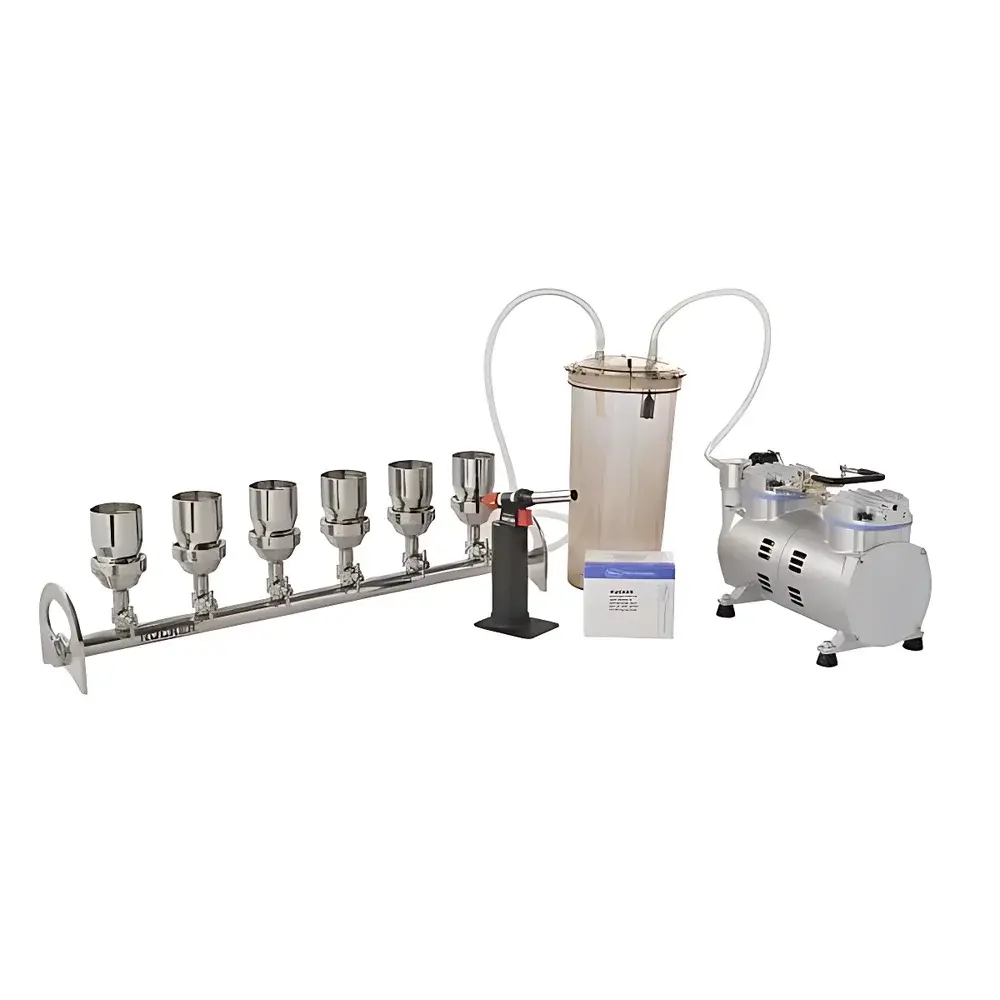
Rocker BioVac 630B Vacuum Filtration System
| Brand | Rocker |
|---|---|
| Origin | Taiwan |
| Model | BioVac 630B |
| Filter Capacity | 6-position |
| Construction Material | Full SUS316 stainless steel |
| Filtration Membrane Compatibility | 47 mm diameter, 0.45 µm MCE (Pall GN-6) |
| Vacuum Pump | Oil-free Rocker 600 (ultimate vacuum ≤ 80 mbar, flow rate ≥ 25 L/min) |
| Waste Bottle | 3000 mL polycarbonate |
| Sterilization Compatibility | Autoclavable, dry-heat oven-safe, flame-sterilizable |
| Fastening Mechanism | Patented rotary-lock coupling (Patent No. M381450) |
| Warranty | 2-year parts coverage |
Overview
The Rocker BioVac 630B Vacuum Filtration System is an integrated, laboratory-grade solution engineered for high-throughput microbiological testing and routine liquid clarification in life science and quality control laboratories. Based on the principle of vacuum-assisted membrane filtration, the system enables rapid, parallel processing of up to six 47 mm samples under controlled negative pressure. Its core architecture adheres to fundamental requirements for aseptic handling—complete stainless-steel wetted surfaces, flame-compatible components, and seamless sterilization compatibility across multiple modalities (autoclaving at 121 °C/15 psi, dry-heat ovens up to 250 °C, and direct flame treatment). Designed explicitly for compliance with standard microbiological methods—including ISO 7218, USP , and ASTM D5903—the BioVac 630B eliminates cross-contamination risks associated with plastic or plated-metal filtration assemblies while maintaining consistent flow dynamics and filter integrity across repeated cycles.
Key Features
- Full-system construction from electropolished SUS316 stainless steel—resistant to corrosion from aggressive solvents, acids, bases, and biohazardous residues.
- Patented rotary-lock coupling mechanism (Taiwan Patent No. M381450) enabling tool-free, repeatable, leak-tight assembly of the 6-position filtration manifold—no clamps, no torque calibration, no gasket misalignment.
- Integrated oil-free Rocker 600 vacuum pump delivering stable suction (≤ 80 mbar ultimate vacuum, ≥ 25 L/min free-air flow) with low noise (<52 dB(A)) and zero hydrocarbon contamination risk—critical for sterility assurance and downstream analytical workflows.
- 3000 mL polycarbonate waste bottle with integrated level sensor port and reinforced neck design—impact-resistant, autoclavable, and compatible with vacuum-rated stopcocks and vent filters.
- Included Dragon 100 electronic ignition Bunsen burner—piezoelectric spark ignition, adjustable flame output, and certified gas-flow safety cutoff—ensuring reliable, operator-safe flame sterilization of filtration funnels and forceps.
- Pre-qualified Pall GN-6 mixed cellulose ester (MCE) membranes (0.45 µm pore size, 47 mm diameter, 200/pack), validated for bacterial retention (e.g., E. coli, S. aureus) per ISO 8573-1 and USP .
Sample Compatibility & Compliance
The BioVac 630B accommodates all standard 47 mm membrane types—including MCE, nylon, PVDF, PTFE, and track-etched polycarbonate—across a wide pH range (1–14) and temperature range (−20 °C to +121 °C). Its stainless-steel filtration manifold supports both aqueous and mildly organic solvent-based samples (e.g., diluted ethanol, acetone, isopropanol), provided vapor pressure remains below pump tolerance limits. The system meets essential regulatory expectations for GMP/GLP environments: all wetted components are non-leaching, extractables-tested per USP , and fully traceable via Rocker’s serial-numbered component labeling. Documentation packages include material certifications (EN 10204 3.1), RoHS/REACH declarations, and CE conformity statements under Directive 2014/34/EU (ATEX zone 2 compatibility for lab gas use).
Software & Data Management
While the BioVac 630B operates as a standalone mechanical system without embedded firmware or digital controls, its modular architecture supports full integration into regulated data workflows. All included components—particularly the Rocker 600 pump and Dragon 100 burner—are supplied with complete calibration records, maintenance logs, and IQ/OQ documentation templates aligned with FDA 21 CFR Part 11 requirements. Users may pair the system with third-party electronic lab notebooks (ELNs) or LIMS platforms via standardized SOPs for equipment usage logging, membrane lot tracking, and sterilization cycle verification. Optional Rocker-certified validation kits (e.g., vacuum decay test fixtures, flow calibration adapters) enable periodic performance requalification per ISO/IEC 17025.
Applications
- Membrane filtration assays for total viable count (TVC), coliforms, and Pseudomonas aeruginosa per ISO 9308-1, ISO 16266, and APHA Standard Methods 9222.
- Clarification and particulate removal from culture media, fermentation broths, and bioprocess intermediates prior to HPLC or spectrophotometric analysis.
- Pre-filtration of environmental water samples (surface, wastewater, potable) for subsequent pathogen enrichment or molecular detection.
- Reagent preparation workflows requiring endotoxin-free filtrates—leveraging low-binding MCE membranes and stainless-steel inertness.
- Teaching laboratories conducting microbial enumeration exercises under GLP-aligned pedagogical protocols.
FAQ
Can the BioVac 630B be used with membranes other than 0.45 µm MCE?
Yes—the system accepts any 47 mm diameter membrane with standard support grid geometry, including 0.22 µm sterilizing-grade variants and hydrophobic PTFE for solvent filtration.
Is the entire filtration manifold autoclavable?
Yes—all stainless-steel components—including the 6-hole base, funnel holders, and sealing rings—are rated for repeated autoclaving at 121 °C, 15 psi for 20 minutes.
What vacuum pump maintenance is required?
The Rocker 600 oil-free diaphragm pump requires no lubrication; routine inspection includes checking inlet filter cleanliness and verifying silicone tubing elasticity every 6 months.
Does the system comply with FDA 21 CFR Part 11 for electronic records?
While the hardware itself has no digital interface, Rocker provides audit-trail-ready documentation templates and validation support tools to meet Part 11 requirements when used within a compliant ELN or LIMS ecosystem.
How is leak integrity verified during operation?
A built-in vacuum decay test port allows connection to a calibrated digital manometer; acceptable decay rate is ≤ 2 mbar/min over 5 minutes at 60 mbar operating vacuum.
Related Products




