
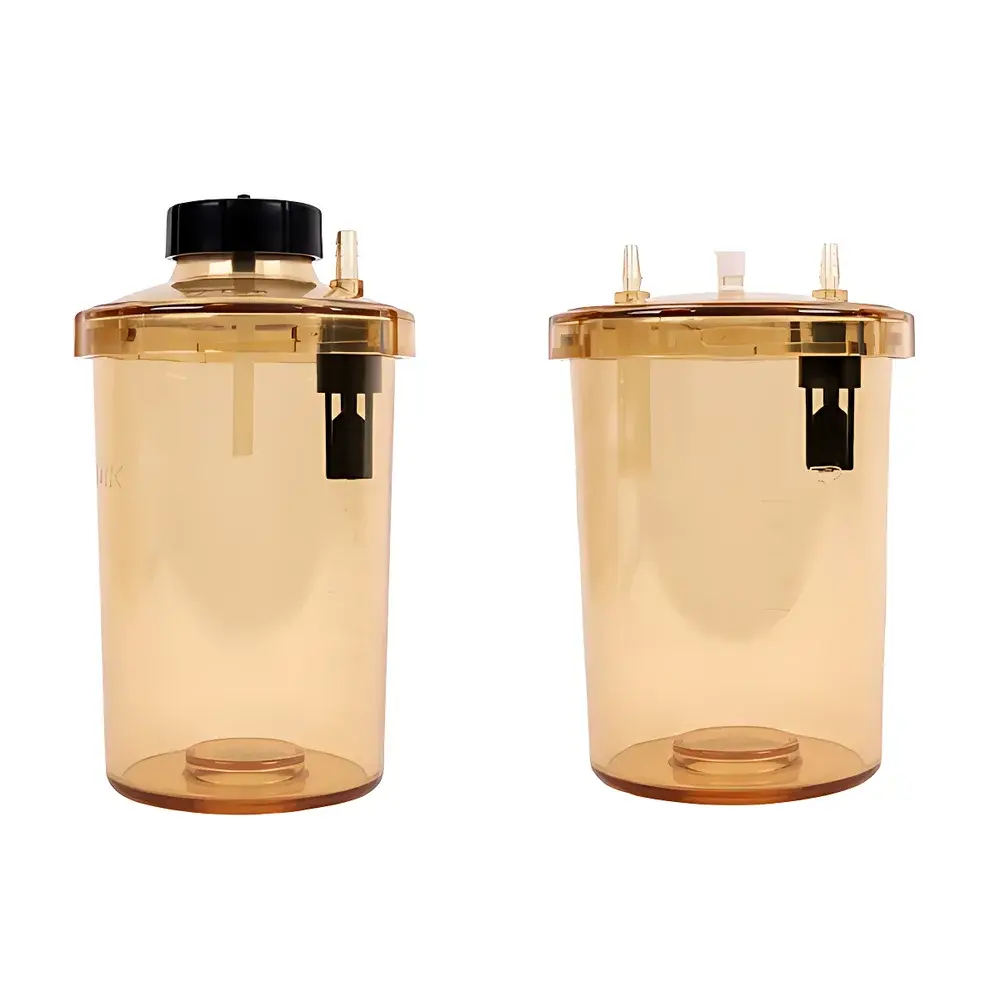
Rocker PES Waste Collection Bottle 1200 mL
| Brand | Rocker Instruments |
|---|---|
| Origin | Taiwan |
| Model | 1200 mL |
| Capacity | 1200 mL |
| Tubing ID Compatibility | 3/16 in. (5 mm) |
| Bottle Material | Polyethersulfone (PES) |
| Cap Material | PES |
| O-ring Material | Silicone |
| Overflow Protection Mechanism | Polypropylene (PP) Float Valve |
| Sterilization | Autoclavable (121 °C, 20 min, full assembly) |
| Part Numbers | 197000-11 (with suction adapter), 197000-12 (standard cap) |
Overview
The Rocker PES Waste Collection Bottle 1200 mL is an engineered component designed for integration into vacuum-driven liquid handling systems used in life science laboratories, cell culture facilities, and bioprocessing workflows. Constructed from medical-grade polyethersulfone (PES), this bottle provides exceptional chemical resistance to common biological solvents, disinfectants, and aqueous media—including ethanol, isopropanol, sodium hypochlorite, and 0.1 N NaOH—while maintaining structural integrity under repeated autoclaving cycles. Its primary function is the safe, contained collection of waste fluids generated during vacuum filtration, aspiration, centrifugation supernatant removal, or benchtop cell harvesting. Unlike generic plastic containers, this system incorporates a mechanically actuated overflow protection mechanism grounded in buoyancy-based fluid level sensing—a passive, fail-safe design that requires no power, sensors, or software intervention.
Key Features
- Integrated Overflow Protection: A precision-molded polypropylene (PP) float valve is housed within the cap assembly. As liquid rises to the designated fill line (approximately 1100 mL), the buoyant float ascends and physically occludes the gas inlet pathway, halting vacuum transmission before liquid reaches the vacuum line—preventing pump contamination and system downtime.
- Full-Assembly Autoclavability: The entire unit—including bottle, PES cap, and silicone O-ring—is validated for steam sterilization at 121 °C for 20 minutes (per ISO 17665-1). No disassembly is required prior to autoclaving, ensuring consistent sterility assurance and eliminating risk of misalignment or seal degradation during reassembly.
- Modular Suction Adapter Interface: The 197000-11 variant includes a threaded, leak-tight suction adapter cap that converts the waste bottle into a sterile receiver vessel. This enables seamless transition between waste collection and filtrate recovery applications without changing hardware platforms—supporting flexible workflow adaptation in GMP-aligned environments.
- Chemical & Thermal Stability: PES exhibits low protein binding, high tensile strength (>70 MPa), and glass transition temperature (Tg) of ~225 °C, enabling reliable performance across routine lab temperatures (−20 °C to +60 °C) and short-term exposure to sterilization conditions.
- Ergonomic & Traceable Design: Molded volume graduations (±5% accuracy), integrated handle, and embossed lot-number traceability support GLP-compliant documentation. The 5 mm (3/16 in.) tubing interface ensures compatibility with standard Rocker vacuum pumps and peristaltic manifolds.
Sample Compatibility & Compliance
This waste collection system is compatible with a broad spectrum of biological liquids, including cell culture supernatants, PBS washes, enzyme digestion mixtures, clarified lysates, and buffered saline solutions. It is not intended for use with strong oxidizing agents (e.g., concentrated HNO3, peracetic acid >5%), halogenated hydrocarbons, or organic solvents with prolonged exposure (e.g., chloroform, DMF). The PES material complies with USP Class VI biological reactivity standards and meets ISO 10993-5 cytotoxicity requirements. The autoclave validation protocol aligns with EN 285 and ANSI/AAMI ST79 guidelines for steam sterilization of reusable laboratory components.
Software & Data Management
As a passive mechanical component, the PES Waste Collection Bottle operates independently of digital control systems. However, its design supports audit-ready workflows in regulated environments: the embossed lot number enables full traceability from manufacturing to end-use; the autoclave-compatible construction facilitates documented sterilization cycles logged in electronic batch records; and the overflow safety mechanism contributes to equipment uptime metrics tracked in CMMS (Computerized Maintenance Management Systems). When deployed with Rocker vacuum pumps featuring RS-485 or analog I/O, system-level vacuum status can be correlated with bottle fill events via external pressure transducers—enabling predictive maintenance scheduling based on usage frequency.
Applications
- Vacuum-assisted aspiration in laminar flow hoods and biosafety cabinets
- Waste collection during tangential flow filtration (TFF) and dead-end microfiltration
- Supernatant removal in centrifuge decanting workflows
- Cell harvesting and media exchange in adherent and suspension cultures
- Sterile filtrate recovery in downstream purification steps (when used with suction adapter)
- Supporting ISO 5 cleanroom operations where single-use alternatives are cost-prohibitive
FAQ
Can the bottle be reused after autoclaving?
Yes—this unit is designed for ≥50 autoclave cycles when processed per validated parameters (121 °C, 20 min, saturated steam, slow exhaust).
Is the silicone O-ring compliant with USP Class VI?
Yes—the FDA-listed silicone formulation meets USP and ISO 10993-10 requirements for extractables and leachables in contact with biological materials.
Does the overflow protection activate at a fixed fill volume?
The float valve engages reproducibly at approximately 1100 mL ±30 mL, verified by gravimetric testing under standard atmospheric conditions (23 °C, 50% RH).
Can I use this bottle with non-Rocker vacuum systems?
Yes—provided the vacuum source delivers ≤−0.9 bar (90 kPa) and uses 3/16 in. (5 mm) ID tubing compatible with standard Luer-lock or barbed fittings.
Is there a certificate of conformance available?
Yes—each production lot is supplied with a CoC documenting material certifications, autoclave validation summary, and dimensional inspection reports upon request.




