
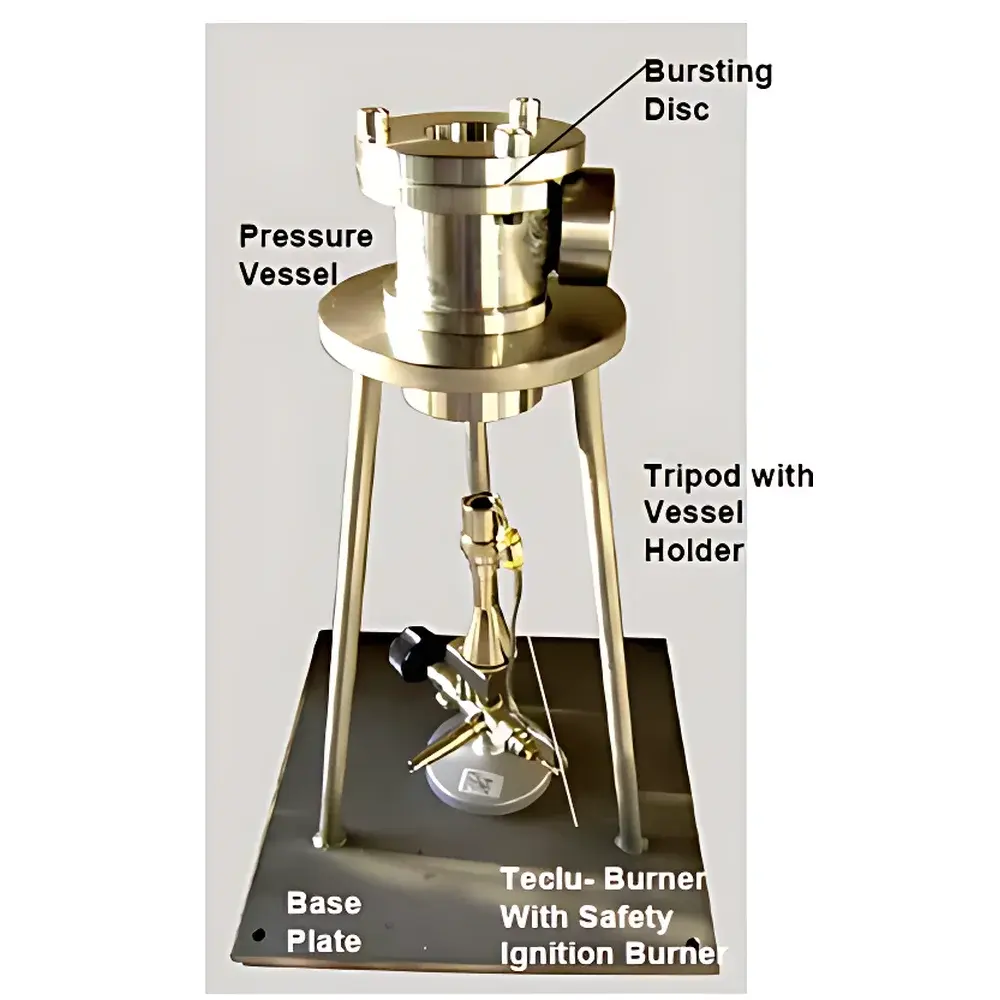
R&P DPV Dutch Pressure Vessel Test Apparatus
| Brand | R&P |
|---|---|
| Origin | Germany |
| Distributor Status | Authorized Distributor |
| Origin Category | Imported |
| Model | DPV |
| Pricing | Upon Request |
Overview
The R&P DPV Dutch Pressure Vessel Test Apparatus is a rigorously engineered laboratory instrument designed to assess the thermal sensitivity of solid and liquid substances under highly confined, high-temperature conditions. It implements the standardized pressure vessel test method described in UN Recommendations on the Transport of Dangerous Goods: Manual of Tests and Criteria, specifically Test E.2. This test evaluates whether a substance undergoes self-sustaining exothermic decomposition when subjected to rapid heating in a sealed stainless-steel vessel — a critical parameter for classifying substances under the UN Globally Harmonized System (GHS) and the UN Transport Regulations for Class 1 (explosives), Class 4.1 (flammable solids), and Class 5.1 (oxidizing substances). The apparatus operates on the principle of controlled thermal initiation within a fixed-volume, high-strength containment system, enabling reproducible determination of pressure rise profiles and time-to-rupture behavior under defined heating rates.
Key Features
- Pressure vessel constructed from AISI 316 stainless steel — selected for its high tensile strength, corrosion resistance, and dimensional stability at elevated temperatures;
- Standardized internal dimensions: 50 mm inner diameter × 94.5 mm internal height — compliant with UN Test E.2 geometric specifications;
- Stable three-legged support stand with rigid base plate for secure vertical alignment and vibration damping during pressurization;
- Protective cylindrical housing surrounding the vessel assembly — mitigates risk from radial fragmentation in the event of overpressure failure;
- Interchangeable nozzle plates (8 per set) with calibrated orifice diameters: 1.0, 2.0, 3.5, 6.0, 9.0, 12.0, 16.0, and 24.0 mm — enabling systematic evaluation of venting efficiency and pressure relief dynamics;
- Teclu burner (single unit) providing precise, adjustable flame heat flux for standardized thermal ramping;
- Aluminum rupture discs (20 per set), rated for burst pressure of 6.2 bar ±10% at 22°C — traceably certified and replaceable per test cycle to ensure consistent failure thresholds.
Sample Compatibility & Compliance
The DPV apparatus accommodates both powdered solids and low-viscosity liquids (e.g., molten salts, organic peroxides, nitro compounds, and energetic formulations) in quantities up to 10 g or 10 mL, depending on density and decomposition gas yield. Sample loading follows strict procedural controls to minimize void space and ensure uniform thermal coupling with the vessel wall. All operational protocols align with UN Test E.2 procedural requirements, including ambient conditioning, ignition timing, pressure monitoring intervals, and pass/fail criteria based on pressure-time integral and maximum recorded pressure. The system supports documentation workflows compatible with GLP-compliant laboratories and satisfies audit requirements for UN classification reports submitted to regulatory authorities such as the U.S. DOT, ECHA, and national competent bodies under ADR/RID/IMDG Code frameworks.
Software & Data Management
While the core DPV test is conducted manually per UN E.2 protocol, the apparatus integrates seamlessly with third-party digital data acquisition systems (e.g., National Instruments DAQ or Keysight 34972A) via analog pressure transducer outputs (0–10 V or 4–20 mA). Time-synchronized pressure vs. temperature traces are recorded at ≥10 Hz sampling rate to resolve rapid exothermic events. Raw datasets can be exported in CSV or TDMS format for post-processing in MATLAB, Python (NumPy/Pandas), or specialized thermal hazard analysis software (e.g., TSS, AKTS Thermokinetics). Audit trails—including operator ID, calibration certificate numbers for rupture discs and transducers, environmental chamber logs, and raw sensor timestamps—are maintained to meet FDA 21 CFR Part 11 and ISO/IEC 17025 traceability standards where electronic records are employed.
Applications
- Determination of thermal instability onset for new chemical entities in process safety screening (e.g., RC1, ARC follow-up);
- Classification testing for transport hazard categories (UN Class 1.1–1.6, 4.1, 5.1) per UN Manual of Tests and Criteria;
- Verification of packaging compatibility for oxidizers and self-reactive substances;
- Validation of emergency vent sizing calculations using experimentally derived vent flow coefficients (Kv);
- Supporting SDS authoring by generating empirical data for GHS Hazard Statements H200–H205 and precautionary statements P280–P284;
- Regulatory submission packages for REACH registration dossiers and EPA TSCA pre-manufacture notices (PMNs).
FAQ
Is the DPV apparatus certified for use in official UN classification testing?
Yes — when operated strictly in accordance with Test E.2 procedures and using certified rupture discs and calibrated instrumentation, test reports generated with the DPV apparatus are accepted by UN-accredited test laboratories and national regulatory authorities.
Can the apparatus be used with reactive gases or oxygen-enriched atmospheres?
No — the DPV test is performed under ambient air conditions only; intentional introduction of oxidizing or inert gas environments violates UN E.2 protocol and invalidates classification results.
What maintenance is required for long-term accuracy?
Annual recalibration of the pressure transducer and verification of Teclu burner flame geometry and heat output are recommended; rupture disc batches must be accompanied by valid calibration certificates traceable to NIST or equivalent NMIs.
Does R&P provide method validation documentation?
Yes — R&P supplies a comprehensive User Manual, UN E.2 Protocol Checklist, and IQ/OQ documentation templates aligned with ISO/IEC 17025 for laboratory accreditation purposes.



