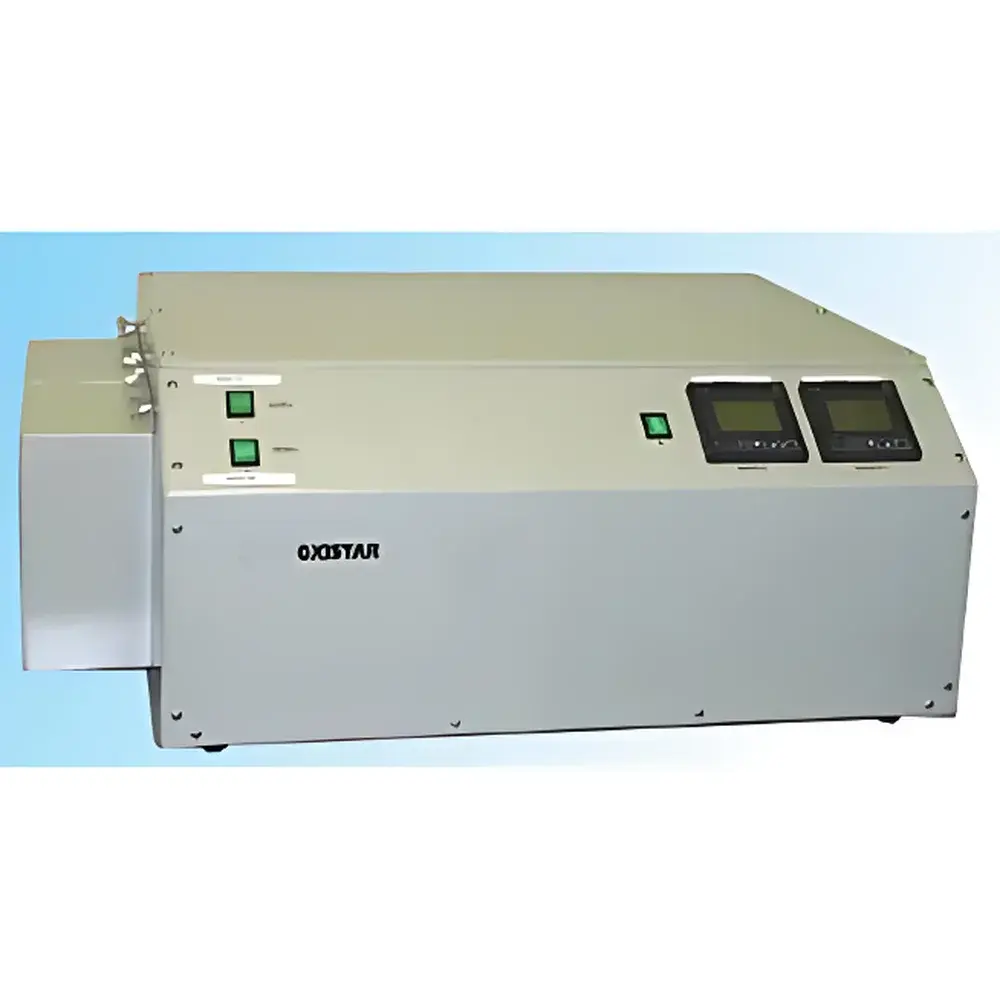
R&P OXISTAR Series Rubber Oxidative Stability Tester
| Brand | R&P |
|---|---|
| Origin | Germany |
| Model | OXISTAR I / OXISTAR II |
| Maximum Working Pressure | 21 bar |
| Oxygen Pre-Pressure Range | 25 ±1 bar |
| Compressed Air Pre-Pressure | ≥7 ±0.5 bar |
| Burst Pressure Rating | 35 bar |
| Max Operating Temperature | 150 °C |
| Temperature Control Accuracy | ±0.2 °C |
| Temperature Uniformity | ±1 °C at 70 °C, ±2 °C at 150 °C |
| Pressure Sensor Range | 0–25 bar (±0.5% FS) |
| Rupture Disc Activation Pressure | 32 ±7.5% bar |
| Chamber Volume | 4 L per chamber |
| Heating Power per Chamber | 330 VA |
| Dimensions (W×D×H) | 87 × 66 (45) × 42 cm |
| Weight | 58 kg (OXISTAR II), 42 kg (OXISTAR I) |
| Power Supply | 230 V ±10%, 720 VA (OXISTAR II), 360 VA (OXISTAR I) |
Overview
The R&P OXISTAR Series Rubber Oxidative Stability Tester is an engineered solution for accelerated oxidative aging assessment of elastomeric materials—including natural and synthetic rubbers, thermoplastic elastomers, and polymer-based cable insulation and jacketing compounds. It operates on the principle of high-pressure, elevated-temperature oxidation under controlled gaseous atmospheres—primarily pure oxygen or compressed air—to accelerate chemical degradation pathways that occur during long-term service exposure. The instrument complies strictly with DIN 53 508, DIN VDE 0472, and IEC 60811-1-2 (formerly IEC 811-1-2), which define standardized pressure vessel aging protocols for electrical insulating materials. By subjecting specimens to precisely regulated thermal and oxidative stress conditions—such as 70 °C/21 bar O₂ or 127–150 °C/5.5 bar air—the system enables reproducible simulation of years of ambient aging within hours or days. Post-exposure mechanical characterization (e.g., tensile strength, elongation at break, hardness per ISO 37, ISO 48, or ASTM D412) provides quantifiable metrics for oxidative resistance evaluation.
Key Features
- Two configuration options: OXISTAR I (single 4 L TÜV-certified pressure chamber) and OXISTAR II (dual independent 4 L chambers), enabling parallel testing under differing atmospheres and thermal profiles
- Electronic closed-loop control of temperature and pressure per chamber, with digital setpoint input and real-time display via front-panel interface
- PT100 Class A sensors mounted directly inside each chamber for in-situ temperature measurement; accuracy ±0.2 °C control, uniformity ±1 °C at 70 °C and ±2 °C at 150 °C
- Integrated high-precision pressure transducers (0–25 bar, ±0.5% full scale) mounted internally for rapid feedback-driven regulation
- Capillary-based gas inlet/outlet system ensures low, laminar flow rates—minimizing thermal disturbance and enabling stable pressurization/depressurization cycles
- Mechanical overtemperature cutoff and certified rupture discs (activation pressure 32 ±7.5% bar) provide redundant safety layers compliant with PED 2014/68/EU
- Analog 0–10 V output ports support integration into centralized lab data acquisition systems or SCADA environments
Sample Compatibility & Compliance
The OXISTAR platform accommodates standard dumbbell- or ring-shaped specimens (per ISO 37, ASTM D412, or IEC 60811-1-1), including vulcanized rubber sheets, extruded cable sheaths, and cross-linked polyolefin insulation. Its dual-chamber architecture is especially valuable for comparative studies—for instance, evaluating oxygen-induced chain scission versus thermo-oxidative degradation in halogen-free flame-retardant (HFFR) compounds. All operational parameters meet the metrological and procedural requirements of DIN 53 508 (rubber aging), DIN VDE 0472 (cable materials), and IEC 60811-1-2 (electrical insulating materials). The TÜV-certified pressure vessels satisfy EN 13445-1 (Unfired Pressure Vessels) and are traceable to DAkkS-accredited calibration protocols. Instrument validation documentation supports GLP-compliant laboratory audits and internal quality system alignment (e.g., ISO/IEC 17025).
Software & Data Management
While the base OXISTAR operates via embedded microcontroller logic without proprietary software, its analog 0–10 V outputs enable seamless connection to third-party data loggers (e.g., Testo, Omega, or NI CompactDAQ) for time-stamped recording of temperature, pressure, and runtime. Optional accessories include calibrated portable temperature/pressure meters with DAkkS-traceable certificates and multi-channel strip-chart recorders (2- or 4-channel) for permanent analog archival. For laboratories requiring electronic records compliance, the system’s deterministic analog outputs can be integrated into validated LIMS or ELN platforms supporting 21 CFR Part 11 audit trails when paired with appropriate acquisition hardware and SOP-defined calibration workflows.
Applications
- Comparative oxidative stability ranking of EPDM, SBR, NBR, and silicone rubber formulations
- Qualification of cable jacketing materials for power transmission, rail, and aerospace applications per IEC 60502 and EN 50267
- Development screening of antioxidant packages (e.g., hindered phenols, phosphites, thioesters) in polymer compounding
- Accelerated life modeling for elastomeric seals and gaskets used in automotive and industrial fluid systems
- Supporting ISO 11346 (rubber—estimation of service life) and ASTM D572 (rubber degradation by heat and oxygen) test execution
FAQ
What standards does the OXISTAR comply with?
It fully implements DIN 53 508, DIN VDE 0472, and IEC 60811-1-2 for oxidative aging of elastomers and cable materials.
Can both chambers on the OXISTAR II operate simultaneously under different conditions?
Yes—each chamber has independent temperature and pressure control, allowing concurrent tests such as O₂/70 °C and air/127 °C.
Is the pressure vessel certified for PED compliance?
Yes—TÜV-certified per PED 2014/68/EU with EN 13445-1 design validation and burst pressure rating of 35 bar.
How is temperature uniformity verified across the chamber volume?
Calibration uses multiple PT100 probes positioned at geometrically defined locations per VDI/VDE 2655 Part 3; uniformity is confirmed at ±1 °C (70 °C) and ±2 °C (150 °C).
What maintenance is required for long-term reliability?
Annual verification of pressure sensor linearity, PT100 calibration traceability, rupture disc integrity, and seal condition is recommended—full service documentation and spare parts kits are available from R&P authorized service centers in Europe and North America.