
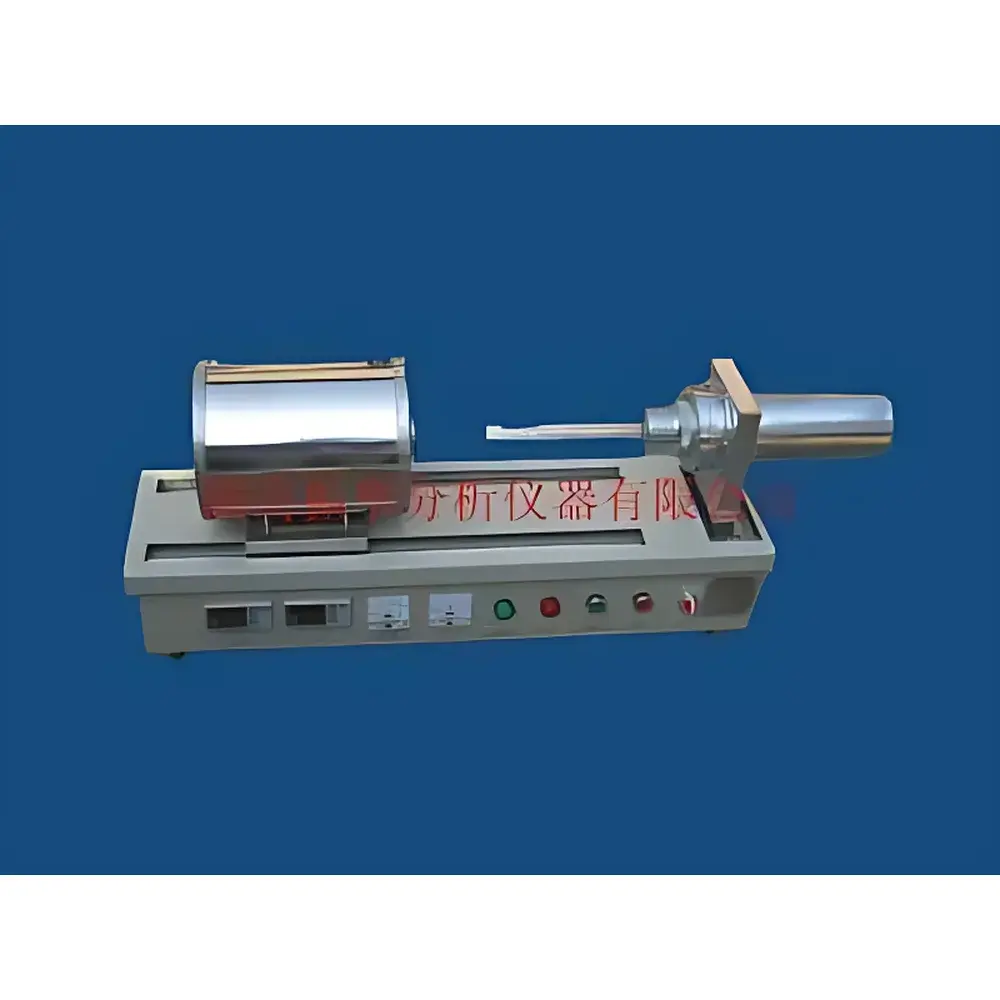
RPT-II Comprehensive Physical Property Tester for Conductive Materials
| Origin | Hunan, China |
|---|---|
| Manufacturer Type | Authorized Distributor |
| Origin Category | Domestic (China) |
| Model | RPT-II |
| Pricing | Available Upon Request |
| Temperature Range | Ambient to 1000 °C |
| Temp. Accuracy | ±0.1 °C |
| Heating Rate | 0–10 °C/min |
| Cooling Options | Natural & Controlled |
| Sample Dimensions | Ø4×100 mm, Ø6×100 mm, Ø8×100 mm |
| Expansion Measurement Range | 0–5 mm |
| Expansion Resolution | 0.1 µm/digit |
| Expansion Accuracy | ±0.1% FS |
| Test Modules | Thermal Expansion Coefficient (CTE), Electrical Conductivity, Thermal Conductivity, Resistivity |
| Control & Analysis | Industrial PC–Based Automated Software Suite |
Overview
The RPT-II Comprehensive Physical Property Tester for Conductive Materials is an integrated thermal–electrical–mechanical characterization platform engineered for precise, synchronized measurement of multiple intrinsic physical properties in conductive and semi-conductive solid materials. Based on the principles of dilatometry (for linear thermal expansion coefficient, CTE), four-point probe or van der Pauw methodology (for electrical conductivity/resistivity), and transient plane source (TPS) or guarded hot plate techniques (for thermal conductivity), the system enables concurrent acquisition of thermally induced dimensional changes, charge-carrier transport behavior, and heat-transfer response across a continuous temperature range from ambient to 1000 °C. Its modular architecture supports traceable, repeatable evaluation under controlled heating/cooling profiles—critical for understanding microstructural evolution, phase transitions, interfacial stability, and thermo-mechanical coupling in advanced functional materials.
Key Features
- Multi-parameter synchronous acquisition: Simultaneous real-time logging of dimensional change (ΔL/L₀), electrical resistance (R), voltage drop (V), and thermal flux (q) during thermal cycling.
- High-precision dilatometric module with optical encoder-based displacement sensing: 0.1 µm resolution, 0.1% full-scale accuracy over 0–5 mm travel range; accommodates cylindrical specimens up to Ø8 mm × 100 mm.
- Programmable thermal control system: Adjustable heating rates from 0 to 10 °C/min; dual-mode cooling (passive ambient + active controlled ramp-down) ensures reproducible thermal history management.
- Integrated electrical characterization circuitry compliant with ASTM F1711 and IEC 60404-5: Supports both DC resistivity and AC impedance modes; auto-compensated lead resistance correction for accurate bulk property extraction.
- Rugged furnace design with alumina-insulated heating zone and inert-gas compatible chamber (N₂, Ar), enabling high-temperature measurements under controlled atmospheres.
- Industrial-grade PC host with deterministic real-time OS: Ensures sub-second data synchronization across all sensor channels and eliminates timestamp jitter during dynamic thermal transients.
Sample Compatibility & Compliance
The RPT-II accepts standard cylindrical solid samples—Ø4, Ø6, or Ø8 mm × 100 mm—with minimal surface preparation requirements. It is validated for use with metals (e.g., Cu, Al, Ni alloys), semiconductors (Si, SiC, GaN wafers), carbon-based conductors (graphite, graphene composites), and ceramic-metal hybrids (e.g., Al₂O₃–Cu cermets, ZrO₂–Ni functionally graded materials). All measurement protocols align with ISO 11359-1 (thermomechanical analysis), ASTM E228 (linear thermal expansion), ASTM D5470 (thermal transmission properties), and IEC 60404-5 (magnetic materials resistivity). Data audit trails comply with GLP and GMP documentation standards; software supports 21 CFR Part 11–compliant electronic signatures and user-access tiering.
Software & Data Management
The proprietary RPT-Studio software suite runs on Windows OS and provides full instrument orchestration—including furnace profile definition, sensor calibration import, real-time waveform visualization, and automated report generation in PDF/CSV/XLSX formats. Raw time-series data are stored in HDF5 format with embedded metadata (sample ID, operator, timestamp, environmental conditions, calibration coefficients). Built-in mathematical modules compute derived parameters such as temperature-dependent CTE(α(T)), electrical conductivity σ(T), thermal diffusivity αₜₕ(T), and Lorenz number L(T) for Wiedemann–Franz law validation. Export interfaces support integration with MATLAB, Python (via PyHDF), and LabVIEW for advanced statistical modeling and machine-learning–driven material property prediction.
Applications
- Development and qualification of high-temperature interconnects and bonding materials in power electronics packaging.
- Thermo-mechanical reliability assessment of battery electrode composites (e.g., Si-anode blends, LiCoO₂ cathodes) under operational thermal cycling.
- Fundamental studies of electron–phonon coupling in transition metal dichalcogenides and topological insulators.
- Process optimization of sintering, annealing, and hot-isostatic pressing (HIP) cycles via in-situ CTE–resistivity correlation.
- Educational laboratories: Hands-on instruction in solid-state physics, materials thermodynamics, and metrology traceability principles.
FAQ
What standards does the RPT-II comply with for thermal expansion measurement?
ASTM E228, ISO 11359-1, and DIN 51045–1 govern its dilatometric operation; calibration is traceable to NIST SRM 735a (Invar).
Can the system measure anisotropic thermal expansion in textured polycrystals?
Yes—by rotating the sample holder (optional accessory) and performing sequential axial measurements, directional CTE tensors can be reconstructed.
Is vacuum operation supported?
The base configuration supports inert gas purging; vacuum-ready variants (10⁻³ mbar) are available upon request with modified furnace seals and feedthroughs.
How is electrical contact maintained at 1000 °C without oxidation interference?
Platinum–rhodium (Pt–Rh) probe tips with spring-loaded kinematic mounting ensure stable contact pressure and minimize interfacial resistance drift; optional gold-plated contacts available for low-resistivity samples.
Does the software support custom scripting for automated test sequences?
Yes—RPT-Studio includes a Python API (PyRPT) for programmable workflow automation, conditional branching, and third-party instrument triggering (e.g., XRD, Raman).



