
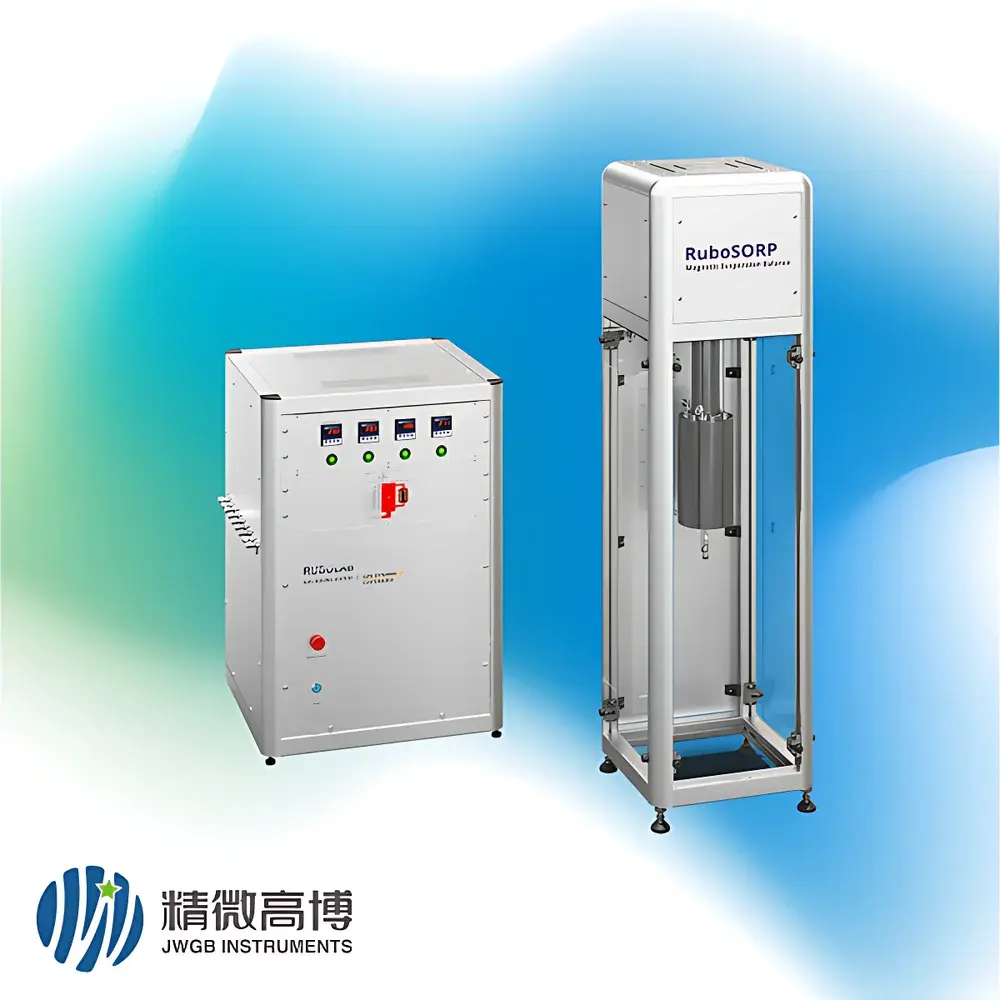
RuboLab RuboSORP MSB Magnetic Suspension Balance – Gravimetric Sorption Analyzer
| Brand | RuboLab |
|---|---|
| Origin | Germany |
| Model | RuboSORP MSB |
| Measurement Principle | Magnetic Suspension Balance |
| Number of Gas Inlets | 8 |
| Maximum Operating Pressure | 700 bar |
| Temperature Range | −10 °C to +400 °C |
| Mass Resolution | Down to 1 μg |
| Maximum Sample Load | 10 g or 20 g (model-dependent) |
| Compatible Fluids | Inert gases, corrosive/toxic gases, flammable/explosive gases, supercritical fluids, vapors, and gas mixtures |
| Compliance | Designed for GLP/GMP-aligned workflows with full audit trail support |
Overview
The RuboLab RuboSORP MSB is a high-precision magnetic suspension balance (MSB) system engineered for gravimetric sorption analysis under extreme thermodynamic conditions. Unlike conventional microbalances that rely on mechanical load cells or electromagnetic force compensation—both inherently limited by thermal drift, vibration sensitivity, and material compatibility—the RuboSORP MSB employs contactless magnetic levitation to isolate the sample pan from the measurement environment. This architecture eliminates mechanical coupling, enabling stable, high-resolution mass determination (<1 μg) across wide pressure (up to 700 bar) and temperature (−10 °C to +400 °C) ranges. The system operates on the principle of active magnetic stabilization: a feedback-controlled electromagnetic field counteracts gravitational and buoyancy forces acting on a diamagnetically stabilized sample holder, allowing real-time mass tracking without physical support structures. This makes it uniquely suited for adsorption/desorption studies involving reactive, corrosive, pyrophoric, or supercritical fluid systems where conventional balances fail.
Key Features
- Contactless magnetic suspension architecture eliminates mechanical hysteresis, thermal conduction paths, and seal-related contamination risks.
- Eight independently controlled gas inlets enable automated multi-gas switching, binary/multi-component mixture dosing, and sequential chemisorption–physisorption protocols.
- Modular furnace design supports rapid thermal ramping (up to 10 K/min) and precise isothermal control (±0.1 K) over −10 °C to +400 °C; optional cryogenic extension available.
- Dual-load configuration: standard models support up to 20 g (inert environments) or 10 g (aggressive media); sub-microgram resolution maintained across full dynamic range.
- Hermetically sealed, all-metal gas path with Hastelloy C-276 wetted parts ensures compatibility with H₂S, NH₃, Cl₂, HF, HCl, CO, and other highly corrosive or toxic process gases.
- Integrated pressure regulation via piezoresistive transducers (0.01% FS accuracy) and high-speed solenoid valves enables true isobaric or isothermal sorption kinetics acquisition.
Sample Compatibility & Compliance
The RuboSORP MSB accommodates heterogeneous solid samples—including catalysts, MOFs, zeolites, activated carbons, polymers, metal oxides, and battery electrode materials—in powder, pellet, or monolith form. Its inert or chemically resistant sample chambers comply with ASTM D3663 (catalyst surface area), ISO 15901-2 (pore size distribution), and USP (sorption isotherms for pharmaceutical excipients). All operational parameters—including temperature setpoints, pressure steps, gas composition, dwell times, and mass readings—are timestamped and logged with cryptographic integrity. Data export formats (CSV, HDF5, NIST-compliant JSON-LD) support FDA 21 CFR Part 11 compliance when deployed with validated LIMS integration and electronic signature modules. Full audit trail functionality—including user login history, parameter change logs, and raw sensor tracebacks—is enabled by default.
Software & Data Management
RuboControl™ v5.2 software provides a deterministic, scriptable acquisition environment with real-time visualization of mass vs. time, P–V–T overlays, and derivative-based kinetic analysis. Built-in isotherm fitting engines support Langmuir, BET, GAB, Toth, and dual-site models with uncertainty propagation. Batch processing allows parallel evaluation of multiple isotherms using identical regression constraints. Raw data files are stored with embedded metadata (instrument ID, calibration certificate ID, operator ID, environmental conditions) and support FAIR principles (Findable, Accessible, Interoperable, Reusable). Optional API access enables direct integration with MATLAB, Python (via PyRuboSDK), and LabVIEW for custom automation sequences or digital twin synchronization.
Applications
- Catalysis research: Quantifying active site density, CO/H₂ chemisorption stoichiometry, and thermal stability of supported metal nanoparticles under realistic reaction pressures.
- Polymer science: Measuring CO₂, CH₄, or H₂O uptake in thermoplastic polyurethanes and polyimides for foam nucleation modeling and barrier property prediction.
- Energy storage: Characterizing Li-ion cathode hydration, solid electrolyte interphase (SEI) formation kinetics, and gas evolution during electrochemical cycling.
- Carbon capture: Validating amine-functionalized sorbents under flue-gas-relevant conditions (15 bar, 40–80 °C, humid CO₂/N₂ mixtures).
- Supercritical processing: Determining solubility limits and phase behavior of pharmaceuticals in scCO₂ or scCHF₃ for particle engineering applications.
- Calibration gas generation: Providing traceable, gravimetrically verified reference mixtures for gas chromatography and laser spectroscopy standards.
FAQ
How does magnetic suspension differ from quartz crystal microbalance (QCM) or electro-balance techniques?
Magnetic suspension eliminates mechanical anchoring entirely, removing thermal expansion artifacts and enabling operation in aggressive chemical environments where QCM electrodes degrade or electro-balance springs corrode.
Can the RuboSORP MSB perform simultaneous TGA–gas adsorption measurements?
Yes—when coupled with optional differential pressure transducers and calibrated mass flow controllers, the system delivers true thermogravimetric adsorption profiles with concurrent gas consumption quantification.
Is remote operation and cybersecurity supported?
The system includes TLS 1.3-secured web interface, role-based access control (RBAC), and optional hardware security module (HSM) integration for encrypted data-at-rest and zero-trust network authentication.
What calibration standards and traceability documentation are provided?
Each unit ships with NIST-traceable mass calibration certificates (per ISO/IEC 17025), pressure transducer calibration reports (valid to 700 bar), and temperature uniformity maps for the furnace zone.



