RWD 62001 Single-Channel Microinfusion System for Stereotactic Intracranial Delivery
| Brand | RWD |
|---|---|
| Origin | Shenzhen, China |
| Manufacturer Type | Original Equipment Manufacturer (OEM) |
| Country of Origin | China |
| Model | 62001 |
| Pricing | Upon Request |
Overview
The RWD 62001 Single-Channel Microinfusion System is an engineered solution for precise, stereotactically guided intracranial microinjection in rodent and non-human primate neuroscience research. Designed to integrate seamlessly with standard small-animal stereotaxic frames—including RWD’s proprietary stereotaxic apparatus, cannula holders, anchoring screws, and polyethylene (PE) tubing—the system implements the widely accepted pre-implanted guide cannula methodology for both acute and chronic intracerebral delivery. Its operational principle relies on mechanical precision alignment and passive fluid displacement via external syringe pumps, ensuring reproducible volumetric dosing (typically 0.1–10 µL) with sub-millimeter spatial accuracy relative to target nuclei. The system is not a standalone infusion pump; rather, it serves as a calibrated, modular interface between the implanted guide cannula and the infusion actuator—enabling controlled delivery without disturbing the animal’s cranial integrity post-surgery.
Key Features
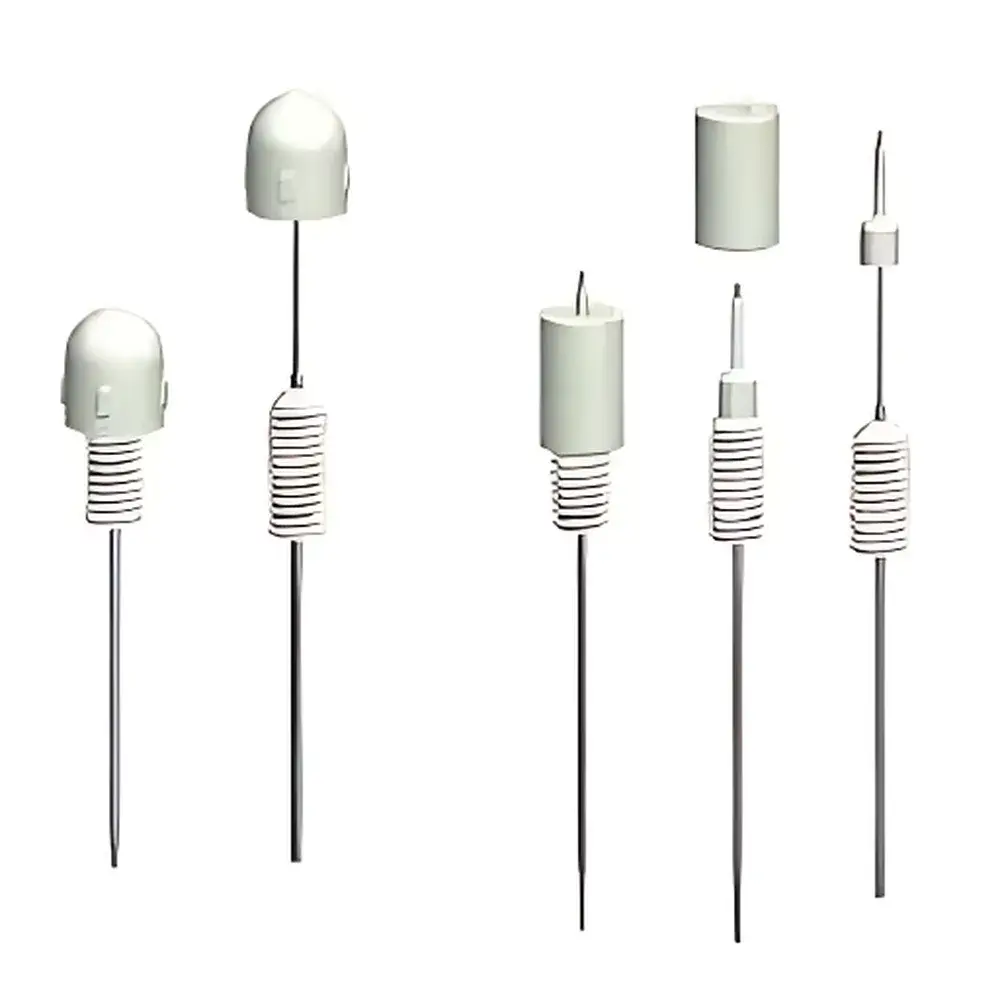
- Modular four-component architecture: stainless-steel guide cannula, threaded cannula cap, removable injection inner tube, and locking nut—each machined to ISO 80601-2-62 tolerances for dimensional consistency.
- Customizable cannula length (C-dimension), defined as the exposed metallic shaft length below the polymer base—available from 3.0 mm to 25.0 mm in 0.1-mm increments to match target coordinates from Paxinos & Watson (rat), Franklin & Paxinos (mouse), or stereotaxic atlases for macaque.
- Adjustable inner tube protrusion (G1-dimension) and cap core extension (G2-dimension), both configurable ±0.5 mm relative to cannula tip—supporting experimental requirements for flush delivery, slight over-extension into tissue, or recessed positioning within the guide lumen.
- Interchangeable compatibility with standard 33–36 gauge stainless-steel inner tubes and PE-50/PE-10 tubing—validated for aqueous, DMSO-based, and lipid-emulsion formulations with viscosity ≤20 mPa·s at 25 °C.
- Mechanically locked interface: the hexagonal locking nut applies uniform axial force to secure the cap assembly without torque-induced deformation—preserving concentricity between inner tube and cannula bore (ID tolerance: ±5 µm).
Sample Compatibility & Compliance
The RWD 62001 system supports intracerebral administration across common preclinical models: C57BL/6 and BALB/c mice (20–30 g), Sprague-Dawley and Wistar rats (250–500 g), and juvenile rhesus macaques (2–4 kg). All components are manufactured from medical-grade 316L stainless steel and USP Class VI-certified polymers. The design conforms to ASTM F2101 (biocompatibility screening) and ISO 10993-1 requirements for short-term implantable devices. While the system itself does not require FDA 510(k) clearance—as a Class I non-invasive accessory—it is routinely deployed in GLP-compliant toxicology studies and IND-enabling pharmacokinetic investigations where traceability of component lot numbers and sterilization validation (EtO or gamma) are documented per client request.
Software & Data Management
As a hardware-only delivery interface, the RWD 62001 does not incorporate embedded firmware or proprietary software. It is fully compatible with third-party programmable syringe pumps (e.g., Harvard Apparatus PHD Ultra, World Precision Instruments SP200i) that support RS-232, USB, or TTL triggering. Pump protocols—including flow rate ramping, multi-phase infusion, and real-time pressure monitoring (when paired with optional pressure transducers)—are managed externally. Audit trails, parameter logging, and electronic signatures adhere to FDA 21 CFR Part 11 when integrated with validated LIMS or ELN platforms (e.g., LabArchives, Benchling) via pump vendor APIs.
Applications
- Unilateral neuropharmacological intervention: site-specific delivery of adeno-associated viruses (AAVs), siRNA, CRISPR-Cas9 ribonucleoproteins, or neuroactive compounds (e.g., muscimol, bicuculline) into discrete nuclei such as the basolateral amygdala, ventral tegmental area, or nucleus accumbens.
- Chronic electrophysiology coupling: co-implantation with silicon probes or tetrodes, where the cannula serves dual roles—drug delivery conduit and mechanical anchor for chronic recording arrays.
- Behavioral circuit mapping: time-locked microinfusions during operant conditioning or fear extinction paradigms, requiring millisecond-level temporal alignment between pump trigger signals and behavioral event timestamps.
- Pharmacokinetic/pharmacodynamic (PK/PD) modeling: serial sampling via adjacent microdialysis probes concurrent with localized drug administration—enabled by precise spatial separation (<200 µm) between cannula and probe tracks.
FAQ
What is the minimum recommended inner diameter (ID) of the guide cannula for reliable fluid passage?
The standard 62001 cannula features a 0.38 mm ID (27 gauge), validated for sustained flow rates ≥50 nL/min using 33-gauge inner tubes. For viscous formulations (>10 mPa·s), we recommend ID ≥0.45 mm (25 gauge) upon customization.
Can the system be autoclaved?
Yes—stainless-steel components withstand 121 °C, 15 psi steam sterilization for 20 minutes. Polymer caps require EtO sterilization; gamma irradiation (25 kGy) is also validated.
Is there a maximum recommended infusion volume per session?
Based on histological validation studies, volumes exceeding 5 µL in mice or 15 µL in rats increase risk of tissue displacement or reflux along the cannula track; optimal range is 0.5–3.0 µL for most neuromodulators.
How is dimensional traceability maintained during custom fabrication?
Each custom order receives a Certificate of Conformance listing actual measured C-, G1-, and G2-dimensions (±0.05 mm), recorded using Mitutoyo IP67-rated digital calipers calibrated daily against NIST-traceable standards.