
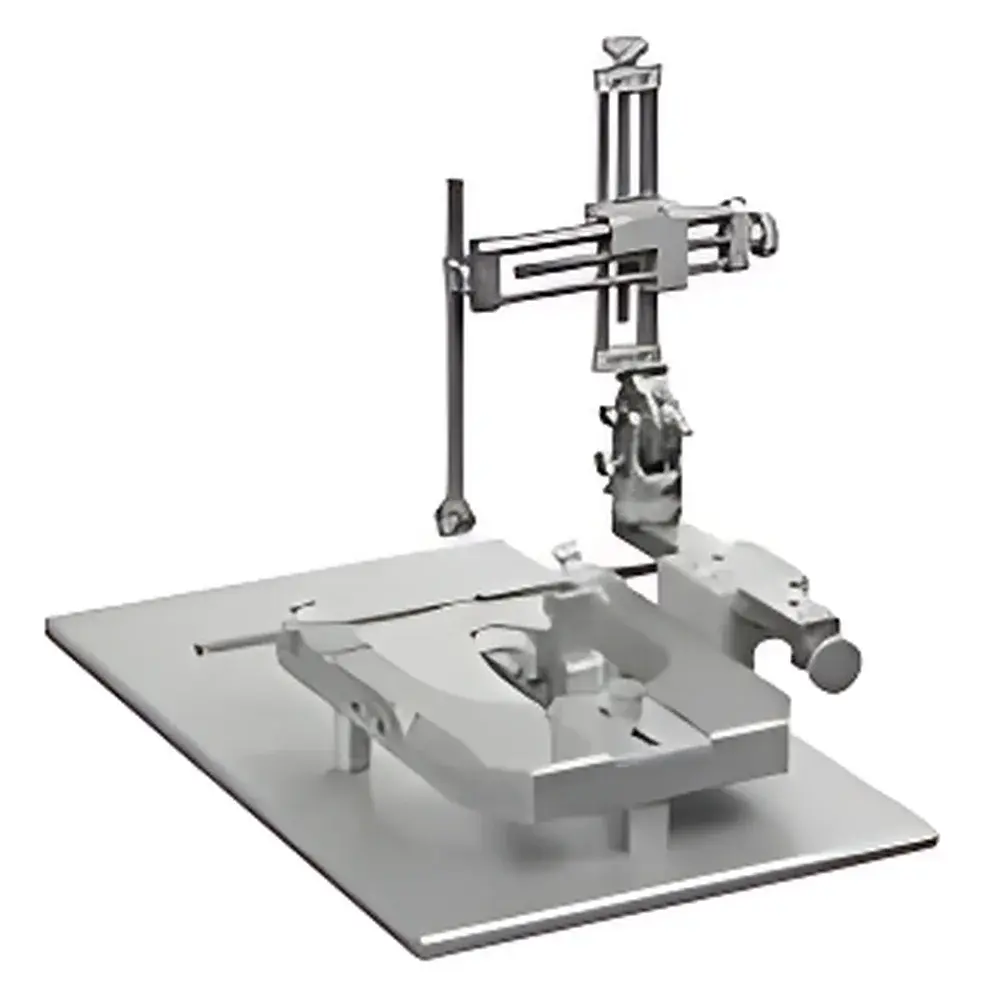
RWD 68001 Standard Stereotaxic Instrument for Small Animal Neurosurgery
| Brand | RWD |
|---|---|
| Origin | Guangdong, China |
| Manufacturer Type | Direct Manufacturer |
| Product Origin | Domestic (China) |
| Model | 68001 |
| Price Range | USD 1,400 – 7,000 |
| Arm Configuration | Single-Arm |
| Ear Bar Angle | 18° |
| Base Dimensions | 355 × 255 mm |
| XYZ Travel Range | 80 mm each axis |
| Vertical Rotation | 0–180° with Locking |
| Horizontal Rotation | 0–360° with Locking |
| Base Structure | Open U-Frame Design |
| Compatible Species | Rat, Mouse, Guinea Pig, Bird, Lizard, Cat |
| Electrode/Probe Mounting | Standard Clamp (68201), Optional C-Clamp (68212), Side-Mount Clamp (68213), Custom Clamps Available |
| Accessories Support | Microinjection Pump, Stereo Microscope, Cranial Drill, Electrophysiology Grounding via Bronze Bushings |
Overview
The RWD 68001 Standard Stereotaxic Instrument is a precision-engineered neurosurgical platform designed for reproducible, high-fidelity stereotactic interventions in preclinical neuroscience research. Built upon the foundational principles of stereotaxic coordinate geometry—where anatomical targets are localized relative to standardized bregma-lambda landmarks—the instrument enables submillimeter spatial accuracy in intracranial procedures across diverse vertebrate models. Its open U-frame base architecture eliminates structural occlusion, facilitating unobstructed access for concurrent use of microinjection systems, electrophysiological recording rigs, or intraoperative imaging devices. The device operates without motorized actuation; instead, it relies on manually controlled, dual-lead-screw translation stages and precision-machined rotational joints—ensuring mechanical stability, zero backlash, and long-term calibration retention under routine laboratory conditions.
Key Features
- Open U-shaped base (355 × 255 mm) engineered for multi-angle surgical access and compatibility with auxiliary equipment including stereomicroscopes, cranial drills, and pressure-driven microinjectors.
- Single-arm 3D manipulator with ±80 mm travel range along X (anterior-posterior), Y (medial-lateral), and Z (dorsal-ventral) axes, driven by dual-lead stainless steel screws for smooth, non-slip positioning and micron-level repeatability.
- Full 360° horizontal rotation and 180° vertical articulation of the manipulator arm, both equipped with calibrated vernier scales and independent locking mechanisms for stable orientation during chronic or acute procedures.
- Interchangeable animal-specific adapters—including standard rat (68020) and mouse (68010) holders—as well as optional 18° or 45° ear bar configurations (68301 / 68302) to accommodate species-specific skull morphology and auditory canal alignment requirements.
- Electrophysiology-ready design: bronze bushings integrated into the manipulator arm housing provide low-resistance grounding paths, minimizing noise during extracellular or intracellular recordings.
- Laser-etched scale markings on all linear and angular axes ensure rapid, parallax-free reading under standard lab illumination; surface-hardened anodized aluminum base and mounting plates resist wear and maintain dimensional integrity across thermal cycles (15–30°C operational range).
Sample Compatibility & Compliance
The RWD 68001 supports stereotactic targeting in rodents (Sprague-Dawley/Wistar rats, C57BL/6 and BALB/c mice), lagomorphs, avian models (e.g., zebra finch), reptiles (Anolis carolinensis), and small carnivores (domestic cat). Its modular clamp system—including standard diagonal (68201), C-type (68212), and lateral-mount (68213) configurations—accepts electrodes (0.1–2.0 mm OD), glass micropipettes, fiber optic cannulae, and stainless-steel injection needles. While not certified to ISO 13485 or FDA 510(k), the instrument conforms to general laboratory safety standards (IEC 61010-1) and is routinely deployed in GLP-compliant behavioral pharmacology and neurodegeneration studies where procedural traceability and inter-operator consistency are documented per institutional animal care protocols.
Software & Data Management
As a purely mechanical stereotaxic platform, the RWD 68001 does not incorporate embedded firmware or proprietary software. All coordinate entry, trajectory planning, and procedural documentation are performed externally using validated third-party tools—including Stereotaxic Atlas Software (e.g., Paxinos & Watson digital atlases), MATLAB-based targeting calculators, or electronic lab notebooks (ELNs) compliant with 21 CFR Part 11 when used in regulated environments. Users may integrate the instrument with automated microinjection controllers (e.g., WPI UltraMicroPump) or digital microscope capture systems via standard TTL or USB interfaces—data synchronization is maintained at the host PC level.
Applications
- Induction of neurodegenerative disease models: bilateral 6-OHDA injections into the medial forebrain bundle for Parkinson’s disease modeling in rats; Aβ1–42 or tau fibril infusion into hippocampal CA1 for Alzheimer’s-related synaptic dysfunction studies.
- Epileptogenesis research: kainic acid or pilocarpine microinfusion into the amygdala or entorhinal cortex to establish temporal lobe epilepsy models with subsequent EEG monitoring.
- Neural circuit mapping: optogenetic viral vector delivery (AAV-ChR2, AAV-NpHR) into defined nuclei followed by fiber photometry or patch-clamp validation.
- Stem cell transplantation: stereotactic grafting of human neural progenitor cells into striatal or cortical lesions, with post-operative immunohistochemical tracking of migration and differentiation.
- Cerebral ischemia modeling: endothelin-1-mediated focal vasoconstriction or photothrombotic occlusion guided by bregma-referenced coordinates in transient MCAO paradigms.
FAQ
What species are compatible with the RWD 68001?
Rats, mice, guinea pigs, birds (e.g., zebra finch), lizards (e.g., Anolis), and domestic cats—via interchangeable head holders and ear bar angle options.
Is the instrument suitable for electrophysiology experiments?
Yes. Bronze bushings in the manipulator arm enable reliable electrical grounding, reducing noise during extracellular single-unit or whole-cell patch recordings.
Can I upgrade from a single-arm to a dual-arm configuration later?
Yes. The U-frame base accepts either 68401 (left-arm) or 68402 (right-arm) manipulators independently; dual-arm kits (68002/68006) share identical mounting interfaces.
Does the device include stereotaxic atlas references?
No. Atlas data must be sourced separately (e.g., Paxinos & Franklin’s “The Mouse Brain in Stereotaxic Coordinates”); however, all scale graduations align with standard millimeter-based coordinate systems.
What maintenance is required to preserve calibration accuracy?
Periodic cleaning of lead screws with isopropyl alcohol and light lubrication with silicone-free grease every 6–12 months; no recalibration is needed unless subjected to mechanical impact or extreme thermal cycling.




