
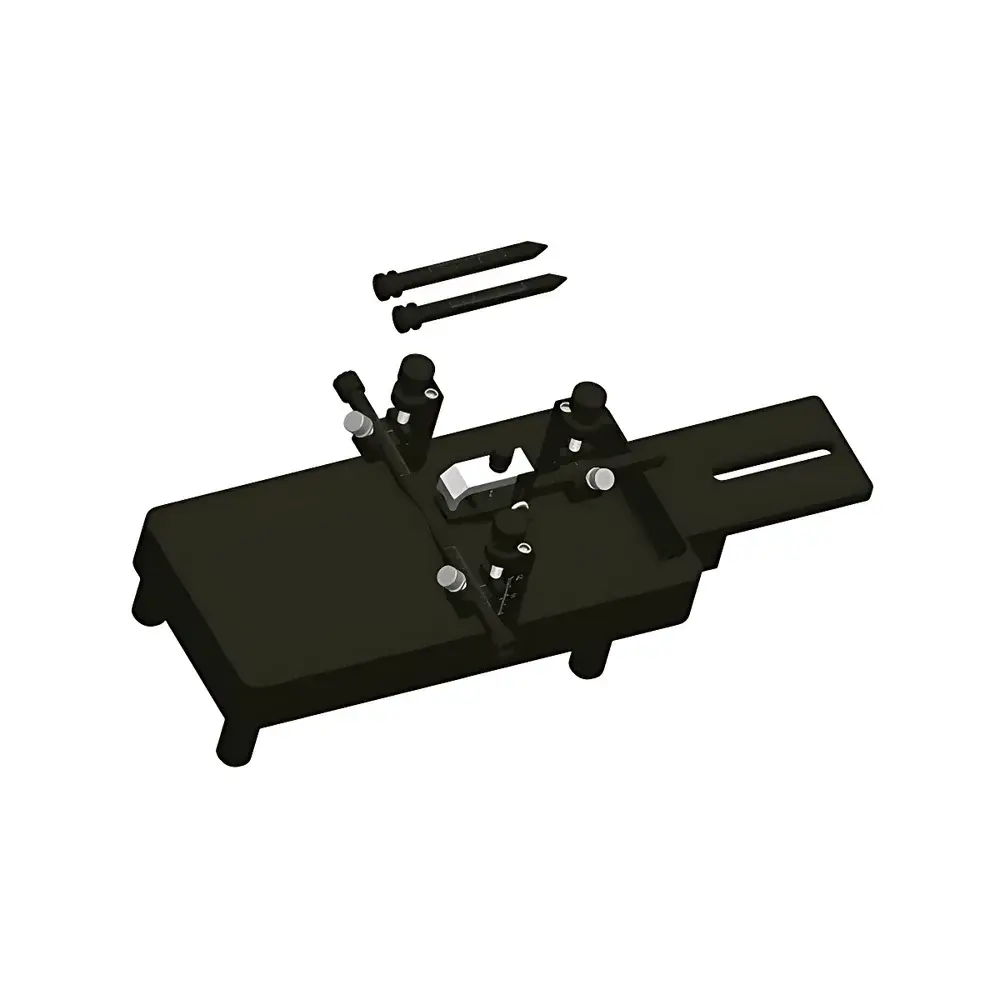
RWD 68015 Rat Adapter with 18° Ear Bars
| Brand | RWD |
|---|---|
| Origin | Shenzhen, China |
| Manufacturer Type | Original Equipment Manufacturer (OEM) |
| Country of Origin | China |
| Model | 68015 |
| Pricing | Available Upon Request |
Overview
The RWD 68015 Rat Adapter is a precision-engineered stereotaxic accessory designed for consistent, reproducible head fixation of adult rats during neurosurgical, electrophysiological, or imaging procedures. It operates on the principle of three-point cranial immobilization—using adjustable incisor/nose clamp and dual 18° angled ear bars—to achieve rigid, low-movement positioning while preserving unobstructed airway patency. Compatible exclusively with RWD’s U-shaped stereotaxic base plate (e.g., model 68030 series mounting interface), this adapter eliminates the need for auxiliary lift platforms or shim stacks, thereby reducing setup variability and minimizing mechanical drift during long-duration experiments. Its geometric design ensures that the interaural line and bregma–lambda plane remain parallel to the horizontal plane of the stereotaxic frame when properly adjusted—a prerequisite for accurate coordinate mapping in rodent brain atlases such as Paxinos & Watson.
Key Features
- 18° pre-angled stainless steel ear bars optimized for rat temporal bone anatomy, enabling secure yet low-pressure tympanic membrane engagement without auditory canal occlusion
- Coaxial vertical adjustment mechanism (0–20 mm range) for independent fine-tuning of incisor bar, nose clamp, and ear bar height—facilitating rapid leveling of the skull’s dorsal surface relative to the stereotaxic coordinate system
- Direct-mounting interface compatible with RWD U-type base plates (e.g., models 68000, 68010, 68020), ensuring mechanical continuity and torsional rigidity across the entire stereotaxic assembly
- Corrosion-resistant anodized aluminum body and medical-grade stainless steel contact surfaces compliant with ISO 13485–aligned manufacturing practices
- No-tool operation: all height adjustments performed via knurled thumb screws with tactile feedback and locking capability to prevent inadvertent displacement during procedure
Sample Compatibility & Compliance
The 68015 adapter is validated for use with Sprague-Dawley, Wistar, and Long-Evans rats weighing 250–500 g. It supports both acute terminal surgeries and chronic implantation protocols requiring postoperative recovery. All materials meet USP Class VI biocompatibility requirements for short-term tissue contact. The device conforms to IEC 61000-6-2 (immunity) and IEC 61000-6-3 (emission) standards for laboratory equipment. While not a medical device per FDA 21 CFR Part 820, it is routinely employed in GLP-compliant preclinical neuroscience studies where traceable instrument qualification (IQ/OQ) and maintenance logs are maintained per institutional animal care and use committee (IACUC) protocols.
Software & Data Management
As a mechanical stereotaxic component, the 68015 adapter does not incorporate embedded electronics or firmware. However, its dimensional repeatability (±0.1 mm positional tolerance across adjustment range) enables seamless integration with digital stereotaxic navigation systems—including third-party platforms such as NeuroStar™, Stereoinvestigator®, and open-source tools like BrainMaker—that rely on calibrated coordinate input. When used in conjunction with RWD’s optional digital angle sensors or motorized manipulators (e.g., 68050 series), the adapter contributes to end-to-end audit trails satisfying FDA 21 CFR Part 11 requirements for electronic records in regulated research environments.
Applications
- Intracranial injection of viral vectors, tracers, or pharmacological agents into discrete nuclei (e.g., hippocampus, striatum, prefrontal cortex)
- Chronic electrode array implantation for in vivo electrophysiology (tetrode, silicon probe, or optrode-based recordings)
- Craniotomy and cortical window preparation for two-photon microscopy or intrinsic signal imaging
- Stereotaxic lesioning via electrolytic, radiofrequency, or photochemical methods
- Functional MRI-compatible setups when paired with non-magnetic accessories and RF-shielded stereotaxic frames
FAQ
Is the 68015 adapter compatible with non-RWD stereotaxic frames?
No—it is mechanically engineered for direct interface only with RWD U-shaped base plates (e.g., 68000-series). Adapters for other brands require custom mounting brackets and are not supported by RWD.
Can the ear bar angle be modified from 18°?
No—the 18° angle is fixed and validated for optimal rat temporal bone engagement; altering it compromises stability and risks otologic trauma.
What is the maximum rat weight supported?
The adapter is validated for rats up to 500 g. For animals exceeding this mass, verify skull thickness and zygomatic arch clearance during pilot testing.
Does the adapter include sterilization instructions?
Yes—autoclavable at 121°C for 20 minutes; avoid ultrasonic cleaning of ear bar threads to preserve calibration integrity.
How often should the vertical adjustment mechanism be lubricated?
Under standard lab use (≤5 procedures/week), lubrication with silicone-based grease is recommended every 6 months or after 100 adjustment cycles.





