
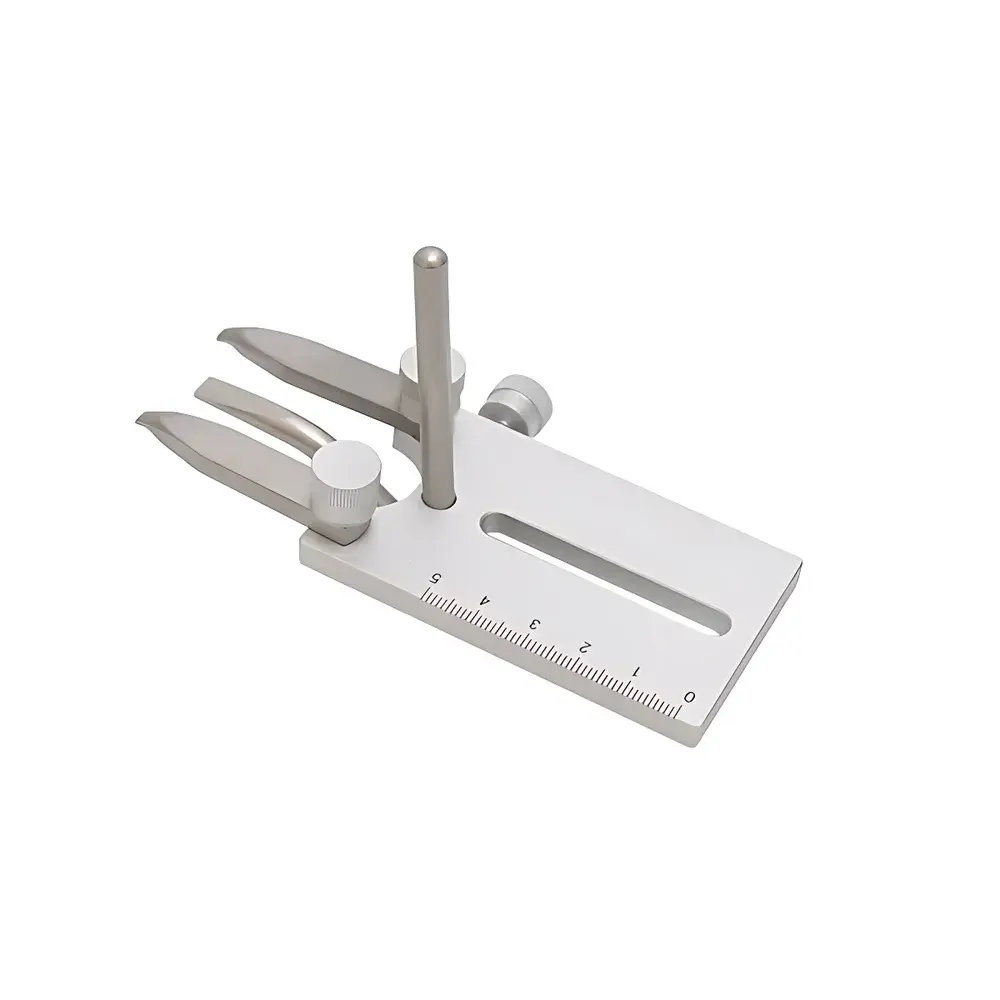
RWD 68041 Cat and Non-Human Primate Head Adapter
| Brand | RWD |
|---|---|
| Origin | Shenzhen, China |
| Manufacturer Type | OEM Manufacturer |
| Country of Origin | China |
| Model | 68041 |
| Pricing | Available Upon Request |
Overview
The RWD 68041 Cat and Non-Human Primate Head Adapter is a precision-engineered stereotactic accessory designed for secure, reproducible head fixation during neurophysiological, electrophysiological, and imaging procedures in feline and non-human primate (NHP) models. Unlike generic rodent adapters, this device accommodates the distinct craniofacial morphology of larger species—specifically cats (Felis catus) and medium-to-large NHPs such as Macaca fascicularis or Macaca mulatta—by engaging anatomically stable reference points: the orbital rims (eye sockets) and the hard palate (anterior roof of the mouth). Its mechanical interface is fully compatible with standard stereotactic frames—including RWD’s own large-animal stereotaxic systems—as well as third-party platforms adhering to industry-standard mounting geometries (e.g., 19 mm or 25 mm rail spacing, ISO 9001–certified frame compatibility). The adapter does not incorporate active components; it functions purely as a passive, rigid mechanical coupling system engineered for minimal movement under physiological loading conditions.
Key Features
- Anatomically optimized dual-point fixation: simultaneous bilateral orbital rim clamping and anterior hard palate support ensure high positional stability without compressive deformation of neural tissue or ocular structures.
- Modular design with standardized mounting interface: integrates seamlessly with RWD large-animal stereotaxic frames (e.g., Model 68030 series) and other commercially available systems conforming to common rail-based stereotactic architecture.
- Corrosion-resistant, medical-grade stainless steel construction (AISI 316L): compliant with ISO 13485 requirements for reusable surgical instrumentation; suitable for repeated sterilization via autoclaving (134 °C, 3 bar, 18 min cycle).
- Adjustable depth stop and lateral symmetry calibration: enables precise alignment of bregma–lambda coordinates relative to the stereotactic coordinate system, supporting accurate targeting in multi-session longitudinal studies.
- No integrated electronics or sensors: maintains electromagnetic compatibility (EMC) essential for concurrent use with EEG, LFP, fMRI, or optogenetic setups where RF interference must be minimized.
Sample Compatibility & Compliance
The 68041 adapter is validated for use in adult domestic cats (body weight ≥3.5 kg) and non-human primates with skull dimensions falling within defined anthropometric ranges: inter-orbital width 32–58 mm, palatal length (incisive foramen to posterior hard palate) 28–45 mm. It conforms to ISO 10993-1 (biological evaluation of medical devices) for cytotoxicity and sensitization testing. When used in GLP-compliant preclinical neuroscience studies, the adapter supports traceability through engraved model number (68041) and batch-specific laser marking. Documentation includes material certification (EN 10204 3.1), sterilization validation reports, and dimensional inspection records per ASME Y14.5–2018 geometric tolerancing standards.
Software & Data Management
As a purely mechanical adapter, the 68041 requires no dedicated software, firmware, or driver installation. Coordinate mapping and target registration are performed using established stereotactic software platforms—including Paxinos & Watson–based atlases (e.g., Stereotaxic Atlas of the Cat, NHP Brain Atlas v3.2), NeuroInfo, or open-source tools such as Brainstorm or AFNI. All physical adjustments (e.g., pitch/yaw compensation, zero-point calibration) are manually documented and archived as part of study metadata in accordance with ALF (Animal Laboratory Framework) reporting guidelines and NIH-approved IACUC protocol templates. Audit trails for device usage—including sterilization logs, calibration verification dates, and maintenance records—are maintained offline in laboratory notebooks or electronic lab management systems (ELN) compliant with 21 CFR Part 11 when required.
Applications
- Intracranial electrode implantation for chronic electrophysiology (e.g., tetrode arrays, Utah arrays) in awake-behaving NHP motor cortex studies.
- High-resolution structural and functional MRI acquisition requiring sub-millimeter head immobilization over extended scan durations (>90 min).
- Stereotactic injection of viral vectors or tracers into deep limbic structures (e.g., amygdala, hippocampus) in feline epilepsy models.
- Combined optogenetic stimulation and calcium imaging in transgenic NHPs expressing GCaMP variants.
- Validation of novel stereotactic targeting algorithms against histologically verified injection sites in post-mortem tissue analysis.
FAQ
Is the 68041 adapter compatible with small primates such as marmosets?
No. The 68041 is dimensionally optimized for cats and medium-to-large non-human primates. Marmosets require specialized micro-adapters (e.g., RWD Model 68045) due to significantly smaller orbital and palatal dimensions.
Can this adapter be sterilized using ethylene oxide (EtO)?
Yes—though autoclaving is the preferred method. EtO sterilization is acceptable if validated per ISO 11135 and supported by material compatibility testing for residual gas levels.
Does RWD provide coordinate transformation matrices for feline or NHP brain atlases?
RWD supplies reference coordinate tables aligned to Paxinos’ Cat Atlas and the Marmoset/NHP Brain Mapping Consortium standards; full transformation matrices are available upon request with institutional ethics approval documentation.
What torque specification should be applied when tightening the orbital clamps?
Maximum recommended torque is 0.35 N·m per clamp screw—exceeding this may cause plastic deformation of the stainless steel arms or tissue compression. A calibrated torque screwdriver (e.g., Wiha 27200) is advised.
Is technical support available for stereotactic surgery protocol optimization?
Yes. RWD offers application engineering consultation—including surgical workflow review, coordinate system alignment checks, and troubleshooting for motion artifact reduction—subject to signed confidentiality and collaboration agreements.



