
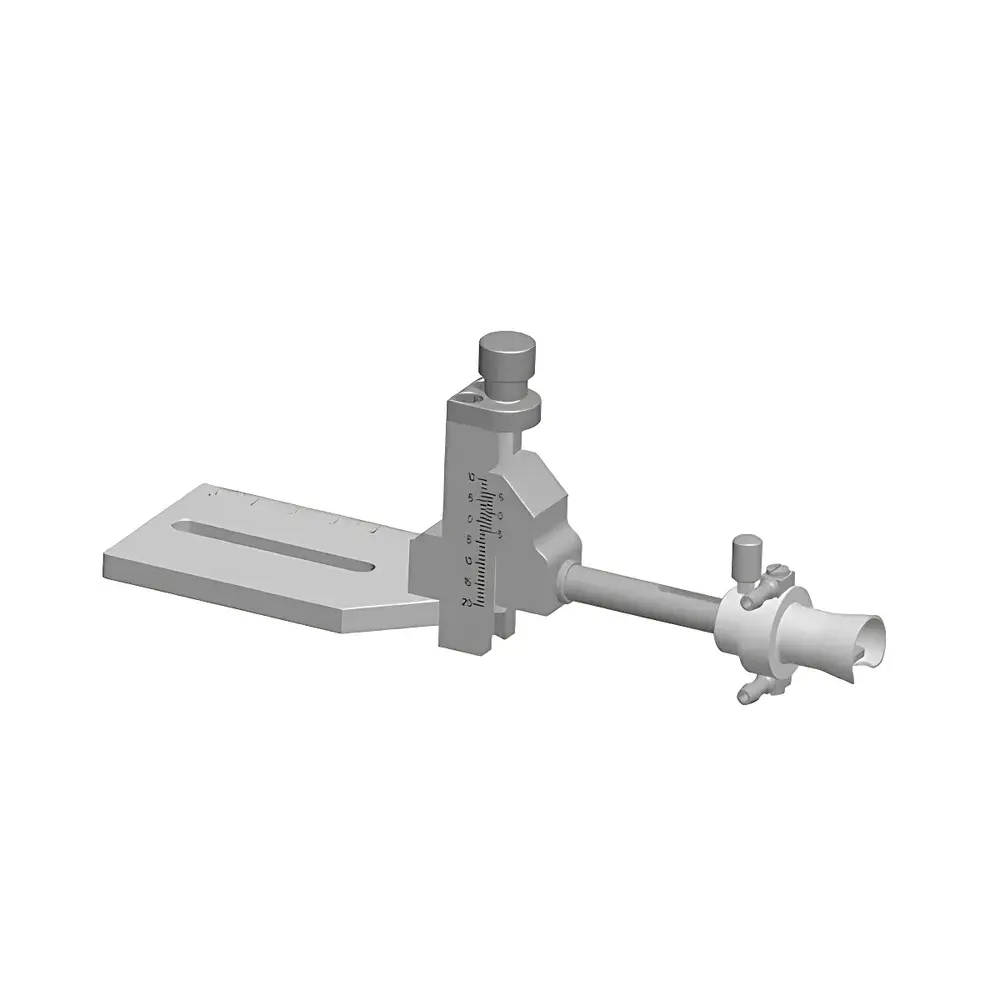
RWD 68053 Rat Anesthesia Adapter
| Brand | RWD |
|---|---|
| Origin | Guangdong, China |
| Manufacturer Type | OEM Manufacturer |
| Region | Domestic (China) |
| Model | 68053 |
| Pricing | Upon Request |
| Vertical Adjustment Range | −20 mm to +10 mm (30 mm total, 100 µm resolution) |
| Vertical Rotation | ±35° (70° total, 5° resolution) |
| Horizontal Rotation | ±35° (70° total, 5° resolution) |
| Anteroposterior Adjustment | 43.5 mm |
| Gas Inlet/Outlet Port Diameter | 2 mm |
Overview
The RWD 68053 Rat Anesthesia Adapter is a precision-engineered stereotactic accessory designed for consistent, reproducible head positioning of adult rats during inhalational anesthesia delivery in neuroscience, pharmacology, and preclinical imaging studies. It operates on a modular mechanical coupling principle—integrating with standard stereotactic frames (e.g., David Kopf or Stoelting systems) via universal mounting interfaces—while maintaining uninterrupted, laminar flow of anesthetic gases (e.g., isoflurane or sevoflurane) through a dedicated 2 mm bore pathway. Unlike fixed-position nose cones, this adapter decouples anatomical alignment from gas delivery integrity: its multi-axis adjustability ensures optimal cranial orientation for procedures such as intracranial injection, electrophysiology, or MRI-compatible sedation—without compromising gas concentration stability or inducing airway resistance.
Key Features
- Five-degree-of-freedom adjustment: independent vertical translation (−20 mm to +10 mm), anteroposterior translation (43.5 mm range), vertical rotation (±35°), horizontal rotation (±35°), and fine-tuned rotational locking at 5° increments.
- Micrometer-grade vertical positioning: 100 µm resolution via calibrated threaded actuator, enabling sub-millimeter repeatability across longitudinal experimental sessions.
- Gas-pathway integrity preservation: centrally aligned 2 mm internal-diameter inlet and outlet ports maintain consistent flow dynamics; compatible with standard vaporizer output tubing and scavenging systems.
- Tool-free, repeatable fixation: dual-locking mechanism (knurled thumbscrews + spring-loaded detent pins) secures position without slippage under vibration or thermal cycling typical in imaging suites.
- Biocompatible construction: anodized aluminum alloy frame (6061-T6) with non-reflective matte finish minimizes RF interference in MRI environments and resists autoclave-compatible disinfectants (e.g., 70% ethanol, hydrogen peroxide vapor).
Sample Compatibility & Compliance
The adapter accommodates Sprague-Dawley, Wistar, and Long-Evans rats weighing 200–500 g, with standardized nose cone interface dimensions compliant with ISO 5356-1 (anesthetic gas pathway connectors). Its mechanical design adheres to IEC 61000-6-2 (immunity to electromagnetic disturbance) and supports GLP-compliant workflows: all adjustments are manually indexed and documented in lab notebooks or electronic lab notebooks (ELNs), satisfying traceability requirements under OECD Principles of Good Laboratory Practice. While not a medical device per FDA 21 CFR Part 820, it is validated for use in AAALAC-accredited facilities and aligns with NIH Guide for the Care and Use of Laboratory Animals (8th Edition) recommendations on minimizing procedural stress during anesthesia administration.
Software & Data Management
As a purely mechanical positioning system, the RWD 68053 requires no embedded firmware, drivers, or proprietary software. All positional parameters are recorded manually or integrated into third-party acquisition platforms (e.g., Bruker ParaVision, Spike2, or MATLAB-based stereotactic scripting tools) via user-defined metadata fields. Positional settings can be saved as coordinate templates in ELNs (e.g., LabArchives or Benchling) with audit-trail support for regulatory review. No data encryption, network connectivity, or 21 CFR Part 11 compliance is applicable—consistent with its classification as a Class I laboratory accessory under ISO 13485-aligned quality management systems.
Applications
- Stereotactic surgery: precise alignment for bilateral hippocampal or striatal injections under continuous isoflurane anesthesia.
- Functional neuroimaging: stable head fixation during awake or sedated fMRI, optical coherence tomography (OCT), or two-photon microscopy.
- Electrophysiology: optimized skull angle for craniotomy placement and electrode trajectory planning in chronic recording paradigms.
- Longitudinal behavioral phenotyping: repeatable repositioning across multiple anesthetic sessions for within-subject comparison of neural activity or drug response.
- Toxicology endpoints: synchronized head orientation during inhalational exposure protocols for respiratory or CNS toxicity assessment.
FAQ
Is the RWD 68053 compatible with non-RWD anesthesia machines?
Yes—the 2 mm gas port conforms to ISO 5356-1 tubing interface standards and interfaces directly with vaporizers from Datex-Ohmeda, Draeger, and Matrx without adapters.
Can this adapter be sterilized using autoclaving?
No—autoclaving exceeds the thermal tolerance of its elastomeric seals and micrometer components. Recommended decontamination: 70% ethanol wipe-down or VHP (vaporized hydrogen peroxide) cycle at ≤60°C.
Does it support mouse-sized subjects?
Not natively—the nose cone aperture and clamping geometry are optimized for rat-scale anatomy (≥200 g); use of the RWD 68052 Mouse Anesthesia Adapter is advised for mice.
What maintenance is required?
Annual inspection of thread integrity, lubrication of rotation axes with silicone grease (Dow Corning 111), and verification of micrometer zero-point calibration using gauge blocks traceable to NIST standards.



