
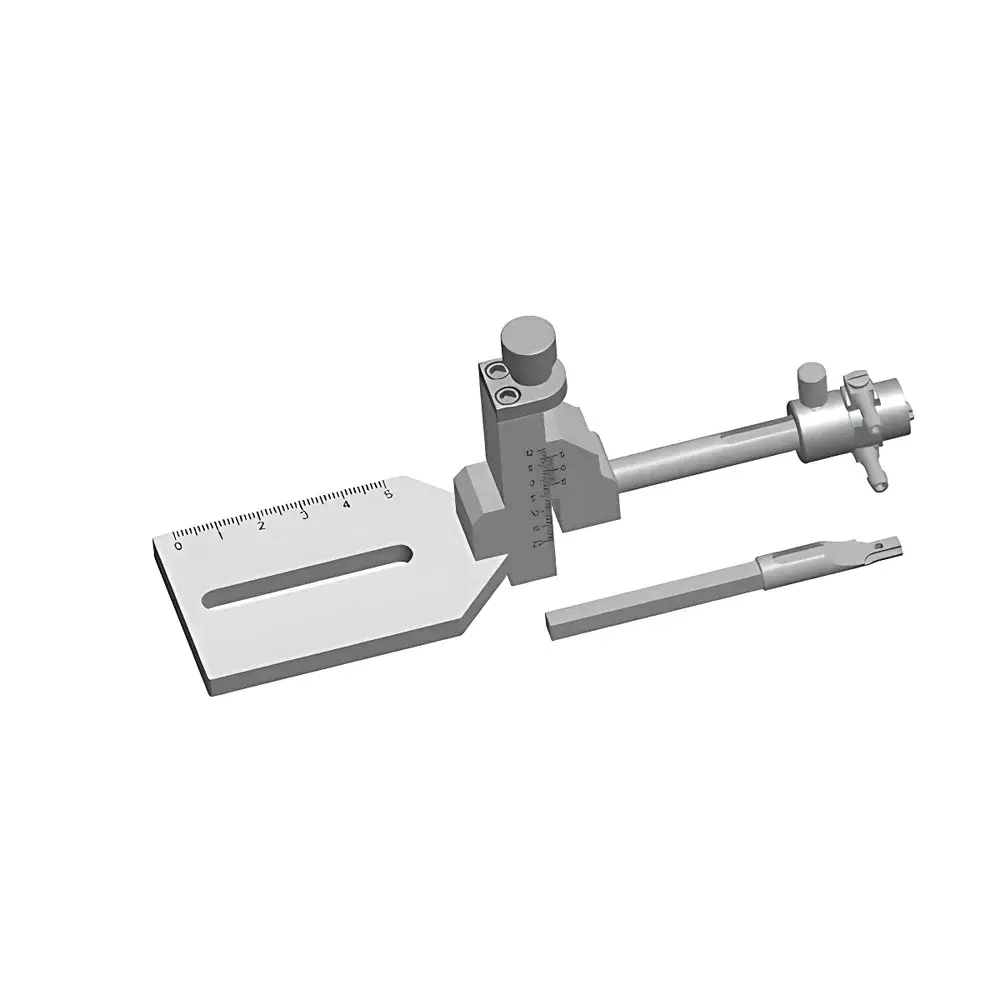
RWD 68057 Mouse Anesthesia Adapter
| Brand | RWD |
|---|---|
| Origin | Guangdong, China |
| Manufacturer Type | OEM Manufacturer |
| Region | Domestic (China) |
| Model | 68057 |
| Pricing | Upon Request |
Overview
The RWD 68057 Mouse Anesthesia Adapter is a precision-engineered stereotactic accessory designed for secure, reproducible head immobilization of mice during inhalational anesthesia and concurrent experimental procedures—including electrophysiology, optical imaging, microinjection, and functional MRI preparation. It operates on mechanical fixation principles: bilateral zygomatic clamps apply controlled, symmetrical lateral force; an adjustable incisor plate engages the maxillary incisors to stabilize the rostral skull; and a vertically actuated nasal pressure bar ensures consistent airway alignment with the anesthesia delivery nozzle. This three-point fixation architecture minimizes cranial movement without compromising respiratory patency or inducing undue tissue stress—critical for longitudinal studies requiring repeated anesthetic sessions.
Key Features
- Mechanically adjustable bilateral zygomatic clamps driven by fine-pitch stainless-steel lead screws, enabling sub-millimeter incremental spacing control for precise skull width accommodation across mouse strains (e.g., C57BL/6, BALB/c, CD-1) and age groups.
- Dual-range incisor plate translation: ±21.75 mm (total 43.5 mm) for adult mice and ±13.25 mm (total 26.5 mm) for juvenile or dwarf strains—achieved via indexed sliding rails and locking thumbscrews to prevent drift under vibration or prolonged use.
- Adapter base plate with ±20 mm linear travel (40 mm total range) along the anteroposterior axis, allowing optimal positioning relative to stereotactic frames or imaging gantries without repositioning the entire animal platform.
- Rotational tilt mechanism with calibrated scale and detent stops spanning −67.5° to +67.5° (135° total arc), facilitating standardized head angle adjustment for dorsal, ventral, or oblique surgical approaches while maintaining mechanical rigidity at all positions.
- Non-ferromagnetic construction (anodized aluminum alloy and medical-grade PEEK components) compatible with high-field MRI environments (up to 9.4 T) and electromagnetic interference-sensitive recordings.
Sample Compatibility & Compliance
The adapter accommodates mice weighing 18–35 g (adult) and 10–18 g (juvenile), with skull widths ranging from 8.2 mm to 11.6 mm. All contact surfaces feature rounded edges and low-friction polymer coatings to prevent pressure necrosis or dental wear during extended immobilization (≤4 h per session). The device complies with ISO 10993-5 (cytotoxicity) and ISO 10993-10 (irritation/sensitization) for biocompatibility of materials in direct contact with mucosal tissue. It supports adherence to AAALAC International accreditation requirements for humane restraint and is routinely validated in GLP-compliant preclinical pharmacology studies under IACUC-approved protocols.
Software & Data Management
As a purely mechanical interface, the RWD 68057 requires no embedded electronics, firmware, or software drivers. Its operation is independent of digital control systems, eliminating compatibility constraints with third-party anesthesia machines (e.g., VetEquip, Kent Scientific, Euthanex) or stereotactic platforms (e.g., David Kopf, Stoelting, Neurostar). All adjustments are manually recorded in lab notebooks or integrated into electronic lab notebooks (ELN) such as LabArchives or Benchling using standardized SOP templates. Audit trails for positional settings (e.g., clamp spacing = 9.4 mm, incisor plate offset = +12.3 mm, tilt = +15°) are maintained per FDA 21 CFR Part 11–aligned documentation practices when used in regulated toxicology or PK/PD studies.
Applications
- Intracranial stereotactic surgery: precise targeting of hippocampal, cortical, or thalamic regions for electrode implantation or viral vector delivery.
- In vivo two-photon calcium imaging: stable head fixation minimizing motion artifacts during awake or anesthetized recording sessions.
- Functional ultrasound (fUS) or laser speckle contrast imaging (LSCI): consistent head orientation enables repeatable vascular mapping across timepoints.
- Optogenetic stimulation protocols requiring synchronized light delivery and electrophysiological readout.
- Anesthesia dose-response characterization where tidal volume, respiratory rate, and end-tidal isoflurane concentration must be monitored without head movement interference.
FAQ
Is this adapter compatible with rats?
No—the 68057 is dimensionally optimized for mice only. RWD offers separate models (e.g., 68058) for rat-sized crania.
Can the nasal pressure bar be removed for non-anesthetic procedures?
Yes—the bar is modular and detachable via two M3 hex screws, allowing conversion to a passive head-holder configuration for awake-behavioral assays.
Does the adapter include a gas scavenging port?
No—it is not equipped with integrated waste-gas evacuation; users must connect external scavenging tubing to their anesthesia machine’s exhaust outlet.
What maintenance is required?
Wipe clean with 70% ethanol after each use; inspect lead screws and locking mechanisms monthly for particulate accumulation or thread wear.
Is calibration certification provided?
Mechanical calibration certificates are available upon request (ISO/IEC 17025-accredited third-party verification optional at additional cost).




