
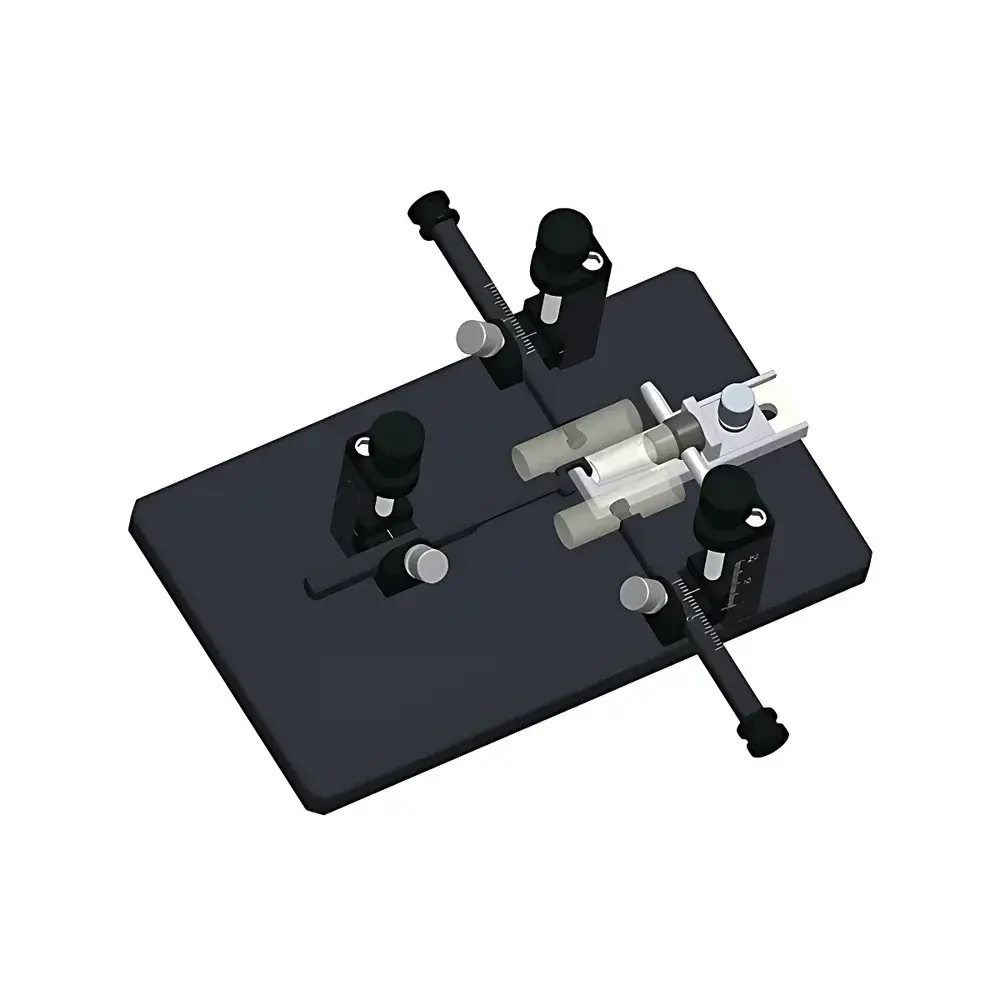
RWD 68072 Neonatal and Juvenile Mouse Anesthesia Adapter for Stereotactic Surgery
| Brand | RWD |
|---|---|
| Origin | Shenzhen, China |
| Manufacturer Type | OEM Manufacturer |
| Country of Origin | China |
| Model | 68072 |
| Pricing | Available Upon Request |
Overview
The RWD 68072 Neonatal and Juvenile Mouse Anesthesia Adapter is an engineered accessory designed specifically to support precise, physiologically stable gas anesthesia delivery and secure head fixation during stereotactic neurosurgical procedures in neonatal (P0–P10) and juvenile (P11–P21) mice. Unlike standard adult rodent anesthesia masks or nose cones, this adapter integrates a low-dead-volume, temperature- and humidity-controlled inhalation interface with a rigid, adjustable stereotactic mounting platform. It operates on the principle of continuous-flow isoflurane or sevoflurane delivery via calibrated vaporizer output, maintaining consistent anesthetic depth while minimizing respiratory resistance and thermal stress—critical factors influencing cerebral blood flow, neural activity, and experimental reproducibility in developing murine models.
Key Features
- Modular stereotactic compatibility: Direct integration with standard small-animal stereotaxic frames (e.g., David Kopf, Stoelting, and RWD-branded systems) via universal 1/4″-20 threaded base plate.
- Age-specific airway geometry: Precision-machined nasal interface accommodates pups as small as P0 (1.5–2.0 g) through juveniles up to ~12 g, with tapered silicone nozzles to ensure leak-free seal without airway compression.
- Integrated thermoregulation: Built-in heating element (controlled via external proportional controller) maintains nasopharyngeal temperature within ±0.3°C of normothermic setpoint (36.5–37.5°C), mitigating hypothermia-induced neuronal depression.
- Low-resistance gas pathway: Total internal dead volume < 0.8 mL; pressure drop < 0.5 cm H₂O at 0.5 L/min O₂ flow—validated per ISO 80601-2-13 for pediatric anesthesia devices.
- Autoclavable and chemically resistant construction: Medical-grade PEEK housing and platinum-cured silicone seals withstand repeated sterilization (134°C, 3 bar) and exposure to isoflurane, ethanol, and hydrogen peroxide vapor.
Sample Compatibility & Compliance
The 68072 adapter supports longitudinal studies involving transgenic, knockout, and humanized neonatal mouse models used in developmental neuroscience, epilepsy modeling, and early-life intervention research. It complies with IACUC-recommended endpoints for neonatal anesthesia duration (up to 120 min under monitored conditions) and aligns with NIH Guide for Care and Use of Laboratory Animals Section IV.C.3 on pediatric rodent anesthesia. Device design adheres to ASTM F2982-13 (Standard Practice for Small Animal Anesthesia Equipment) and incorporates fail-safes consistent with GLP-compliant surgical workflows—including visual flow indicator and redundant O₂ concentration monitoring ports.
Software & Data Management
While the 68072 is a hardware-only mechanical adapter, it is fully compatible with RWD’s integrated digital anesthesia control platforms (e.g., RWD 68070 Anesthesia Delivery System), enabling synchronized logging of delivered anesthetic concentration (% ISO), fresh gas flow (L/min), and core body temperature (via optional rectal probe input). All parameters are timestamped and exportable in CSV or HDF5 format for audit trails required under FDA 21 CFR Part 11–compliant environments. No proprietary software installation is required for standalone use; analog outputs (0–5 V) allow integration with third-party acquisition systems (e.g., Spike2, LabChart, or custom Python-based DAQ).
Applications
- Intracranial injection of AAV vectors or CRISPR-Cas9 components in postnatal day 1–7 mice for circuit-specific gene editing.
- Chronic electrode implantation for in vivo electrophysiology (tetrode, silicon probe) in P14–P21 animals undergoing sensory cortex mapping.
- Two-photon calcium imaging through thinned-skull or cranial window preparations under stable isoflurane maintenance.
- Functional MRI (fMRI) and diffusion tensor imaging (DTI) in unanesthetized vs. lightly anesthetized neonatal cohorts—enabling direct comparison of baseline neurovascular coupling.
- Pharmacokinetic/pharmacodynamic (PK/PD) studies assessing blood–brain barrier permeability in developing CNS following systemic drug administration.
FAQ
Is the 68072 compatible with non-RWD stereotaxic frames?
Yes—its base plate conforms to ANSI/ISO 10360-5 mounting standards and includes M6 and 1/4″-20 threaded inserts for universal adaptability.
Can this adapter be used for rats or larger rodents?
No—it is dimensionally optimized for mice ≤12 g. For rat applications, refer to RWD model 68073 (Juvenile Rat Adapter).
Does the device include a vaporizer or gas mixing unit?
No—the 68072 is a passive delivery interface only. Users must supply a calibrated precision vaporizer and medical-grade O₂/N₂O source.
What cleaning protocols are validated for reuse?
Autoclaving (134°C, 3 bar, 18 min), 70% ethanol immersion (10 min), or hydrogen peroxide vapor (HPV) sterilization—full validation data available upon request.
Is technical support available for IACUC protocol development?
Yes—RWD provides application notes, SOP templates, and collaborative consultation for institutional animal care and use committee submissions.



