RWD 68202 Universal Clamp
| Brand | RWD |
|---|---|
| Origin | Shenzhen, China |
| Manufacturer Type | OEM Manufacturer |
| Regional Classification | Domestic (China) |
| Model | 68202 |
| Pricing | Available Upon Request |
Overview
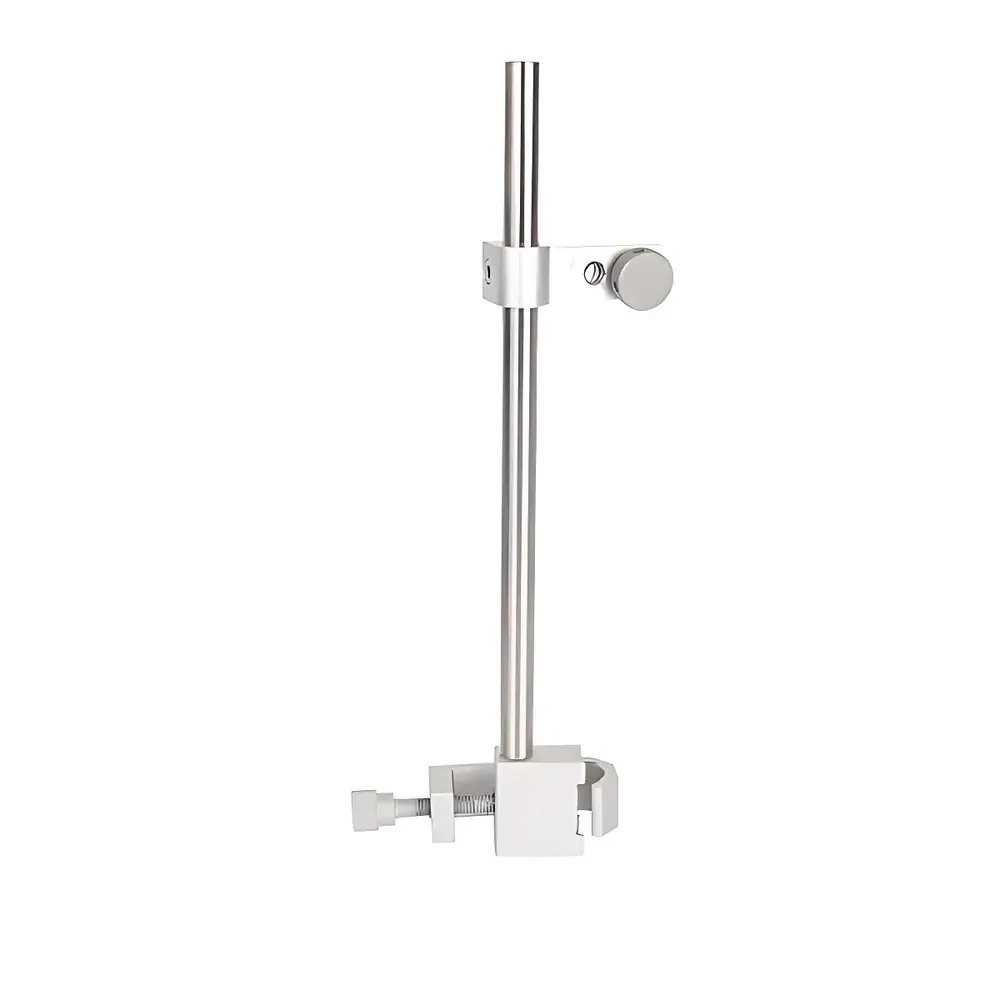
The RWD 68202 Universal Clamp is a precision-engineered mechanical mounting accessory designed for stable, repeatable lateral fixation of cylindrical laboratory and neurosurgical instruments in stereotactic and electrophysiology workstations. It operates on a simple yet robust mechanical clamping principle—utilizing dual opposing jaws with integrated V-groove geometry to generate uniform radial compressive force around the circumference of the mounted object. This design eliminates torsional stress and axial slippage, ensuring positional integrity during micro-manipulation, chronic implantation procedures, or long-duration recording sessions. Unlike spring-loaded or friction-based holders, the 68202 employs a manually tightened knurled knob that drives a threaded actuator, enabling fine-tuned torque control and consistent clamping pressure across repeated use cycles. Its application scope spans preclinical neuroscience, in vivo electrophysiology, and microinjection workflows where instrument alignment stability directly impacts experimental reproducibility.
Key Features
- V-groove jaw geometry engineered for uniform load distribution across diameters from 6 mm to 12 mm—compatible with standard 10–50 µL glass syringes, stainless-steel macro/microelectrodes (e.g., tungsten, platinum-iridium), and ergonomic cranial drill handpieces.
- Lateral (side-mount) configuration allows direct integration into RWD stereotaxic frames (e.g., Model 68000 series) and third-party manipulators via standardized 1/4″-20 UNC or M6 threaded base plates.
- Corrosion-resistant anodized aluminum housing with stainless-steel internal components ensures compatibility with ethanol, isopropanol, and mild disinfectants used in clean-room and vivarium environments.
- No-tool adjustment: single-knob operation provides tactile feedback and repeatable positioning without requiring Allen keys or torque wrenches—critical for rapid setup changes between animal subjects or experimental conditions.
- Zero-backlash mechanism maintains clamping force over extended periods (>72 h), validated under static load testing at 5 N axial pull force.
Sample Compatibility & Compliance
The 68202 accommodates a defined range of cylindrical tools with outer diameters between 6.0 mm and 12.0 mm, including but not limited to Hamilton 10–50 µL syringes (glass or polypropylene barrels), NeuroNexus silicon probes with integrated handle shanks, and RWD Model 69210 handheld cranial drills. It is not intended for use with non-cylindrical, tapered, or irregularly profiled instruments. While the clamp itself carries no regulatory certification (e.g., ISO 13485 or FDA 510(k)), its materials and construction comply with ISO 10993-5 (cytotoxicity) and RoHS Directive 2011/65/EU for restricted substances. When deployed within GLP-compliant preclinical studies, the device supports traceable instrument positioning per OECD Series 122 guidance on good laboratory practice for in vivo neurophysiology assays.
Software & Data Management
The RWD 68202 Universal Clamp is a purely mechanical hardware component and does not incorporate embedded electronics, sensors, or firmware. As such, it requires no software drivers, calibration routines, or data logging interfaces. Its operational parameters—clamping diameter, orientation angle, and mounting position—are recorded manually in lab notebooks or integrated into electronic lab notebook (ELN) systems (e.g., LabArchives, Benchling) as part of experimental metadata. For users operating within 21 CFR Part 11–regulated environments, the absence of digital controls simplifies audit trail requirements; physical setup configurations may be documented with timestamped photographs and signed verification logs.
Applications
- Intracerebral microinjection: secure fixation of syringe needles during stereotactic delivery of viral vectors, tracers, or pharmacological agents into rodent brain regions (e.g., hippocampus, striatum).
- Chronic electrode implantation: stabilization of high-impedance microwire arrays or silicon probes during craniotomy and dura penetration, minimizing tissue displacement artifacts.
- Behavioral neuroscience rigs: mounting of optogenetic fiber-optic cannulas or thermocouple probes in head-fixed paradigms requiring sub-millimeter spatial repeatability across multiple sessions.
- Ex vivo slice electrophysiology: lateral support for suction electrodes or stimulation pipettes in submerged or interface-style recording chambers.
- Training platforms: modular tool-holding solution for teaching stereotactic surgery fundamentals in academic veterinary and biomedical engineering curricula.
FAQ
Is the RWD 68202 compatible with non-RWD stereotaxic frames?
Yes—it features a universal 1/4″-20 UNC threaded base mount, allowing mechanical integration with David Kopf, Stoelting, and other major-brand stereotaxic systems using standard adapter plates.
Can it hold tapered instruments such as sharpened microelectrodes?
No—the V-groove geometry requires consistent outer diameter along the clamped segment; tapered or conical profiles are outside the specified 6–12 mm tolerance band and may result in uneven contact or slippage.
What is the maximum recommended clamping torque?
The knurled knob should be tightened to finger-tight plus one-quarter turn with moderate hand pressure; overtightening beyond this point risks deformation of soft polymer syringe barrels or misalignment of precision-ground electrode shanks.
Does RWD provide calibration certificates or metrology documentation?
No—this is a passive mechanical fixture without dimensional or force-measurement functionality; users requiring traceable dimensional verification may perform in-house validation using calibrated calipers per ISO/IEC 17025 guidelines.