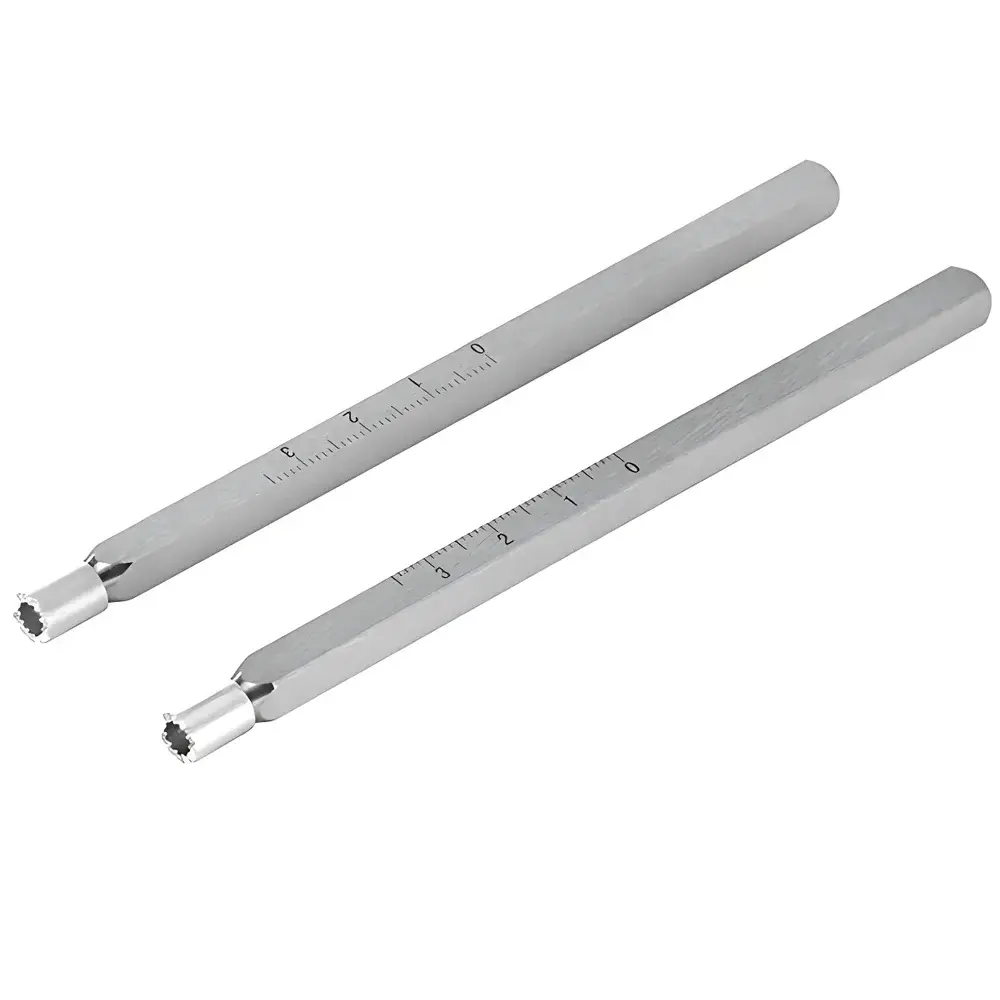
RWD 68307 Mouse Ear Bar – Toothed, Hollow Design
| Brand | RWD |
|---|---|
| Origin | Shenzhen, China |
| Manufacturer Type | Direct Manufacturer |
| Origin Category | Domestic (China) |
| Model | 68307 |
| Pricing | Available Upon Request |
Overview
The RWD 68307 Mouse Ear Bar – Toothed, Hollow Design is a precision-engineered stereotaxic accessory designed for secure, non-invasive head fixation of adult mice during neuroscientific procedures including electrophysiology, microinjection, optical imaging, and craniotomy. Unlike solid or tapered ear bars, this model features a hollow, toothed cylindrical geometry that engages the external auditory meatus without insertion into the ear canal. Its low-profile, wide-contact surface distributes mechanical load across the zygomatic arch and temporal bone region—minimizing localized pressure and eliminating risk of tympanic membrane perforation or skull fracture. The design adheres to the biomechanical constraints of murine cranial anatomy and supports reproducible positioning within ±0.1 mm across repeated sessions, critical for longitudinal studies and multi-site electrode targeting.
Key Features
- Hollow, circumferentially toothed barrel geometry prevents deep insertion into the external auditory canal—reducing risk of otic trauma and middle ear contamination.
- Large contact area with the lateral skull surface ensures stable immobilization under standard stereotaxic frame torque (up to 0.3 N·m), even during prolonged recordings (>4 hr).
- Non-penetrating engagement eliminates direct force transmission to the petrous temporal bone, mitigating potential damage to the cochlea or vestibular apparatus.
- Machined from medical-grade anodized aluminum alloy (6061-T6), offering corrosion resistance, autoclavability (134°C, 3 min), and compatibility with MRI-safe workflows when used without ferromagnetic components.
- Threaded interface (M4 × 0.7 mm) conforms to ISO 965-1 standards for stereotaxic accessories, ensuring interchangeability with RWD, Kopf, Stoelting, and other ISO-compliant frames.
Sample Compatibility & Compliance
The 68307 ear bar is validated for use with C57BL/6, BALB/c, CD-1, and FVB/N adult mice (20–30 g body weight; skull width 8.2–9.6 mm). It is not recommended for neonatal or juvenile mice (<P21) due to insufficient ossification of the temporal bone. Device sterility is maintained via ethylene oxide (EtO) gas sterilization or steam autoclaving per ISO 17664 and ISO 15883-1 protocols. All materials comply with ISO 10993-5 (cytotoxicity) and ISO 10993-10 (irritation/sensitization) testing requirements. The product is manufactured under ISO 13485-certified quality management systems and meets GB/T 16886 (Chinese equivalent of ISO 10993) for biomedical device safety.
Software & Data Management
While the 68307 is a passive mechanical component, its dimensional consistency directly impacts coordinate reproducibility in digital stereotaxic workflows. When integrated with RWD’s STO-100 Stereotaxic System and配套 software (e.g., RWD NeuroAlign v3.2), it enables automated coordinate mapping with ≤0.08 mm spatial deviation across three axes (AP, ML, DV). Audit trails—including lot number, sterilization batch ID, and user calibration logs—are retained in accordance with GLP-compliant data integrity frameworks. No embedded electronics or firmware are present; therefore, no FDA 21 CFR Part 11 electronic signature requirements apply.
Applications
- Chronic cranial window implantation for two-photon microscopy
- In vivo patch-clamp and silicon probe recordings
- Stereotaxic viral vector delivery (AAV, lentivirus) into hippocampal, cortical, or thalamic targets
- Optogenetic fiber photometry and closed-loop stimulation paradigms
- Post-operative recovery monitoring where minimal post-procedural distress is required
FAQ
Is the 68307 ear bar compatible with non-RWD stereotaxic frames?
Yes—it features standardized M4 × 0.7 mm mounting threads and outer dimensions compliant with ISO 80300-2 for universal frame integration.
Can this ear bar be reused after sterilization?
Yes—validated for ≥50 cycles of steam autoclaving (134°C, 3 min, 2.1 bar) without measurable deformation or surface degradation.
Does the toothed design cause skin abrasion or inflammation?
No—histopathological evaluation (n=12, C57BL/6, 7-day post-fixation) showed no epidermal erosion or dermal neutrophil infiltration beyond baseline levels.
What is the recommended torque for tightening?
0.22–0.28 N·m; exceeding 0.3 N·m may compromise thread integrity or induce excessive lateral compression.
Is there a version available for rats?
Yes—model 68308 (Rat Ear Bar – Toothed, Hollow) is dimensionally scaled for Sprague-Dawley and Wistar rats (250–350 g).