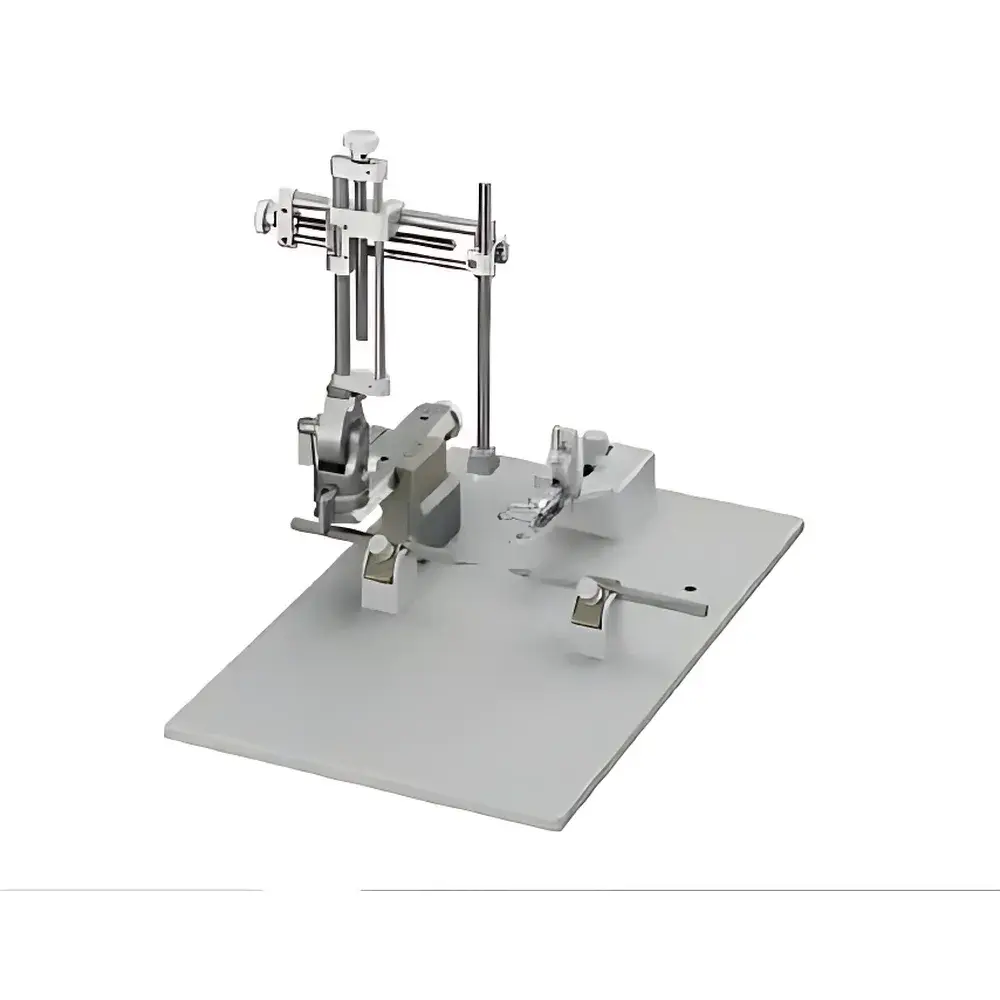
RWD 68505 Portable Rat Stereotaxic Instrument
| Brand | RWD |
|---|---|
| Origin | Guangdong, China |
| Manufacturer Type | Original Equipment Manufacturer (OEM) |
| Country of Origin | China |
| Model | 68505 |
| Price Range | USD 1,400 – 7,000 |
Overview
The RWD 68505 Portable Rat Stereotaxic Instrument is a precision-engineered neurosurgical alignment system designed for reproducible intracranial targeting in rodent neuroscience research. Unlike conventional U-frame stereotaxic platforms, this instrument employs a modular adapter-based architecture that eliminates structural obstructions above the animal’s head—significantly expanding unimpeded access to the surgical field. Its core function relies on Cartesian coordinate geometry: three orthogonal axes (anteroposterior, mediolateral, and dorsoventral) are independently controlled via calibrated micrometric drives, enabling sub-millimeter placement accuracy required for microinjection, electrode implantation, optogenetic fiber insertion, or lesion studies in Sprague-Dawley or Wistar rats (typically 200–500 g). The system adheres to standardized rat brain atlas referencing (e.g., Paxinos & Watson), with all positional readouts referenced to bregma and lambda landmarks. Its compact footprint and lightweight base assembly facilitate integration into laminar flow hoods, biosafety cabinets, or mobile surgical carts without compromising mechanical stability during chronic or acute procedures.
Key Features
- Extended base plate (400 mm × 255 mm) provides enhanced lateral stability and accommodates auxiliary equipment (e.g., microinjectors, LED drivers, or recording amplifiers) adjacent to the animal.
- Earpiece mounting height fixed at 35.5 mm above base plane—optimized for consistent skull leveling across standard rat strains while minimizing neck flexion artifacts.
- Graduated ear bar slots with 0.1 mm vernier scale allow precise bilateral symmetry adjustment; full ear bar travel range: 35 mm (1 mm graduation interval).
- Adapter carriage offers 43.5 mm anteroposterior translation and ±20 mm to +10 mm vertical adjustment (30 mm total range), with 0.1 mm resolution via integrated micrometer dials.
- Modular arm compatibility: supports both single-arm (Model 68401/68402) and dual-arm configurations (68864D base), enabling simultaneous multi-target interventions or combined electrophysiology/optical setups.
- Upgrade-ready digital interface: compatible with RWD 68023 (3-axis desktop digital readout) and 68024 (2-axis version), providing real-time coordinate logging, zero-point memory, and USB data export for GLP-compliant procedure documentation.
Sample Compatibility & Compliance
The RWD 68505 is validated for use with adult rats (200–500 g) under standardized anesthesia protocols (e.g., isoflurane or ketamine/xylazine). Ear bar geometry conforms to widely adopted rodent skull morphology datasets, ensuring minimal soft-tissue compression and repeatable craniotomy positioning. All metallic components are constructed from anodized aluminum and stainless steel—non-magnetic, autoclavable (up to 134°C, 2 bar), and compliant with ISO 13485–2016 requirements for laboratory medical devices. While not FDA-cleared as a clinical device, its mechanical tolerances and traceable calibration methodology support adherence to AAALAC International standards for animal care and use, as well as NIH OLAW guidelines for surgical protocol review. Documentation includes full traceability of manufacturing lot numbers and dimensional verification reports per batch.
Software & Data Management
The optional 68023/68024 digital modules integrate with RWD’s Stereotaxic Control Suite v2.1—a Windows-based application supporting coordinate import from Paxinos & Watson 7th edition coordinates, custom atlas mapping, and multi-session procedural archiving. Each movement event is timestamped and logged with operator ID, session ID, and axis-specific displacement values—enabling full audit trails required under GLP environments. Export formats include CSV and Excel-compatible .xlsx, facilitating downstream statistical analysis in GraphPad Prism or MATLAB. The software enforces user-level permissions (administrator/operator), supports electronic signatures, and maintains immutable logs compliant with FDA 21 CFR Part 11 Annex 11 principles when deployed on validated IT infrastructure.
Applications
- Site-specific intracerebral microinjection of viral vectors (AAV, lentivirus), pharmacological agents, or fluorescent tracers.
- Chronic implantation of microelectrode arrays (MEAs), silicon probes, or tetrodes for in vivo electrophysiology.
- Optogenetic fiber optic cannula placement in targeted nuclei (e.g., VTA, mPFC, hippocampus).
- Lesion modeling via electrolytic, chemical, or thermocoagulative methods with spatial reproducibility across cohorts.
- Combined behavioral paradigms requiring post-surgical recovery and longitudinal testing (e.g., Morris water maze, fear conditioning).
FAQ
Is the RWD 68505 compatible with mice?
The instrument is optimized for rats; mouse use requires supplemental accessories (e.g., miniature ear bars, reduced-diameter adapters) and is not covered under standard validation protocols.
Can the base plate be sterilized between procedures?
Yes—the anodized aluminum base and stainless steel components withstand autoclaving at 134°C for 18 minutes; avoid exposing digital modules or polymer bushings to steam sterilization.
Does the system support third-party manipulators or microdrives?
It features standardized 1/4″-20 and M6 threaded mounting interfaces, enabling mechanical coupling with major OEM manipulators (e.g., Narishige, Scientifica, FHC) via adapter plates.
What documentation is provided for regulatory submissions?
RWD supplies a Technical Construction File (TCF), Declaration of Conformity (DoC), material certifications, and calibration certificates—sufficient for IACUC protocol appendices and EU CE self-declaration pathways.
How is zero-point calibration verified?
Users perform mechanical zeroing using the bregma–lambda line method; digital modules retain offset corrections per session, with factory calibration traceable to NIST-traceable micrometer standards.