
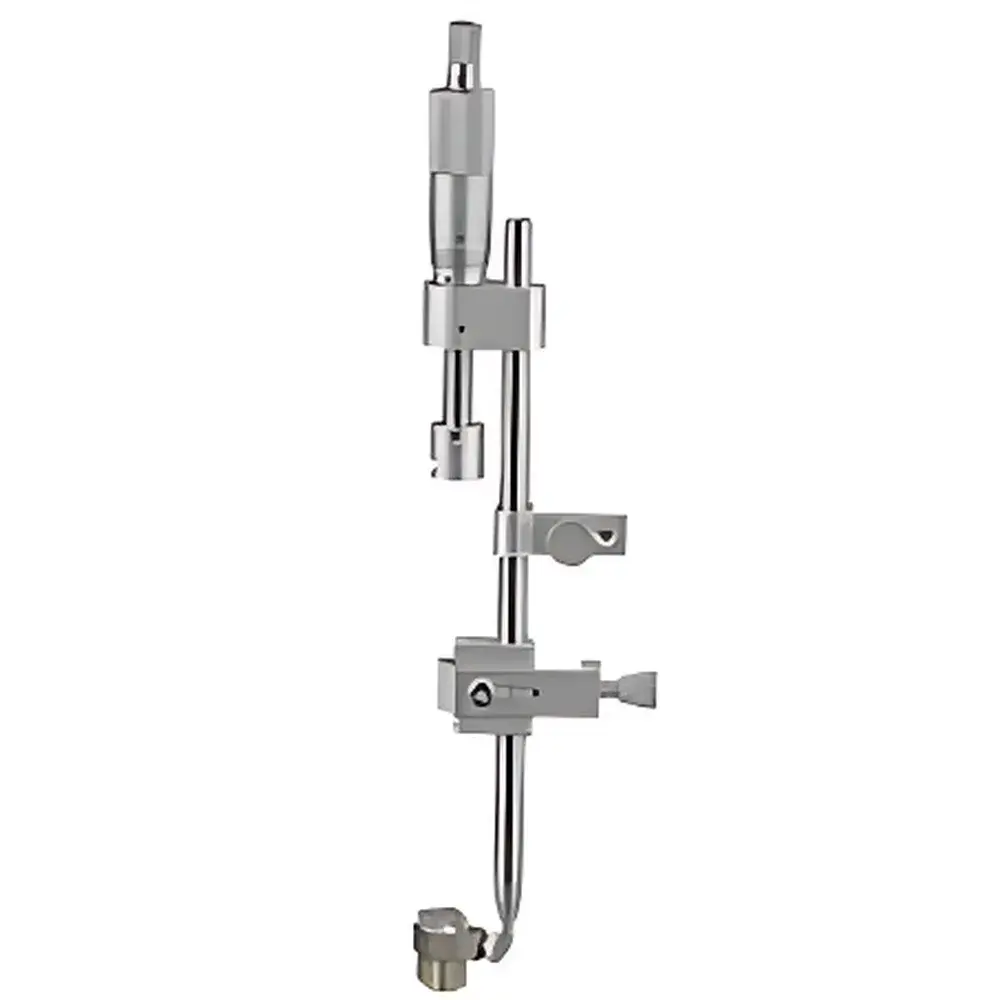
RWD 68606 Manual Microsyringe Pump for Stereotaxic Instrumentation
| Brand | RWD |
|---|---|
| Origin | Guangdong, China |
| Manufacturer Type | Direct Manufacturer |
| Region of Origin | Domestic (China) |
| Model | 68606 |
| Pricing | Upon Request |
| Syringe Compatibility | 1–1000 µL |
| Displacement Resolution | 10 µm |
| Maximum Stroke | 25 mm |
| Clamp Compatibility | Integrates with RWD stereotaxic frames via V-type coupler (e.g., 68207), supports concurrent syringe barrel (6–12 mm Ø) and needle (0.3–1.5 mm Ø) fixation |
Overview
The RWD 68606 Manual Microsyringe Pump is an engineered precision actuation module designed exclusively for integration with stereotaxic instrumentation in preclinical neuroscience research. It operates on a calibrated mechanical lead-screw principle, translating manual rotation into linear displacement of the syringe plunger with deterministic repeatability. Unlike motorized or pressure-driven systems, this pump delivers full tactile control over injection velocity and direction—critical for slow-rate infusions (e.g., viral vector delivery, pharmacological microinjection) where real-time adjustment prevents tissue backflow, reflux, or pressure-induced damage to delicate neural structures. Its modular design ensures seamless mechanical coupling to RWD stereotaxic frames (e.g., 68207 V-coupler interface), enabling synchronized depth control alongside manipulator arm positioning. The device is not standalone; it functions as a calibrated actuator within a closed-loop stereotaxic workflow—where coordinate accuracy, injection consistency, and procedural reproducibility are governed by ISO/IEC 17025-aligned laboratory practices.
Key Features
- Manual lead-screw mechanism with 10 µm per-step resolution, enabling precise volumetric control across 1–1000 µL syringes without electronic dependency or power supply requirements.
- Dual-clamp architecture: Simultaneous stabilization of syringe barrel (6–12 mm diameter) and needle shaft (0.3–1.5 mm diameter), minimizing lateral deflection during injection and ensuring coaxial alignment with the stereotaxic trajectory.
- 25 mm maximum stroke length—sufficient for full-volume delivery from standard glass or plastic microsyringes while maintaining mechanical rigidity and backlash-free motion.
- Tool-free compatibility with RWD’s ecosystem of stereotaxic accessories: integrates directly with 68218 syringe clamp, 68202/68206 universal clamps, and 68605/68228 drill holders via standardized 8 mm vertical rod mounting.
- Machined aluminum housing with anodized finish—optimized for cleanroom-compatible disinfection protocols and long-term dimensional stability under repeated thermal cycling in vivarium environments.
Sample Compatibility & Compliance
The 68606 pump accommodates industry-standard Luer-lock and cemented-glass microsyringes (e.g., Hamilton 7000 series, NanoFil, World Precision Instruments Nanoject). Its mechanical interface conforms to ASTM F2694-21 guidelines for stereotaxic device interoperability. While not FDA-cleared as a medical device, its design adheres to GLP-relevant engineering controls: traceable calibration documentation, non-migrating fasteners, and absence of lubricants in contact zones. All RWD stereotaxic components—including the 68397 cranial leveling calibrator referencing Paxinos & Watson (5th ed.) bregma–lambda geometry—are validated against NIST-traceable depth gauges and used routinely in studies compliant with NIH Guide for Care and Use of Laboratory Animals and EU Directive 2010/63/EU.
Software & Data Management
As a manually operated, analog actuation system, the 68606 does not incorporate embedded firmware, wireless connectivity, or digital logging. This intentional design eliminates electromagnetic interference with electrophysiological recordings (e.g., single-unit or LFP acquisition) and avoids regulatory classification under FDA 21 CFR Part 11 or IEC 62304. Experimental parameters—including syringe type, target volume, injection rate (calculated from rotation count × step resolution), and dwell time—are documented externally in ELN systems (e.g., LabArchives, Benchling) or paper-based SOPs aligned with AAALAC-accredited facility requirements. Calibration certificates and mechanical tolerance reports are provided upon request for audit readiness.
Applications
- Stereotaxic intracerebral injection of AAV, lentivirus, or CRISPR-Cas9 constructs into defined nuclei (e.g., hippocampus CA1, ventral tegmental area) with minimal tissue displacement.
- Controlled microinfusion of neuroactive compounds (e.g., muscimol, bicuculline, optogenetic actuators) during awake-behaving electrophysiology or fiber photometry experiments.
- Co-registration of injection sites with histological verification: consistent plunger displacement enables post-hoc reconstruction of infusion spread using dye co-injection and serial sectioning.
- Combined use with RWD 68605/68228 drill holders for sequential craniotomy and injection within a single surgical session—reducing inter-session variability in longitudinal studies.
- Training platform for stereotaxic technique standardization across laboratory personnel, where tactile feedback reinforces understanding of injection dynamics and tissue resistance thresholds.
FAQ
Is the 68606 compatible with non-RWD stereotaxic frames?
Yes—when paired with an 8 mm diameter vertical support rod and appropriate adapter (e.g., custom-machined V-coupler), though optimal performance and alignment are guaranteed only within the RWD ecosystem.
Can it be used for retrograde or anterograde tracer injections?
Yes—its stable needle fixation and fine-resolution displacement support slow, pressure-controlled delivery of tracers such as Fluoro-Gold, CTB, or AAV-retro at rates ≤50 nL/min.
Does it support automated or programmable injection sequences?
No—it is strictly manual. For programmable workflows, RWD offers the 68607 motorized pump variant, which interfaces with third-party timing controllers.
What maintenance is required?
Annual inspection of lead-screw backlash and clamp jaw wear; cleaning with 70% ethanol or isopropanol; no lubrication required.
Is calibration data provided with each unit?
Yes—a certificate of mechanical conformity, including step-size verification at three load points (0.1 N, 1 N, 5 N), is included in the shipment documentation.






