
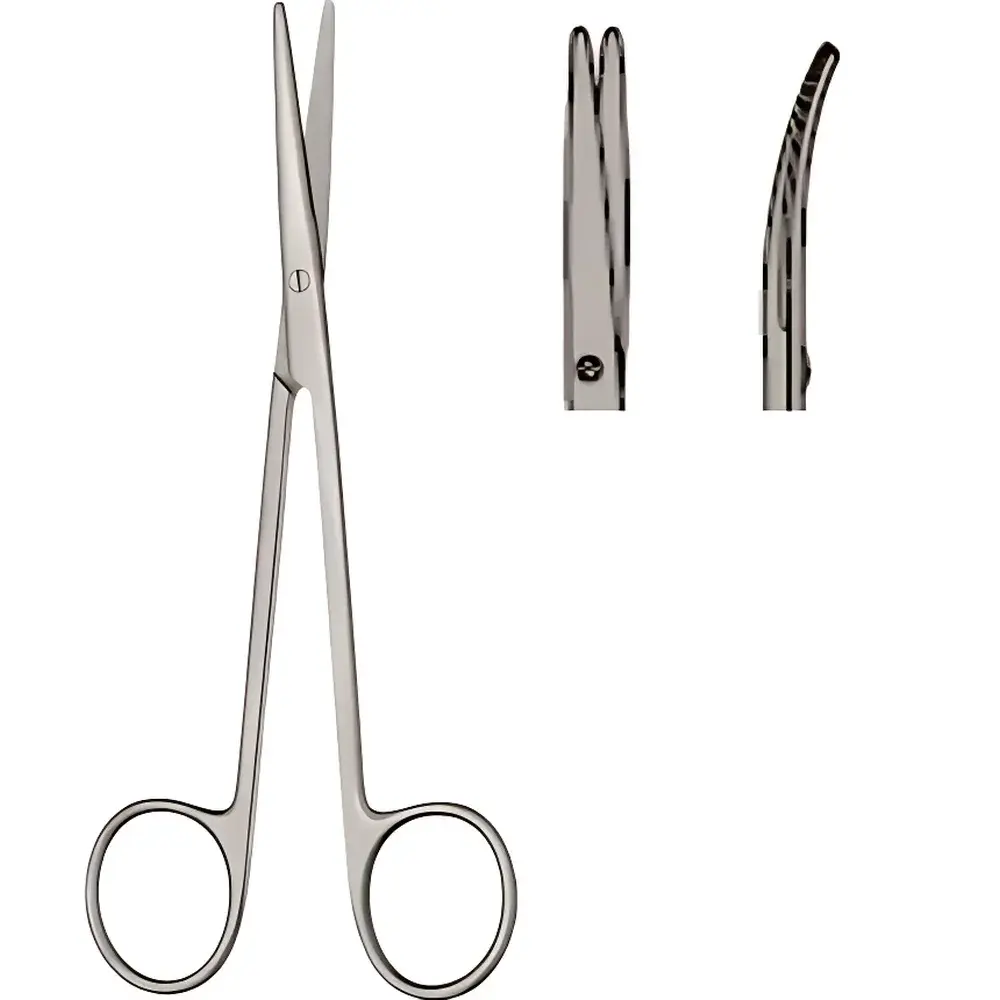
RWD BABY-METZENBAUM Curved-Blade Blunt-Tip Dissection Scissors S13041-14
| Brand | RWD |
|---|---|
| Origin | Shenzhen, China |
| Manufacturer Type | Direct Manufacturer |
| Country of Origin | China |
| Model | S13041-14 |
| Price | Upon Request |
Overview
The RWD BABY-METZENBAUM Curved-Blade Blunt-Tip Dissection Scissors (Model S13041-14) are precision-engineered surgical instruments designed for delicate soft-tissue dissection in preclinical research, veterinary procedures, and academic histology laboratories. Based on the classic Metzenbaum scissor geometry, this variant features a 14.5 cm overall length with fully curved blades and blunt tips—optimized to minimize tissue trauma while enabling controlled separation of fascial planes, adipose layers, and neurovascular bundles. Unlike straight-bladed or sharp-tipped alternatives, the curved-blade configuration provides enhanced visibility and access to deep or recessed anatomical sites without compromising tactile feedback or mechanical control. These scissors are manufactured using high-grade stainless steel (AISI 420 or equivalent), heat-treated for consistent hardness (52–56 HRC), and electropolished to ensure corrosion resistance and biocompatibility under repeated sterilization cycles.
Key Features
- Curved-blade geometry with symmetrical curvature along both cutting edges—improves ergonomics and reduces hand fatigue during prolonged microdissection tasks.
- Blunt-tip design on both blades prevents accidental puncture of underlying structures such as vessels, nerves, or serosal membranes—critical for embryonic, neonatal, and small-animal dissections.
- Precision-ground cutting edges maintain sharpness after multiple autoclave cycles (up to 134 °C, 3 bar saturated steam) without edge deformation or burr formation.
- Ergonomic finger rings with satin-finish interior surface reduce slippage and enhance grip stability, even when wearing standard nitrile or latex gloves.
- Full tang construction ensures structural integrity and torque transmission—eliminating blade wobble or lateral play during fine manipulation.
- Complies with ISO 7740:2015 (Surgical instruments — Requirements for materials and construction) and ISO 80369-3:2016 (Small-bore connectors for liquids and gases in healthcare applications) for dimensional consistency and material traceability.
Sample Compatibility & Compliance
These scissors are routinely employed in rodent (mouse, rat), rabbit, avian, and zebrafish models where minimal mechanical stress is essential for preserving tissue architecture prior to fixation or live imaging. They are compatible with all standard sterilization protocols including autoclaving, ethylene oxide (EtO), and low-temperature hydrogen peroxide plasma. Each batch undergoes non-destructive dimensional verification (blade curvature radius ±0.2 mm tolerance) and surface roughness testing (Ra ≤ 0.4 µm per ISO 13320). Documentation includes material certification (mill test report), sterilization validation summary, and CE marking under Regulation (EU) 2017/745 (MDR) Class I non-sterile device classification.
Software & Data Management
As a manually operated mechanical instrument, the S13041-14 requires no embedded electronics, firmware, or software integration. However, it supports full traceability within GLP-compliant laboratory workflows: model number, serial identifier (laser-engraved on shank), and manufacturing lot code are permanently marked for audit-ready recordkeeping. Institutions utilizing electronic lab notebooks (ELN) such as LabArchives or Benchling may log usage history, maintenance logs, and sterilization cycle data against the unique device identifier. No FDA 21 CFR Part 11 requirements apply due to absence of electronic records generation.
Applications
- Neonatal mouse brain dissection for cortical layer isolation and primary neuron culture preparation.
- Vascular harvesting from murine mesentery for ex vivo perfusion assays.
- Embryonic chick heart outflow tract dissection in developmental biology studies.
- Adipose tissue excision and capsule removal in metabolic phenotyping protocols.
- Microsurgical training modules for residents and graduate students in comparative anatomy labs.
- Preparation of intact organ slices (e.g., liver, kidney) for acute slice electrophysiology.
FAQ
What is the recommended sterilization method for long-term durability?
Autoclaving at 134 °C for 5 minutes (pre-vacuum cycle) is validated for ≥500 cycles; avoid prolonged exposure to alkaline enzymatic cleaners (>pH 10.5) to prevent passive layer degradation.
Can these scissors be used for human clinical procedures?
No—this model is designated for research-use-only (RUO) and complies with ISO 13485:2016 for medical device manufacturing but lacks regulatory clearance for human diagnostic or therapeutic application.
Is replacement of individual components (e.g., blades, rivets) supported?
No—the scissors are supplied as a monolithic unit with integral pivot rivet; disassembly voids warranty and compromises mechanical alignment.
How does the curvature radius compare to standard Metzenbaum patterns?
The S13041-14 features a nominal 12 mm radius curvature—optimized for sub-millimeter depth access in specimens <50 g body weight, differing from general-purpose 20 mm radius variants.
Are custom engraving or OEM labeling options available?
Yes—RWD offers laser-marked institutional logos or internal inventory codes upon minimum order quantity (MOQ) of 50 units, subject to engineering review for mark placement compliance with ISO 15223-1.





