
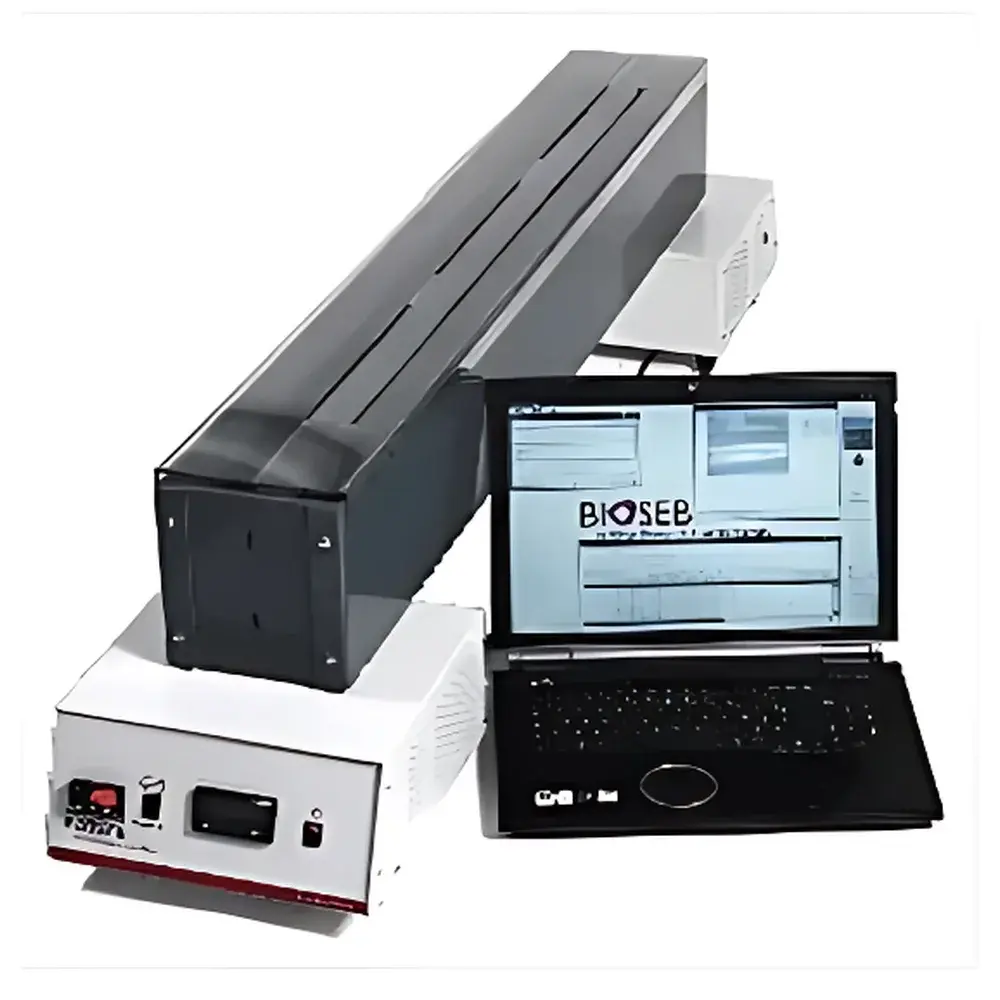
RWD BIO-TGT2 Thermal Gradient Nociception Analyzer for Rodents (Single Rat or Dual Mouse Configuration with Integrated Software and Synchronized Video Recording)
| Brand | RWD |
|---|---|
| Origin | Shenzhen, China |
| Manufacturer Type | Original Equipment Manufacturer (OEM) |
| Country of Manufacture | China |
| Model | BIO-TGT2 (supports 1 rat OR 2 mice simultaneously) |
| Temperature Range | 5–55 °C (±1 °C stability under 20–25 °C ambient, 45–55% RH) |
| Gradient Length | 120 cm heated/cooled linear floor |
| Data Output | Total trial duration, real-time temperature per zone (up to 20 discrete zones), dwell time per zone, cumulative locomotion distance |
| Data & Video | AES-256 encrypted synchronized recording with timestamp alignment |
| Compliance | GLP-compliant audit trail, metadata-embedded video export, FDA 21 CFR Part 11–ready configuration options |
Overview
The RWD BIO-TGT2 Thermal Gradient Nociception Analyzer is a precision-engineered behavioral phenotyping platform designed for objective, quantitative assessment of thermally evoked nociceptive responses in rodents. Based on the validated thermal gradient paradigm, the system establishes a continuous, linear temperature gradient (5–55 °C) across a 120 cm thermally regulated floor, enabling spontaneous, non-invasive evaluation of thermal preference behavior without forced stimulation or restraint. Unlike traditional reflex-based assays (e.g., tail-flick or hot-plate), the BIO-TGT2 captures ethologically relevant, operant avoidance/seeking decisions—providing functional readouts of central and peripheral pain processing, including neuropathic, inflammatory, and opioid-modulated states. The instrument operates under tightly controlled environmental conditions (20–25 °C ambient, 45–55% RH) to minimize confounding thermal stress, and maintains ±1 °C spatial and temporal stability across the entire gradient profile—critical for reproducible detection of subtle shifts in thermal preference thresholds.
Key Features
- Linear 120 cm bidirectional thermal gradient with independent Peltier-based heating/cooling zones, calibrated traceable to NIST standards.
- Simultaneous dual-species capability: optimized chamber geometry supports either one adult rat (200–300 g) or two adult mice (20–30 g each) with species-specific behavioral tracking parameters.
- Integrated high-resolution monochrome camera (60 fps, 1280×720) with IR illumination, synchronized to thermal sensor data at millisecond-level timestamp precision.
- Real-time acquisition of multi-parameter behavioral metrics: total trial duration, zone-specific dwell time (per user-defined up to 20 temperature bins), cumulative path length, velocity profiles, and entry/exit frequency per thermal zone.
- AES-256 hardware-accelerated encryption for both raw thermal sensor logs and video streams, ensuring data integrity and compliance with institutional data governance policies.
- Modular software architecture supporting role-based access control, electronic signatures, and configurable audit trail logging—fully compatible with GLP/GCP workflows and preparatory for FDA 21 CFR Part 11 validation.
Sample Compatibility & Compliance
The BIO-TGT2 accommodates standard laboratory rodent strains (Sprague-Dawley, Wistar, C57BL/6, BALB/c) without modification. Chamber dimensions (L×W×H: 130 × 20 × 25 cm) ensure unrestricted locomotion while minimizing edge effects. All materials contacting animals are autoclavable stainless steel and medical-grade polycarbonate, compliant with ISO 10993-5 cytotoxicity requirements. System firmware and software comply with IEC 62304 Class B for medical device software safety, and data structures conform to CDISC SDTM v2.1 for preclinical toxicology submissions. Full validation documentation—including IQ/OQ/PQ protocols, calibration certificates, and uncertainty budgets—is provided upon request.
Software & Data Management
The proprietary BioTherm Suite v3.2 provides intuitive experiment design, real-time visualization, and post-hoc analysis. Users define thermal binning resolution (0.5–5 °C increments), set exclusion criteria (e.g., immobility >10 s), and apply automated motion artifact filtering. Export formats include CSV (for statistical packages such as GraphPad Prism or R), HDF5 (for machine learning pipelines), and MP4 with embedded metadata (temperature/time/video sync). Audit trails record all user actions—including parameter changes, data exports, and video annotations—with immutable timestamps and operator IDs. Backup and restore functions support network-attached storage (NAS) and LTO-8 tape archival.
Applications
- Characterization of thermal allodynia/hyperalgesia in chronic constriction injury (CCI), spared nerve injury (SNI), and streptozotocin-induced diabetic neuropathy models.
- Evaluation of analgesic efficacy and dose-response relationships for novel TRPV1/TRPM8 modulators, opioid receptor agonists, and NSAID derivatives.
- Longitudinal monitoring of pain phenotype progression during autoimmune encephalomyelitis (EAE) or collagen-induced arthritis (CIA).
- Genetic screening of nociceptor-specific knockout/knockin lines (e.g., Nav1.7, PIEZO2, ASIC3) under baseline and inflammatory challenge conditions.
- Behavioral pharmacokinetic-pharmacodynamic (PK-PD) correlation studies using microdialysis-coupled thermal gradient testing.
FAQ
What is the minimum recommended acclimation time before initiating a thermal gradient test?
Animals must undergo a minimum 30-minute habituation period in the chamber under isothermal conditions (25 °C) prior to gradient activation.
Can the BIO-TGT2 be integrated with third-party electrophysiology or optogenetics systems?
Yes—the system provides TTL-compatible trigger I/O ports and Ethernet-based API (RESTful JSON) for synchronized stimulus delivery and multimodal data fusion.
Is video compression applied during recording, and does it affect behavioral quantification accuracy?
No lossy compression is used; videos are stored in lossless Motion JPEG-A format at native resolution and frame rate to preserve pixel-level fidelity required for sub-pixel motion tracking algorithms.
How frequently does the system require recalibration, and what documentation is provided?
Annual calibration is recommended; a full calibration report—including reference standard certificates, measurement uncertainty values, and drift analysis over 72-hour stability testing—is issued with each service event.
Related Products




