
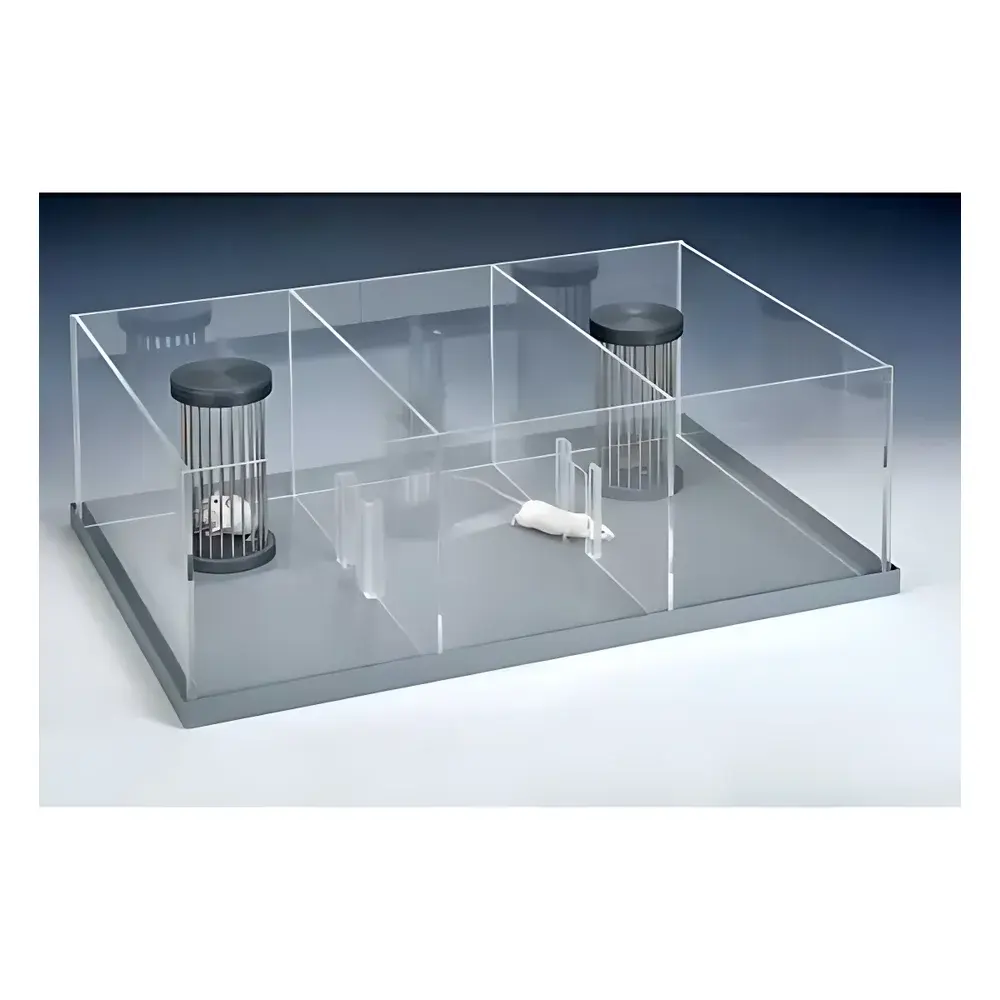
RWD Three-Chamber Social Interaction Apparatus
| Brand | RWD |
|---|---|
| Origin | Guangdong, China |
| Manufacturer Type | Original Equipment Manufacturer (OEM) |
| Country of Origin | China |
| Price | USD 14,000 (approx.) |
Overview
The RWD Three-Chamber Social Interaction Apparatus is a standardized, behaviorally validated platform engineered for quantitative assessment of sociability and social novelty preference in rodent models—primarily mice. Grounded in ethologically relevant paradigms, the system implements the well-established three-chamber paradigm based on spontaneous exploratory motivation and natural social investigation behaviors. The apparatus consists of three interconnected acrylic chambers arranged linearly: a central neutral zone flanked by two identical side chambers. Each side chamber accommodates a wire-mesh enclosure (typically 8 cm × 8 cm × 10 cm) to house a stimulus animal—either a novel (unfamiliar) conspecific or a familiar one—while permitting olfactory, auditory, and limited visual contact without physical interaction. The subject mouse is placed in the central chamber and allowed to freely explore all three zones for a defined session (commonly 10 min), with time spent in each chamber and proximity to the mesh enclosures recorded via automated video tracking. This behavioral assay directly probes core domains affected in neurodevelopmental disorders, including autism spectrum disorder (ASD), making it a cornerstone tool in preclinical translational research.
Key Features
- Modular, optically uniform acrylic construction ensures consistent lighting transmission and eliminates visual artifacts during video-based tracking.
- Standardized chamber dimensions (60 cm × 40 cm × 20 cm total footprint; central chamber: 20 cm × 40 cm; side chambers: 20 cm × 40 cm each) comply with published protocols (e.g., Moy et al., 2004; Nadler et al., 2004) to ensure cross-laboratory reproducibility.
- Interchangeable stainless-steel or nickel-plated wire-mesh stimulus cages (mesh aperture: 0.5 cm) provide secure containment while maximizing sensory exchange and minimizing stress-induced confounds.
- Integrated mounting interface compatible with leading commercial video-tracking systems (e.g., EthoVision XT, ANY-maze, Noldus; Smart v3.0, Panlab) for synchronized spatial data acquisition.
- Non-invasive design eliminates requirement for surgical implantation or pharmacological manipulation—enabling longitudinal studies across developmental stages or treatment regimens.
Sample Compatibility & Compliance
The apparatus is optimized for adult C57BL/6J, BALB/c, and FVB/N mice (6–12 weeks old); validation data support use in both male and female cohorts with appropriate habituation protocols. It supports standard laboratory environmental controls (22 ± 2°C, 40–60% RH, 12-h light/dark cycle). All materials meet ISO 10993-5 biocompatibility requirements for short-term non-implantable contact. Experimental protocols align with NIH Guide for the Care and Use of Laboratory Animals and AAALAC International standards. Data collection workflows are compatible with GLP-compliant documentation practices when paired with audit-trail-enabled software (e.g., EthoVision XT with FDA 21 CFR Part 11 module).
Software & Data Management
The system does not include proprietary software but interfaces natively with third-party behavioral analysis platforms supporting ROI (region-of-interest) definition, zone entry/exit detection, distance-to-mesh calculation, and dwell-time quantification. Raw video files (AVI/MPEG-4) and metadata (session ID, subject ID, stimulus identity, timestamp) are exported in structured formats (CSV, XML) for downstream statistical analysis in R, Python (SciPy/Pandas), or GraphPad Prism. Time-stamped event logs support traceability required under ICH-GCP and institutional animal care committee reporting frameworks.
Applications
- Phenotypic screening of genetically modified mouse lines modeling ASD-associated genes (e.g., Shank3, Cntnap2, Fmr1).
- Evaluation of pharmacological interventions targeting oxytocin, vasopressin, or GABAergic pathways on sociability deficits.
- Assessment of environmental enrichment or early-life stress effects on social development trajectories.
- Validation of neural circuit manipulations (optogenetic/chemogenetic) in medial prefrontal cortex, nucleus accumbens, or ventral tegmental area.
- Multi-assay integration with parallel tests (e.g., elevated plus maze, open field, ultrasonic vocalization recording) for comprehensive behavioral profiling.
FAQ
What is the recommended acclimation protocol prior to testing?
Subjects should undergo two 10-min habituation sessions in the empty apparatus on consecutive days, followed by a 24-h rest period before the sociability test.
Can the apparatus be used for rats?
Yes—chamber dimensions may be scaled (standard rat version available upon request); however, stimulus cage mesh size and inter-chamber barrier height must be adjusted to prevent climbing or escape.
Is cleaning between trials required?
Yes—ethanol (70%) wipe-down of all surfaces and mesh cages is mandatory to eliminate olfactory cues; air-drying for ≥5 min is required before next subject.
Does RWD provide validation data for this system?
RWD supplies reference performance data from internal benchmarking using C57BL/6J mice, including mean sociability index (SI = [Tnovel − Tfamiliar] / [Tnovel + Tfamiliar]) and coefficient of variation (<12% across n=24 controls).
How is stimulus animal selection controlled?
Stimulus animals must be age-, sex-, and strain-matched to subjects; they undergo no prior exposure to test subjects and are housed separately. Each stimulus animal is used for ≤3 trials per day with ≥1-h rest intervals between exposures.



