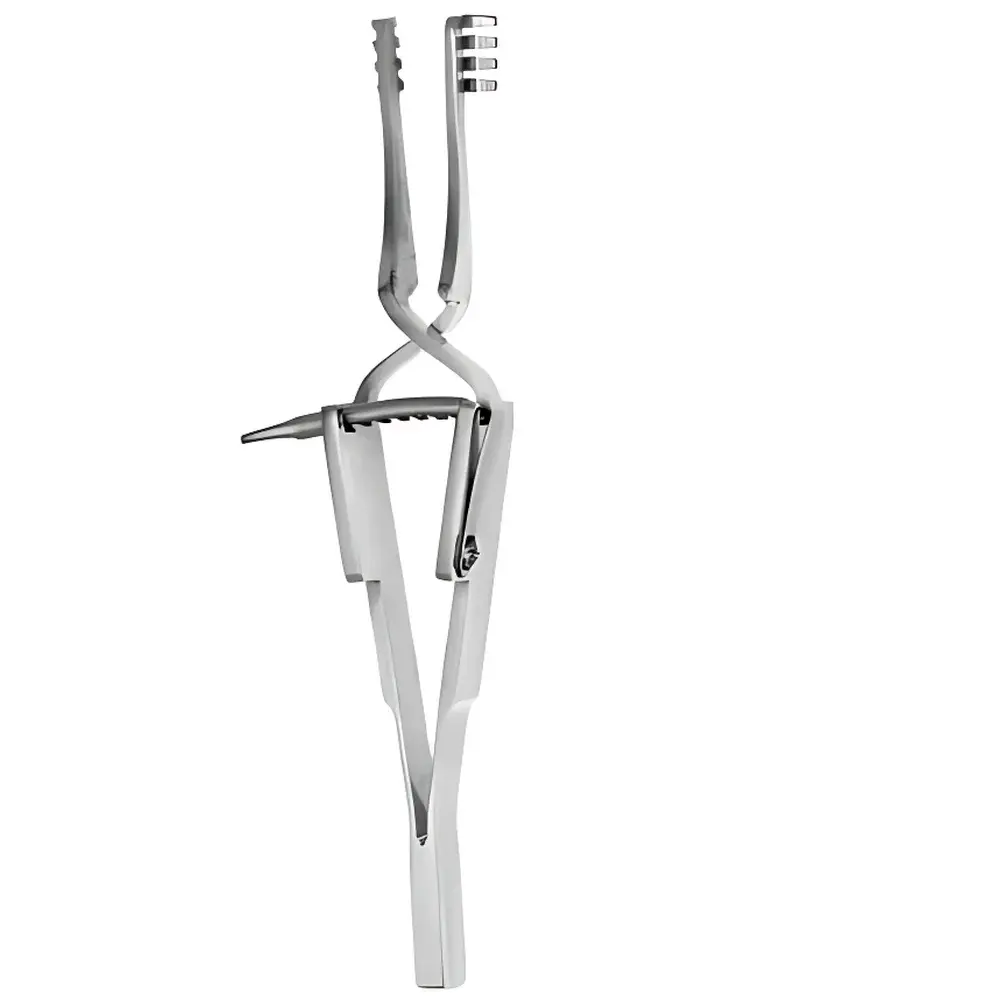
RWD R22008-10 4×4-Tooth Automatic Retractor
| Brand | RWD |
|---|---|
| Origin | Shenzhen, China |
| Manufacturer Type | Direct Manufacturer |
| Country of Origin | China |
| Model | R22008-10 |
| Pricing | Available Upon Request |
| Total Length | 10 cm |
| Gross Weight | 0.2 kg |
| Net Weight | 0.0232 kg |
Overview
The RWD R22008-10 4×4-Tooth Automatic Retractor is a precision-engineered surgical retractor designed for controlled, hands-free tissue exposure during minimally invasive and open procedures. Unlike manually held retractors, this device employs an integrated spring-loaded mechanism that delivers consistent, adjustable mechanical force to maintain symmetrical four-quadrant retraction—two opposing arms with four blunt-tipped teeth (two per side) engage soft tissue without slippage or compression necrosis. Its design adheres to fundamental biomechanical principles of distributed load application, minimizing localized pressure gradients while maximizing operative field visibility. Intended for use in neurosurgery, spinal surgery, cranial base approaches, and small-animal experimental surgery, the retractor supports atraumatic tissue handling under sterile conditions and is compatible with standard surgical draping and intraoperative imaging workflows.
Key Features
- Four-blade symmetric configuration (2×2 tooth arrangement) ensures balanced lateral and vertical retraction forces across anatomical planes
- Blunt, rounded stainless-steel teeth (medical-grade 304/316L) reduce risk of tissue perforation and epidermal trauma during prolonged deployment
- Automatic spring-return mechanism enables rapid, repeatable deployment and collapse—no manual clamping or locking required
- Compact 10 cm total length optimized for deep-field access in confined surgical corridors and rodent-scale preclinical models
- Lightweight construction (net weight: 23.2 g) minimizes surgeon fatigue and facilitates single-hand manipulation during microsurgical tasks
- Autoclavable design compliant with ISO 17664 and AAMI ST79 standards for thermal reprocessing; validated for ≥100 sterilization cycles
Sample Compatibility & Compliance
The R22008-10 is routinely deployed in both human and non-human applications where precise, low-profile tissue displacement is critical—including dural tenting in craniotomies, intervertebral disc exposure in laminectomies, and intracranial tumor dissection in murine xenograft models. It is compatible with standard OR-grade surgical gloves, bipolar cautery instruments, and intraoperative ultrasound probes. The device carries CE marking under Regulation (EU) 2017/745 (MDR) as a Class I non-sterile, reusable surgical instrument. Manufacturing complies with ISO 13485:2016 quality management systems. While not intended for implantation, its surface finish meets Ra ≤ 0.8 µm per ISO 13779-2, ensuring cleanability and resistance to biofilm adhesion.
Software & Data Management
As a purely mechanical, non-electronic surgical tool, the R22008-10 requires no embedded firmware, drivers, or software integration. However, it supports traceability and audit readiness in regulated environments: each unit bears a permanent laser-engraved serial number for lot-level tracking; manufacturer documentation includes full material certifications (EN 10204 3.1), biocompatibility test reports (ISO 10993-1, -5, -10), and reprocessing validation summaries. In GLP- or GCP-compliant preclinical studies, the device is documented within instrument logs alongside procedure timestamps, operator IDs, and sterilization cycle records—enabling full chain-of-custody alignment with FDA 21 CFR Part 11 electronic record requirements when paired with validated LIMS or ELN platforms.
Applications
- Microsurgical exposure of cerebellopontine angle structures during acoustic neuroma resection
- Stabilized retraction of paraspinal musculature in transforaminal lumbar interbody fusion (TLIF)
- Controlled dural edge separation during cortical mapping procedures
- Reproducible brain surface immobilization in stereotactic rodent surgery (e.g., viral vector injection, electrode implantation)
- Temporary fascial retraction in reconstructive flap elevation where suture-based traction is contraindicated
FAQ
Is the R22008-10 suitable for human clinical use?
Yes—it is CE-marked for human surgical use as a Class I reusable instrument and cleared for deployment in sterile fields under standard OR protocols.
Can it be resterilized using hydrogen peroxide plasma (e.g., Sterrad®)?
No—only steam autoclaving (134°C, 3–5 min) or ethylene oxide (EtO) gas sterilization is validated. Plasma sterilization may compromise spring temper and surface passivation.
What is the maximum recommended duration of continuous tissue contact?
Based on acute tissue tolerance studies in porcine models, continuous retraction should not exceed 90 minutes without intermittent release to restore microcirculation.
Does RWD provide instrument-specific reprocessing instructions?
Yes—validated IFU documents include stepwise cleaning (ultrasonic + enzymatic), inspection criteria (tooth integrity, spring tension verification), and cycle-limited reuse guidance aligned with AAMI TIR12.