
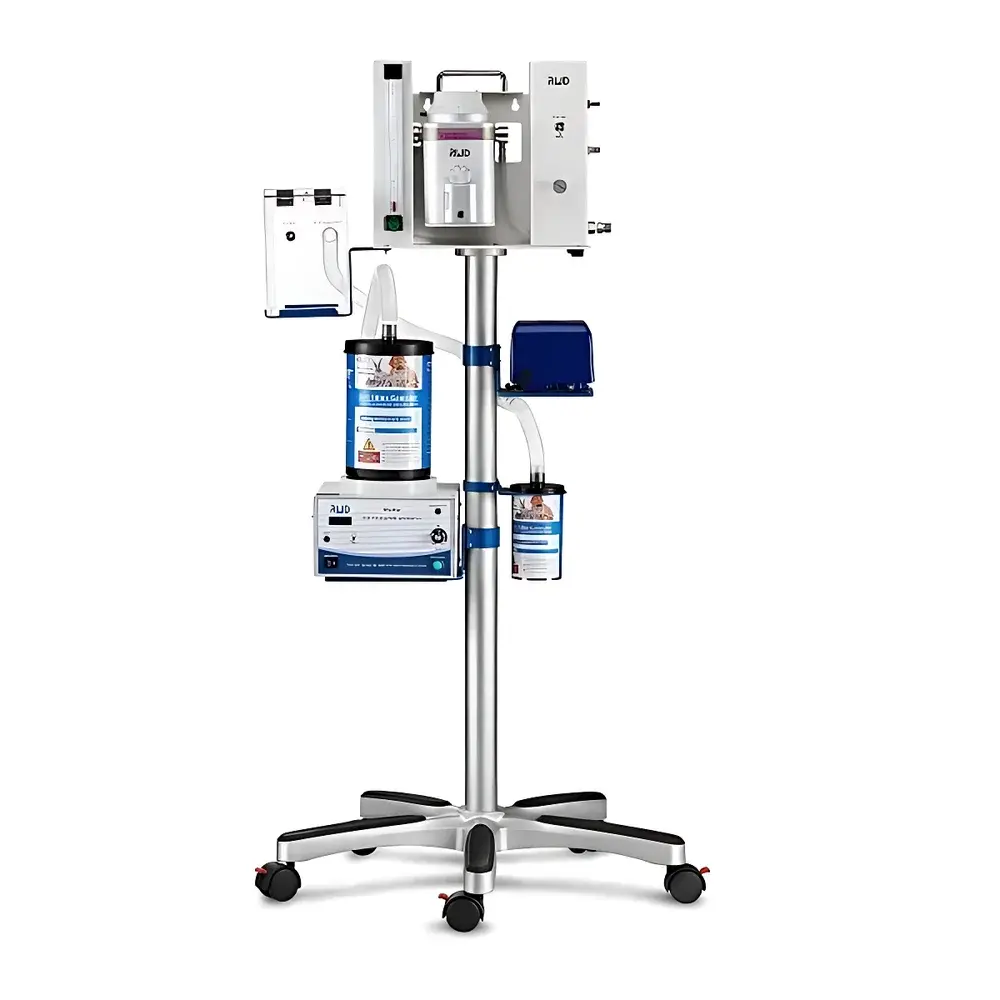
RWD R520 Mobile Small Animal Anesthesia Machine
| Brand | RWD |
|---|---|
| Origin | Guangdong, China |
| Manufacturer Type | Original Equipment Manufacturer (OEM) |
| Country of Origin | China |
| Model | R520 |
| Price Range | USD 1,400 – 2,800 |
| Flowmeter Capacity | 4 L/min (standard), optional dual-channel 0.1–1 L/min |
| Anesthetic Agent Compatibility | Isoflurane (Pour Fil / Easy Fil), Sevoflurane (Pour Fil / Easy Fil) |
| Optional N₂O Flow Module | 0.1–4 L/min |
| Air Supply Options | Integrated HF air pump (220 V) or medical-grade oxygen cylinder |
| Key Accessories | Induction chamber mounting bracket (V100-A), gas scavenging unit bracket (R510-46A), air pump bracket (R510-25A) |
Overview
The RWD R520 Mobile Small Animal Anesthesia Machine is an integrated, cart-mounted anesthesia delivery system engineered for precision, reproducibility, and operational flexibility in preclinical research environments. Designed according to ISO 8573-1 (compressed air quality) and aligned with GLP-compliant laboratory infrastructure requirements, the R520 employs calibrated variable-orifice flowmeters and agent-specific vaporizers operating on the principle of temperature-compensated, concentration-controlled vaporization. It delivers stable, adjustable anesthetic concentrations (typically 0.5–5% v/v for isoflurane or sevoflurane) to small mammals—including mice, rats, guinea pigs, and rabbits—via calibrated fresh gas flow paths. Its modular architecture enables rapid reconfiguration between induction and maintenance phases, supporting both nose-cone and chamber-based administration protocols common in longitudinal in vivo studies.
Key Features
- Integrated mobile platform: All core components—including the 4 L/min flowmeter assembly, vaporizer (Pour Fil or Easy Fil type), induction chamber bracket (V100-A), gas scavenging unit bracket (R510-46A), and air pump bracket (R510-25A)—are rigidly mounted on a single-height-adjustable stainless-steel trolley with locking casters.
- Vaporizer compatibility: Supports both isoflurane and sevoflurane via interchangeable, agent-specific vaporizers; Pour Fil models feature gravity-fed liquid filling, while Easy Fil variants integrate a sealed, pressure-assisted fill port compliant with USP handling standards.
- Gas supply versatility: Standard configuration includes the R510-29 HF air pump (220 V, oil-free, Class 0 compressed air output); alternatively, users may connect certified medical oxygen cylinders via ISO 4064-compliant regulators and non-return valves.
- Scavenging-ready design: Pre-drilled and threaded mounting points accommodate active or passive gas scavenging systems per ANSI Z79.11 and ISO 10993-1 biocompatibility guidelines.
- Modular expandability: Optional accessories include the R600-N2O-4E nitrous oxide flow module (0.1–4 L/min range, calibrated to ±2% FS) and R510-09 dual-channel low-flow meter (0.1–1 L/min per channel), enabling simultaneous independent anesthesia delivery to two subjects under distinct concentration and flow parameters.
Sample Compatibility & Compliance
The R520 is validated for use with rodents (body weight 15–500 g) and lagomorphs requiring inhalational anesthesia. Its flow control accuracy meets ASTM F2793-21 criteria for small animal anesthetic delivery devices. All wetted materials—including vaporizer internal pathways, flowmeter tubes, and gas tubing connectors—are USP Class VI-certified and DEHP-free. The system supports audit-ready documentation workflows: vaporizer calibration logs, flowmeter verification records, and gas source change timestamps can be manually entered into lab notebooks aligned with 21 CFR Part 11 Annex 11 principles. Device labeling complies with IEC 60601-1 (3rd ed.) essential performance requirements for medical electrical equipment used in laboratory animal science.
Software & Data Management
The R520 operates as a standalone analog-analog device without embedded firmware or digital interfaces; therefore, it does not require software validation or cybersecurity controls. However, its mechanical consistency and repeatable dial settings enable seamless integration into electronic lab notebook (ELN) platforms such as LabArchives or Benchling. Users routinely document vaporizer setting, flowmeter reading, induction duration, and recovery time directly into protocol-driven templates. For labs implementing automated data capture, third-party analog-to-digital converters (e.g., National Instruments USB-6009) may interface with external flow or pressure sensors mounted upstream/downstream of the vaporizer—subject to local institutional biosafety review.
Applications
- Longitudinal neuroimaging studies requiring repeated anesthesia across MRI, PET, or optical imaging sessions.
- Surgical interventions in rodent models of cardiovascular disease, oncology, or metabolic disorders where consistent anesthetic depth and rapid recovery are critical endpoints.
- Toxicology screening involving multi-dose inhalational exposure protocols under OECD 407 or 422 guideline frameworks.
- Behavioral phenotyping pipelines where anesthesia must be administered outside dedicated surgical suites—e.g., in vivarium holding rooms or satellite imaging facilities.
- Training programs for veterinary students and research staff in standardized small animal anesthetic technique per FELASA recommendations.
FAQ
Can the R520 be used with nitrous oxide (N₂O)?
Yes—when equipped with the optional R600-N2O-4E flow module, the R520 supports N₂O delivery at flow rates from 0.1 to 4 L/min, calibrated per ISO 8573-1 purity class 2 specifications.
Is the vaporizer pre-calibrated at the factory?
All R520 vaporizers undergo factory calibration against NIST-traceable reference standards; calibration certificates are shipped with each unit and include temperature-compensation curves across 18–28°C ambient ranges.
Does the system meet international regulatory requirements for GLP studies?
While the R520 itself is not GLP-certified as a standalone instrument, its design, material traceability, and operational repeatability support full compliance when operated within a validated GLP environment—including documented maintenance, operator training, and periodic flowmeter verification per SOP-ANES-003.
What maintenance intervals are recommended?
Vaporizer performance verification every 6 months; flowmeter calibration annually or after physical impact; CO₂ absorbent replacement per manufacturer’s instructions (typically every 4–6 hours of continuous use or upon color indicator shift).
Can two animals be anesthetized simultaneously with independent control?
Yes—using the optional R510-09 dual-channel flowmeter, two separate gas paths can be established, each with independent flow adjustment (0.1–1 L/min) and dedicated vaporizer output ports, enabling concurrent but individually titrated anesthesia administration.
Related Products





