
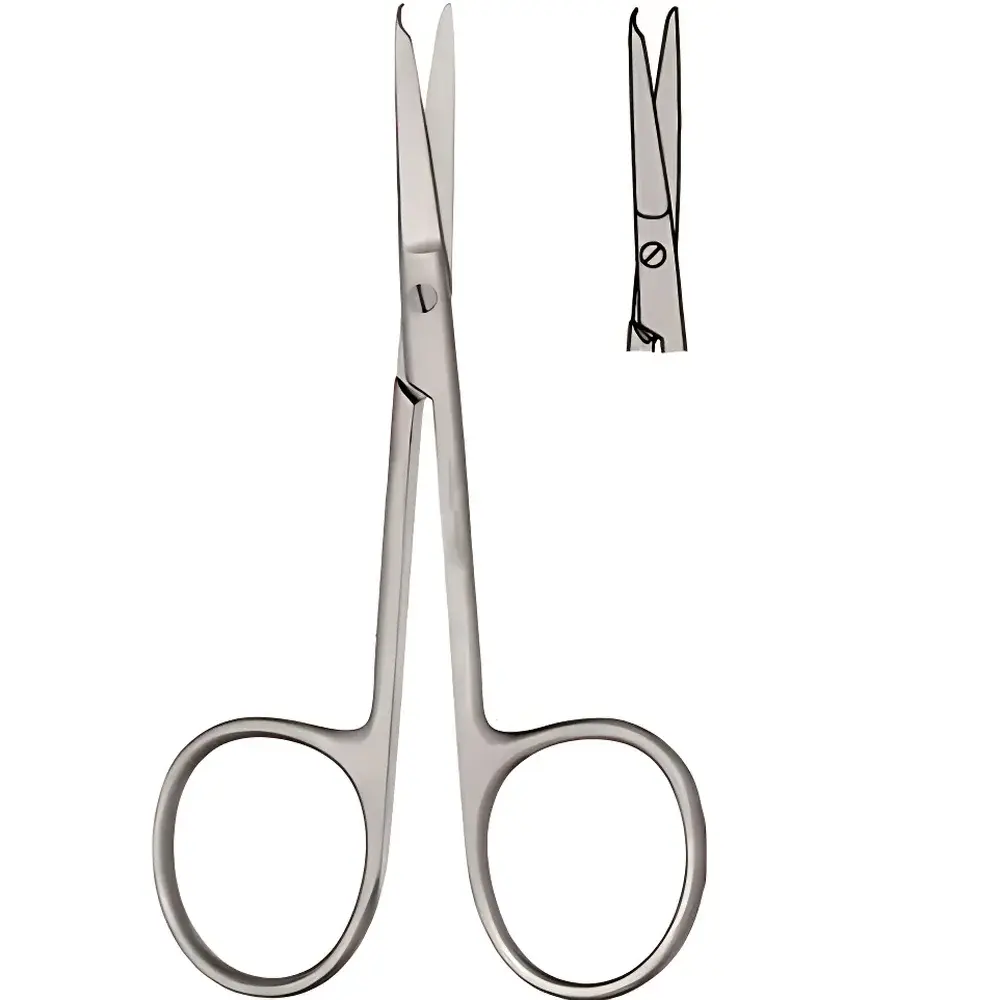
RWD Spencer-Style Suture Removal Scissors
| Brand | RWD |
|---|---|
| Origin | Shenzhen, China |
| Manufacturer Type | Original Equipment Manufacturer (OEM) |
| Country of Origin | China |
| Model Numbers | S15001-09, S15001-11, S15001-13 |
| Pricing | Available Upon Request |
Overview
RWD Spencer-Style Suture Removal Scissors are precision-engineered surgical instruments designed specifically for the safe, controlled, and atraumatic removal of non-absorbable and absorbable sutures in clinical, veterinary, and research laboratory settings. Based on the classic Spencer design—characterized by a narrow, elongated blade geometry with a blunt lower jaw and sharp upper cutting edge—the scissors facilitate precise suture engagement while minimizing tissue trauma and accidental skin nicking. These instruments operate on a simple yet highly effective lever-based mechanical principle: optimized fulcrum placement ensures high cutting force transmission at the tip with minimal hand fatigue, critical during prolonged or repetitive procedures. Manufactured under strict quality control protocols in Shenzhen, China, each pair meets internationally recognized dimensional tolerances and material performance benchmarks for medical-grade stainless steel instrumentation.
Key Features
- Blade geometry: Narrow-profile, angled tip with 45° bevel on upper blade and rounded, non-penetrating lower jaw—engineered to lift and cut suture material without contacting underlying tissue.
- Material construction: High-carbon, corrosion-resistant stainless steel (AISI 420 equivalent), passivated per ASTM F86 for enhanced biocompatibility and long-term durability.
- Ergonomic handles: Textured, satin-finished finger rings with moderate spring tension—designed for secure grip, tactile feedback, and compatibility with standard sterilization cycles (autoclave up to 134°C).
- Three standardized lengths: 9 cm (S15001-09), 11 cm (S15001-11), and 13 cm (S15001-13)—each calibrated for distinct procedural requirements: compact access (e.g., facial or pediatric wound closure), general-purpose use, and deeper anatomical reach respectively.
- Consistent edge retention: Blades undergo precision grinding and micro-honing to maintain sharpness across ≥50 sterilization-reuse cycles when maintained per IFU guidelines.
Sample Compatibility & Compliance
These suture removal scissors are compatible with all common suture types—including nylon, polyester, polypropylene, silk, and braided absorbables such as Vicryl and Monocryl—regardless of gauge (USP 6-0 to 0). They are intended for single-user, multi-use applications in environments governed by ISO 13485:2016 quality management systems. The instruments comply with ISO 7740-1:2018 (Surgical Instruments — Requirements for Reusable Instruments) and meet essential requirements outlined in the EU MDR 2017/745 Class I (non-sterile) classification. Packaging includes traceable lot numbering and conforms to ISO 11607-1 for sterile barrier system validation readiness. Documentation supports GLP-compliant recordkeeping for preclinical research labs.
Software & Data Management
As a manually operated, non-electronic surgical instrument, the RWD Spencer-Style Suture Removal Scissors does not incorporate embedded software, firmware, or digital connectivity. All usage, maintenance, and reprocessing data must be recorded externally via facility-specific documentation systems. Instrument logs—including sterilization cycle records, sharpening history, and visual inspection outcomes—should align with institutional infection control policies and FDA 21 CFR Part 820 requirements for device traceability. Optional QR-code-labeled instrument tags (available upon request) support integration into digital inventory tracking platforms used in academic hospitals and CROs.
Applications
- Clinical outpatient departments: Routine suture removal following laceration repair, biopsy site closure, or minor surgical incisions.
- Veterinary practice: Suture management in small-animal surgery where fine motor control and minimal tissue displacement are essential.
- Academic and pharmaceutical research laboratories: Standardized wound closure assessment in rodent models (e.g., murine dorsal incision studies), supporting reproducible endpoint evaluation per ARRIVE 2.0 guidelines.
- Medical device training simulators: Used in suture technique workshops to teach proper scissor orientation, blade-tissue angle, and tension control—critical competencies assessed in OSCE and ACGME-aligned curricula.
- GMP-regulated manufacturing: Tooling qualification for suture packaging line verification and sterility assurance testing protocols.
FAQ
Are these scissors autoclavable?
Yes—fully compatible with saturated steam sterilization at 121°C (15 psi) for 20 minutes or 134°C (30 psi) for 5 minutes, per ISO 17664 recommendations.
What is the recommended maintenance schedule?
Visual inspection before each use; cleaning with enzymatic detergent followed by ultrasonic agitation; lubrication of pivot joint after every 5–10 sterilization cycles using medical-grade instrument oil.
Do you provide certification documents for regulatory submission?
Yes—Certificate of Conformance (CoC), Material Certifications (EN 10204 3.1), and ISO 13485 manufacturing audit summaries are available upon formal request with purchase order reference.
Can custom engraving or OEM branding be applied?
Yes—RWD offers laser marking services for facility identifiers, lot codes, or proprietary logos in compliance with ISO 15223-1 labeling standards.
Related Products




