
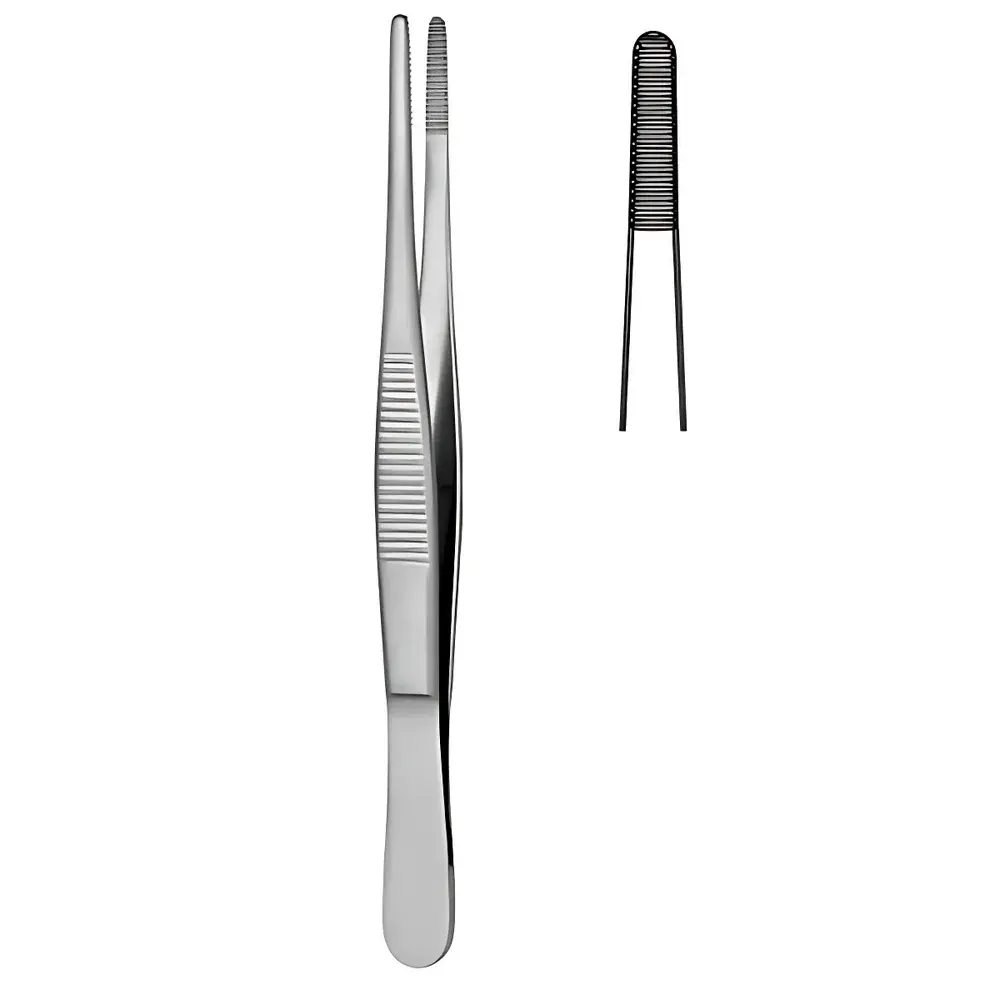
RWD Standard Anatomical Forceps
| Brand | RWD |
|---|---|
| Origin | Shenzhen, China |
| Manufacturer Type | Direct Manufacturer |
| Country of Origin | China |
| Model Numbers | F12018-11, F12018-13, F12018-14, F12018-16 |
| Pricing | Available Upon Request |
Overview
RWD Standard Anatomical Forceps are precision-engineered stainless steel instruments designed for routine dissection, tissue manipulation, and specimen handling in academic research laboratories, preclinical animal studies, and teaching environments. These forceps operate on the fundamental mechanical principle of lever-based gripping—optimized through calibrated spring tension and symmetrical tip geometry—to deliver consistent, controlled pressure without slippage or tissue trauma. Constructed from high-grade austenitic stainless steel (typically AISI 304 or equivalent), they exhibit excellent corrosion resistance, biocompatibility, and compatibility with standard laboratory sterilization protocols including autoclaving (121 °C, 2 bar, 20 min), ethylene oxide (EtO), and hydrogen peroxide plasma. Their ergonomic design minimizes hand fatigue during prolonged use, supporting adherence to occupational health guidelines for repetitive manual tasks in biosafety level 1 and 2 (BSL-1/2) settings.
Key Features
- Precision-ground, straight-tip configuration with smooth, non-toothed jaws—ideal for delicate tissue separation and non-traumatic handling of neural, vascular, or embryonic structures.
- Consistent tip width tolerance (±0.1 mm) and length accuracy (±0.5 mm), verified via optical comparator inspection during final quality control.
- Electropolished surface finish (Ra ≤ 0.4 µm) reduces protein adhesion and enhances cleanability—critical for reducing cross-contamination between experimental replicates.
- Integrated finger grooves and balanced weight distribution (center of mass located within proximal third of shank) improve tactile feedback and operator control.
- Autoclavable up to 1,000 cycles without degradation in tensile strength or dimensional stability, validated per ISO 17664-1:2017 requirements for reprocessing of surgical instruments.
Sample Compatibility & Compliance
These forceps are compatible with a broad range of biological specimens—including murine, porcine, and avian tissues—as well as synthetic hydrogels, agarose scaffolds, and decellularized extracellular matrices. They meet material safety requirements outlined in ISO 10993-5 (cytotoxicity) and ISO 10993-10 (irritation/sensitization). While not classified as Class II medical devices under FDA 21 CFR Part 878, they conform to general laboratory instrument standards referenced in CLSI GP26-A4 and are routinely used in GLP-compliant toxicology studies where instrument traceability and cleaning validation are documented per SOPs.
Software & Data Management
As a manually operated mechanical tool, the RWD Standard Anatomical Forceps requires no embedded electronics, firmware, or software integration. However, it supports full traceability within digital lab management systems (e.g., LabVantage, Quartzy, or Veeva Vault) via serialized model identification (F12018-xx) and batch-specific manufacturing certificates. Each unit is laser-marked with a permanent identifier enabling linkage to sterilization logs, usage records, and maintenance history—facilitating compliance with ISO/IEC 17025:2017 clause 7.5.2 on equipment identification and calibration status tracking.
Applications
- Microdissection of brain regions (e.g., hippocampal subfields, cortical layers) in rodent neuroanatomy studies.
- Embryo handling during ex utero electroporation or microinjection procedures in developmental biology.
- Tissue biopsy retrieval and orientation in histopathology preparation workflows.
- Implant placement and suture manipulation in small-animal surgical models (e.g., carotid artery ligation, myocardial infarction induction).
- Cell sheet harvesting in regenerative medicine protocols using temperature-responsive culture surfaces.
FAQ
Are these forceps certified for sterile use upon delivery?
No—they are supplied non-sterile and must be sterilized by the end user prior to first use, following institutional biosafety and infection control policies.
Can they be used in laminar flow hoods without compromising integrity?
Yes; their passive metal construction introduces no volatile organic compounds (VOCs) or particulate shedding under HEPA-filtered airflow conditions.
What is the recommended cleaning protocol between uses?
Rinse immediately in warm water, followed by enzymatic detergent soak (e.g., Enzol®), ultrasonic cleaning (40 kHz, 5 min), thorough rinse with deionized water, and drying before sterilization.
Do different model numbers indicate functional differences beyond size?
No—only nominal length and jaw width vary; all models share identical metallurgy, surface finish, spring tension profile, and sterilization endurance specifications.
Is there a warranty or replacement policy for bent tips?
RWD provides a 12-month limited warranty covering manufacturing defects; accidental deformation due to misuse or excessive lateral loading is excluded per standard terms.



