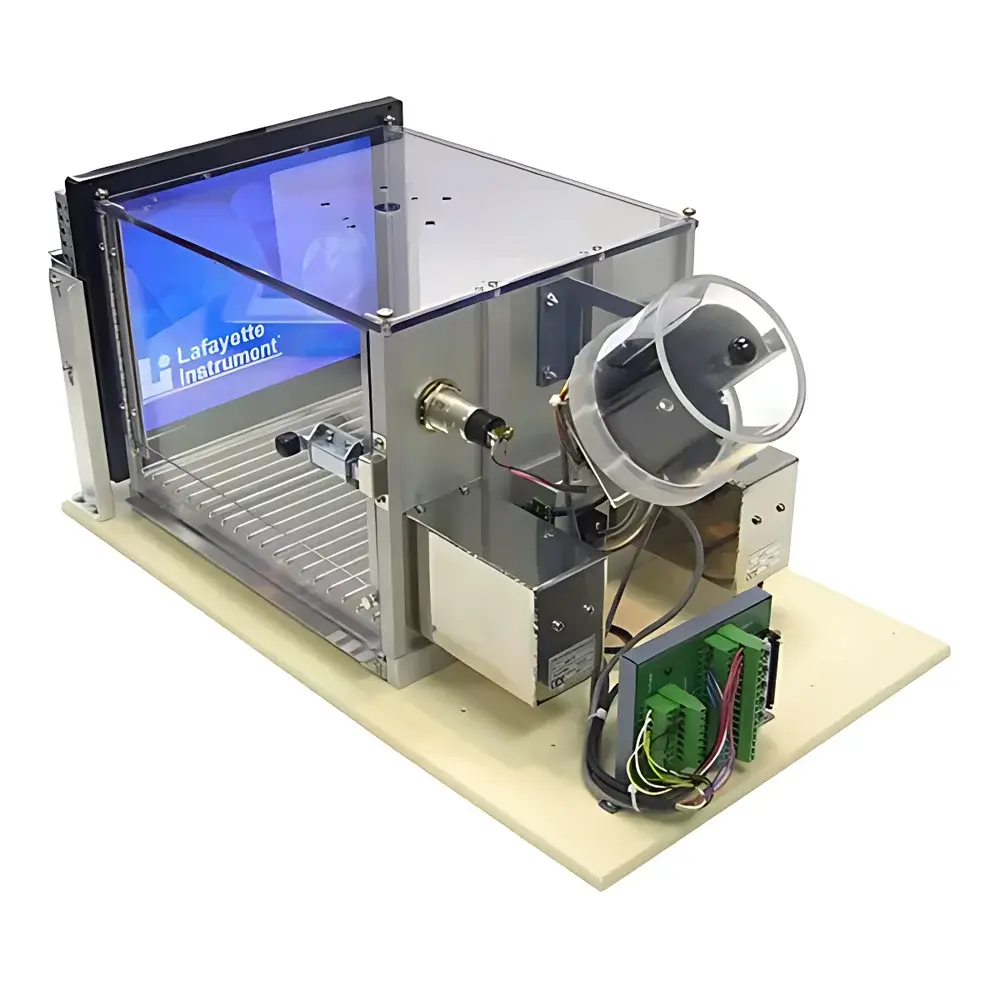
RWD Touchscreen Operant Conditioning Chamber
| Brand | RWD |
|---|---|
| Origin | Shenzhen, China |
| Manufacturer Type | Direct Manufacturer |
| Region of Origin | Domestic (China) |
| Model | Touchscreen |
| Price Range | USD 1,400 – 7,000 |
| Animal Compatibility | Rat & Mouse |
| Chamber Dimensions (L×W×H) | 30.5 × 26.0 × 20.0 cm |
| Observation Window | 26 cm W × 20 cm H |
| Grid Floor | Stainless Steel, Bar Spacing 10.72 mm, Bar Diameter 4.775 mm, Center Hole Ø15.494 mm |
| Sound Attenuation | 25 dB @ 3 m (Dual-Door Acoustic Enclosure, 64.5 × 44.2 cm) |
| LED Illumination | White Diffused Interior Light (≥1000 h Lifetime) |
| Reward Delivery | Pellet Dispenser (45 mg / 20 mg), Peristaltic Liquid Pump (0.025–0.20 mL/sec @ 57 rpm) |
| Input/Output | 8-in / 15-out TTL Module, 0–5 V Synchronization Output |
| Stimulus Control | 7-Tone Audio (1000–16000 Hz, 90 dB SPL), RGB Touch Nose Port (Ø2.30 cm, Depth 2.29 cm), Adjustable Visual Light Intensity |
| Electric Shock | 0–5.10 mA, 0.02 mA Resolution |
| Lever Specifications | Rat (3.8 cm W × 1.27 cm T × 1.5875 cm H, Force 0–25 g, Travel 0.3175 cm) |
| Software | Modular Task Programming Environment Supporting 5-CSRTT, PAL, VCL, TUNL, LDL, ET, 5CPT, PR, GT, rCPT Protocols |
| Data Management | Integrated Acquisition, Timestamped Event Logging, Export to CSV/MAT, FDA 21 CFR Part 11–Ready Audit Trail Optional |
Overview
The RWD Touchscreen Operant Conditioning Chamber is a fully modular, research-grade apparatus engineered for precision behavioral neuroscience experiments in rodents. Based on the foundational principles of operant conditioning—where behavior is shaped by contingent reinforcement or punishment—the system enables rigorous quantification of learning, memory, attention, motivation, and cognitive flexibility. Unlike legacy lever- or nose-poke–only chambers, this platform integrates capacitive touchscreen technology with standardized operant modules, permitting simultaneous assessment of both cognitive (e.g., visual discrimination, working memory) and motor-based (e.g., lever pressing, autoshaping) paradigms within a single, acoustically isolated environment. Its mechanical architecture conforms to GLP-compliant laboratory infrastructure requirements: stainless steel grid flooring ensures uniform aversive stimulus delivery and hygienic maintenance; polycarbonate access doors support rapid animal handling without disrupting experimental continuity; and the dual-door acoustic enclosure meets ISO 3744–derived attenuation specifications (25 dB @ 3 m), minimizing external auditory interference during auditory discrimination tasks.
Key Features
- Fully modular hardware design: All components—including levers, nose ports, pellet dispensers, liquid pumps, audio transducers, and LED arrays—are mechanically and electrically decoupled, enabling rapid reconfiguration between protocols without recalibration.
- Capacitive touchscreen interface: Supports high-resolution visual stimuli presentation (RGB backlighting, color-coded cue sets) and precise response detection (±0.5 cm spatial resolution) for translational cognitive assays such as 5-Choice Serial Reaction Time Task (5-CSRTT) and Trial-Unique Nonmatching-to-Location (TUNL).
- Programmable aversive stimulation: Constant-current foot shock generator (0–5.10 mA, 0.02 mA resolution) with adjustable pulse duration and inter-stimulus interval, compliant with NIH-defined ethical thresholds for rodent behavioral pharmacology studies.
- Multi-modal stimulus control: Seven discrete pure-tone frequencies (1–16 kHz, 90 dB SPL), intensity-tunable white light (0–100% PWM), and independently addressable RGB LEDs in the nose port enable cross-sensory associative learning paradigms.
- High-fidelity reward delivery: Dual pellet dispenser (20 mg / 45 mg) with jam-resistant mechanism and peristaltic liquid pump (flow range 0.025–0.20 mL/sec, ±2% volumetric accuracy) ensure consistent reinforcement timing critical for temporal discounting or progressive ratio analyses.
- TTL-synchronized I/O architecture: 8 digital inputs and 15 outputs (0–5 V logic level) permit real-time interfacing with electrophysiology rigs (e.g., neural recording systems), optogenetic controllers, or video tracking hardware via standardized event triggers.
Sample Compatibility & Compliance
The chamber accommodates both adult Sprague-Dawley rats (up to 500 g) and C57BL/6 mice (18–30 g) without structural modification. The internal dimensions (30.5 × 26.0 × 20.0 cm) satisfy AAALAC International space recommendations for acute operant sessions lasting ≤4 hours. Stainless steel construction complies with ISO 14644-1 Class 8 cleanroom compatibility for sterile behavioral suites. All electrical subsystems meet IEC 61000-4 electromagnetic immunity standards. Optional firmware validation packages support GxP environments, including full audit trail logging, electronic signature capability, and 21 CFR Part 11–compliant user access controls for regulated preclinical safety pharmacology studies.
Software & Data Management
RWD’s proprietary OperantStudio software provides an integrated development and analysis environment built on a deterministic real-time kernel. The graphical programming interface uses drag-and-drop protocol blocks—condition, action, delay, branch—to construct complex state machines (e.g., PR schedules with escalating response ratios or GT tasks requiring go/no-go discrimination). All events (lever presses, nose pokes, stimulus onset, reward delivery, shock pulses) are timestamped with microsecond resolution and logged in hierarchical HDF5 format. Built-in analytical modules compute standard metrics: response latency, omission errors, premature responses, correct/incorrect trial counts, breakpoint (for PR), and d’ sensitivity indices (for signal detection theory applications). Raw data exports support MATLAB (.mat), Python (NumPy .npy), and industry-standard CSV formats. Optional cloud synchronization enables multi-site collaboration with role-based permissions and version-controlled protocol libraries.
Applications
- Preclinical evaluation of CNS-active compounds: Psychostimulants, antipsychotics, anxiolytics, and cognitive enhancers via dose-response curves in 5-CSRTT (attention), PAL (episodic memory), or rCPT (response inhibition).
- Neurodevelopmental disorder modeling: Assessment of behavioral inflexibility in BTBR or Shank3 knockout mice using reversal learning and set-shifting protocols.
- Addiction research: Intravenous or oral self-administration paradigms with programmable timeout periods, FR/VR schedules, and cue-induced reinstatement testing.
- Sensory processing deficits: Auditory gating (PPI), visual contrast sensitivity, and multisensory integration using synchronized cross-modal stimuli.
- Translational biomarker discovery: Correlation of operant performance metrics with in vivo electrophysiology, fMRI, or microdialysis endpoints in longitudinal designs.
FAQ
Is the touchscreen calibrated for rodent visual acuity?
Yes—the display luminance, contrast ratio, and pixel density are optimized for murine photopic vision (peak sensitivity ~360 nm), with stimulus size and duration validated against published psychophysical thresholds.
Can the system interface with third-party video tracking software?
Yes—via TTL output triggers synchronized to behavioral events, enabling frame-accurate alignment of operant responses with EthoVision or DeepLabCut pose estimation outputs.
What validation documentation is provided for regulatory submissions?
Factory-installed IQ/OQ documentation, calibration certificates for shock generator and pump flow rates, and optional PQ protocols aligned with ASTM E2500 and USP analytical instrument qualification guidelines.
Is remote monitoring supported during long-duration sessions?
Yes—Ethernet-enabled embedded controller supports secure SSH access, live event streaming via MQTT, and automated email/SMS alerts for session completion or hardware fault conditions.
Are replacement parts and firmware updates available post-purchase?
All mechanical modules, stimulus generators, and software releases are supported under RWD’s global service network with ≥7-year spare parts availability and quarterly firmware patches addressing bug fixes and minor feature enhancements.