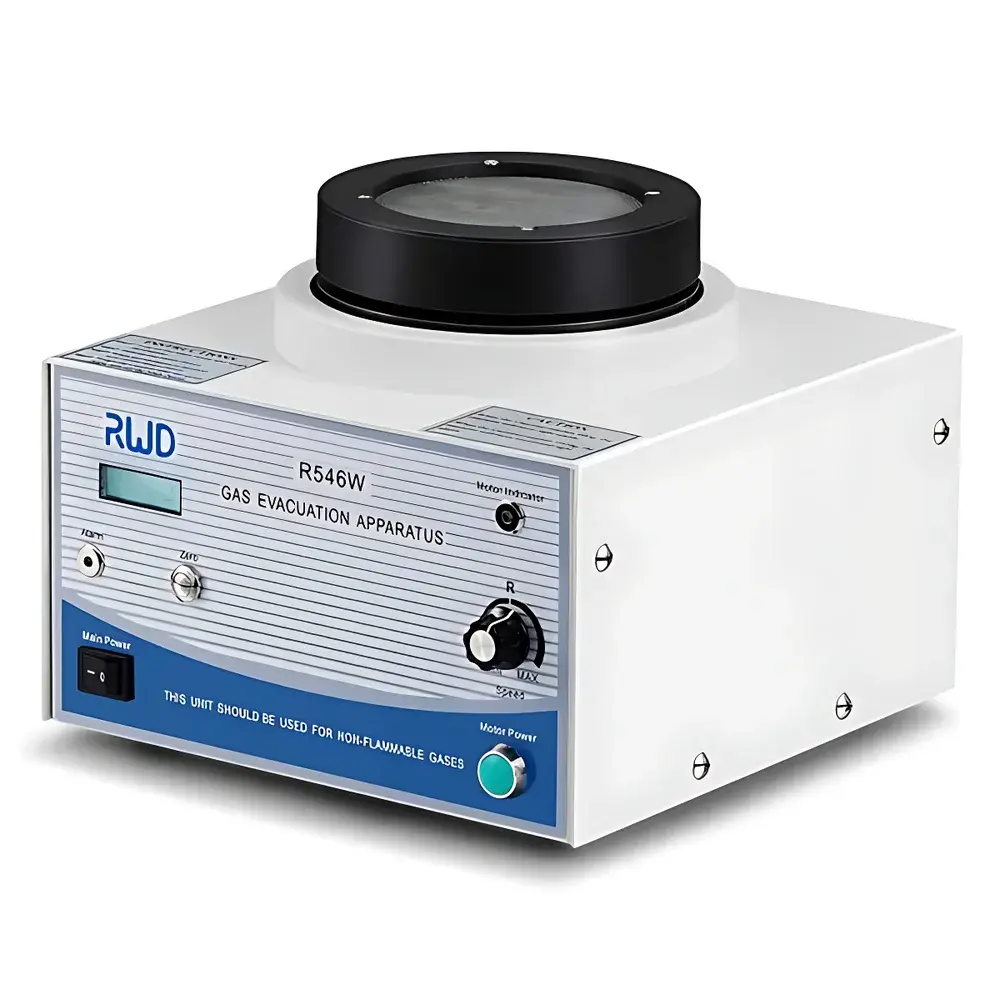
RWD V101 Anesthetic Gas Scavenging System
| Brand | RWD |
|---|---|
| Origin | Shenzhen, China |
| Manufacturer Type | Direct Manufacturer |
| Country of Origin | China |
| Model | V101 |
| Quotation | Upon Request |
| Dimensions | 232 × 200 × 184 mm |
| Flow Rate | 8–60 L/min |
| Weighing Range | 1–2000 g |
| Filter Canister Opening Diameter | 124 mm |
| Operating Voltage | 100–240 V, 50/60 Hz |
| Noise Level | <50 dB(A) |
| Display | LED with real-time flow and weight readout |
| Acoustic Design | Four-sided noise reduction enclosure with one-touch mute function |
Overview
The RWD V101 Anesthetic Gas Scavenging System is an engineered solution for safe and compliant removal of waste anesthetic gases (WAGs) from animal ventilator circuits and anesthesia delivery systems in preclinical research laboratories. Designed in accordance with occupational health standards—including OSHA PELs (Permissible Exposure Limits) and NIOSH recommendations—the V101 operates on a negative-pressure principle to actively capture exhaled or scavenged halogenated anesthetics (e.g., isoflurane, sevoflurane, desflurane) and nitrous oxide before they enter the ambient laboratory environment. Its core function is to protect personnel—especially veterinarians, technicians, and researchers performing repeated or prolonged animal procedures—from chronic low-level exposure, which has been associated with reproductive risks, cognitive effects, and hepatic enzyme induction in epidemiological studies. The system integrates a high-efficiency activated carbon filter canister (not included) and employs laminar-flow suction dynamics to ensure consistent capture efficiency across its full operational flow range.
Key Features
- Wide Adjustable Flow Range: Precisely controllable suction from 8 to 60 L/min, enabling compatibility with single-rodent, multi-rodent, and small-large animal ventilators (e.g., mice to rabbits), as well as standalone vaporizer circuits.
- Integrated Real-Time Monitoring: Dual-parameter LED display simultaneously shows instantaneous flow rate (L/min) and real-time canister weight (g), supporting proactive maintenance scheduling and regulatory documentation.
- Weigh-Based Saturation Alert: Programmable weight threshold alarm notifies users when the filter canister approaches saturation (e.g., at 1800 g), minimizing risk of breakthrough and ensuring adherence to filter replacement intervals per ISO 8573-1 and manufacturer specifications.
- Low-Noise Engineering: Four-sided acoustic shielding combined with vibration-damped internal components achieves sustained operation below 50 dB(A) at 1 m—meeting quiet-zone requirements for AAALAC-accredited facilities and shared imaging or electrophysiology suites.
- Compact Footprint & Ergonomic Integration: At just 232 × 200 × 184 mm, the V101 fits seamlessly beneath lab benches, inside ventilator racks, or adjacent to anesthesia stations without obstructing workflow or compromising access to animal monitoring equipment.
- Universal Power Compatibility: Auto-ranging 100–240 V, 50/60 Hz input eliminates need for external transformers, supporting deployment across North America, EU, APAC, and multi-site global research consortia.
Sample Compatibility & Compliance
The V101 is validated for use with standard 124-mm-diameter cylindrical activated carbon canisters commonly supplied by major filtration vendors (e.g., Datex-Ohmeda, Puritan Bennett, RWD-compatible cartridges). It supports both active (vacuum-driven) and passive (flow-assisted) scavenging configurations when interfaced with RWD’s V300 series ventilators or third-party anesthesia machines equipped with 22 mm ID scavenging ports. The device complies with IEC 61000-6-3 (EMC emission limits) and meets mechanical safety requirements per IEC 61010-1 for laboratory equipment. While not a medical device per FDA 21 CFR Part 820, it aligns with GLP Annex 11 data integrity expectations via timestamped weight logging (when paired with optional RS-232/USB output module) and supports audit-ready records for AAALAC International accreditation reviews.
Software & Data Management
Standalone operation requires no software; all critical parameters are accessible via the front-panel LED interface. For labs requiring traceability, an optional communication module enables serial (RS-232) or USB-C output of time-stamped flow and weight data to LIS or ELN platforms (e.g., LabArchives, Benchling). Exported CSV logs include UTC timestamps, cumulative runtime, and delta-weight trends—facilitating retrospective analysis of filter service life and correlation with procedural volume. No proprietary drivers or cloud dependencies are required; raw ASCII data streams integrate natively with Python-based lab automation frameworks or LabVIEW DAQ systems.
Applications
- Scavenging exhaust from rodent and lagomorph ventilators during longitudinal neurophysiology, cardiovascular, or metabolic phenotyping studies.
- Integration into surgical suites performing survival surgeries under inhalational anesthesia (e.g., craniotomies, thoracotomies, orthotopic tumor implantation).
- Supporting compliance in core facilities where multiple users share anesthesia workstations—ensuring consistent WAG control regardless of operator experience level.
- Enabling safe use of high-flow isoflurane protocols (>2 L/min) in behavioral assays requiring rapid induction/recovery cycles.
- Supplementing central vacuum scavenging systems in decentralized vivaria or mobile field labs where infrastructure vacuum is unavailable or unstable.
FAQ
Does the V101 include a filter canister?
No—the V101 is supplied without a filter canister. Users must procure compatible 124-mm-diameter activated carbon cartridges separately, selected based on expected anesthetic agent, exposure duration, and institutional environmental health policies.
Can the V101 be used with non-RWD ventilators?
Yes—it accepts standard 22 mm OD scavenging tubing and operates independently of ventilator brand, provided the source system provides a dedicated scavenging port with adequate backpressure tolerance (<10 cm H2O).
Is calibration required prior to first use?
The built-in load cell and mass flow sensor are factory-calibrated and do not require user recalibration. Annual verification using NIST-traceable test weights (100 g, 1000 g) is recommended for GLP-compliant environments.
What maintenance intervals are recommended?
Inspect inlet filters monthly; replace if clogged. Monitor weight trend daily—replace canister upon reaching 90% of rated adsorption capacity or per institutional SOP, typically every 40–80 hours of continuous use depending on anesthetic concentration and flow rate.
Does the V101 meet UL or CE safety certification?
It carries CE marking per Directive 2014/30/EU (EMC) and 2014/35/EU (LVD), and conforms to EN 61000-6-3 and EN 61010-1. UL listing is not pursued as the device falls outside UL 61010-1’s scope for “medical electrical equipment.”
Related Products