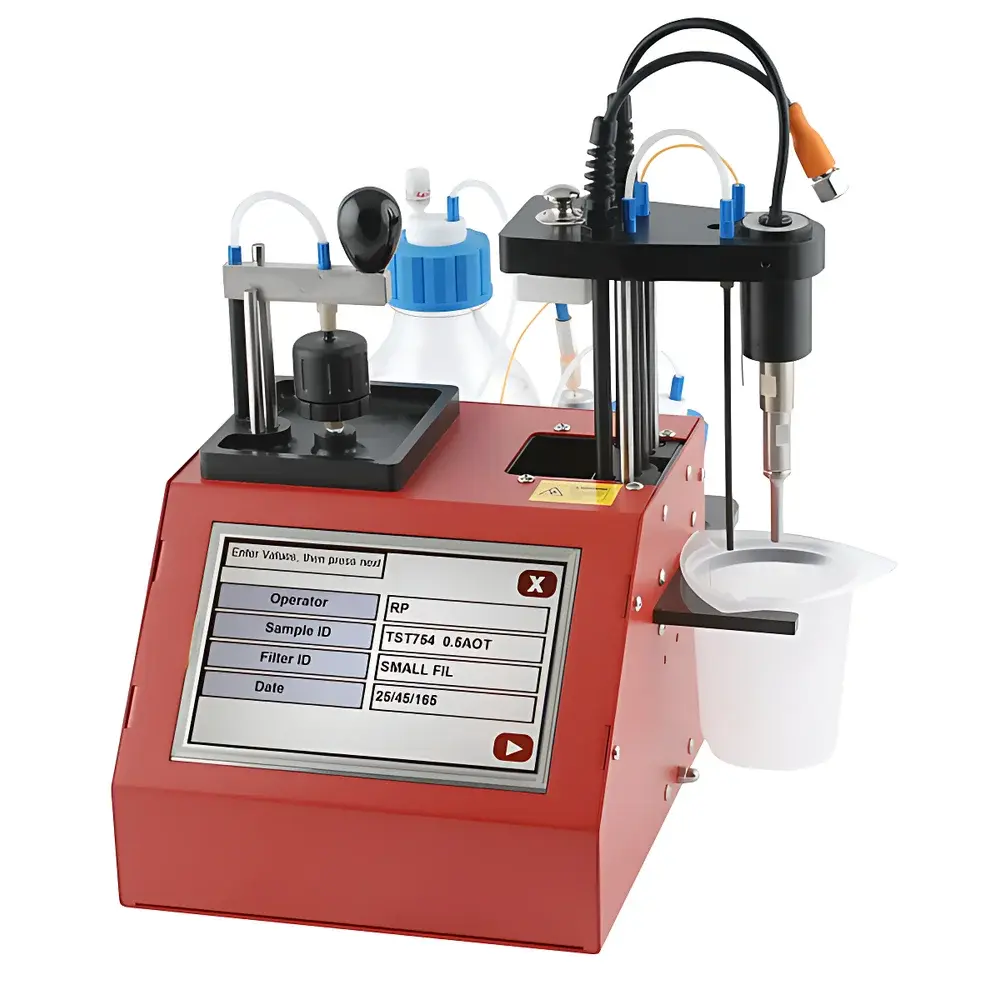
SA9000 Jet Fuel Water Separation Analyzer
| Brand | SETA |
|---|---|
| Origin | United Kingdom |
| Model | SA9000-0 |
| Compliance | ASTM D1655, ASTM D8073, IP 624 |
| Automation Level | Fully Automated Sample Handling |
| Mixing Technology | Patented 40 kHz Ultrasonic Homogenizer with Resonant Ceramic Transducer |
| Water Detection Limit | <1 ppm (by mass) |
| Emulsification Method | Acoustic Cavitation in Fuel-Water Mixtures |
| Filter Test Medium | Fifth-Generation Hydrophobic Coalescer Media |
| Sample Preparation | Precision Volumetric Dispensing System |
Overview
The SA9000 Jet Fuel Water Separation Analyzer is a fully automated benchtop instrument engineered for precise, repeatable evaluation of aviation turbine fuel (Jet A, Jet A-1, JP-8) water separation performance—critical for compliance with modern fuel specification standards including ASTM D1655 and the updated test requirements defined in JIG No. 121 Product Quality Bulletin. Unlike manual or semi-automated alternatives, the SA9000 implements a rigorously controlled acoustic emulsification process based on cavitation physics to generate stable, metrologically traceable water-in-fuel dispersions. The system then subjects these emulsions to standardized coalescence and filtration through fifth-generation hydrophobic coalescer media under regulated flow conditions. Water content downstream of the filter is quantified using a high-sensitivity detection module calibrated to resolve sub-1 ppm (mass basis) residual water concentrations—enabling discrimination between marginal and non-compliant fuel batches with statistical confidence.
Key Features
- Fully automated sample handling and test sequencing—eliminates operator variability and ensures protocol adherence across shifts and laboratories.
- Patented 40 kHz ultrasonic homogenization system featuring a custom-designed resonant ceramic transducer coupled to a precision-machined titanium probe—delivers consistent acoustic energy density for reproducible droplet size distribution (DSD) generation.
- Acoustic emulsification mode operates under ISO/IEC 17025-aligned environmental controls (temperature-stabilized chamber, inert gas purge option) to minimize volatility-related artifacts during dispersion formation.
- Integrated volumetric dispensing system with gravimetric verification ensures ±0.2% accuracy in fuel and water dosing—essential for method fidelity per ASTM D8073 Section 7.2.
- Detection subsystem employs dual-wavelength near-infrared (NIR) absorption spectroscopy with temperature-compensated calibration curves validated against Karl Fischer coulometric reference measurements.
- Modular coalescer test stage accepts industry-standard 3-inch diameter disc filters and cylindrical cartridges; pressure drop monitoring complies with IP 624 Annex B requirements.
Sample Compatibility & Compliance
The SA9000 is validated for use with aviation turbine fuels meeting ASTM D1655 specifications, including Jet A, Jet A-1, and military-grade JP-8. It supports testing of fuel samples containing dissolved water up to saturation limit (~30 ppm at 20 °C), as well as artificially spiked emulsions prepared per ASTM D8073 Annex A1. All operational parameters—including ultrasonic power output, exposure duration, flow rate (0.5–2.0 L/min), and dwell time—are programmable and logged with timestamped metadata to satisfy GLP and GMP audit requirements. The system meets mechanical safety standards per IEC 61010-1 and electromagnetic compatibility per EN 61326-1. Full traceability to NIST-traceable water standards is maintained via annual calibration using certified reference materials (CRM-WS-01 series).
Software & Data Management
Instrument control and data acquisition are managed by SETA’s proprietary Analytical Suite v5.3—a Windows-based application compliant with FDA 21 CFR Part 11 for electronic records and signatures. Audit trails capture all user actions, parameter changes, calibration events, and raw spectral data with immutable timestamps. Reports export in PDF/A-2b format with embedded digital signatures and configurable templates aligned with internal QA documentation workflows. Data archiving supports networked storage with role-based access control (RBAC), and optional integration with LIMS via ASTM E1578-compliant API endpoints.
Applications
- Quality assurance testing at refinery off-gas points and pipeline terminals prior to aircraft refueling.
- Evaluation of coalescer media aging and fouling effects on water removal efficiency over service life.
- Development and validation of fuel additives designed to modify interfacial tension and coalescence kinetics.
- Root-cause analysis of field-reported filter plugging incidents linked to anomalous emulsion stability.
- Supporting JIG Task Force working groups in method harmonization efforts between ASTM and EI/IP standards bodies.
FAQ
What standards does the SA9000 directly support?
ASTM D1655 (Specification for Aviation Turbine Fuels), ASTM D8073 (Standard Test Method for Evaluation of Water Separation Characteristics of Aviation Turbine Fuels), and IP 624 (Determination of Water Separation Characteristics of Aviation Fuels).
Is the ultrasonic mixing process validated for droplet size distribution?
Yes—system validation includes laser diffraction particle sizing (Malvern Mastersizer 3000) of representative emulsions, confirming log-normal DSD with d50 = 12–18 µm and CV < 8% across 100+ replicate runs.
Can the SA9000 be used for non-aviation fuels such as diesel or biodiesel blends?
Not without revalidation; the acoustic coupling, coalescer geometry, and detection algorithm are optimized for jet fuel’s low viscosity (~8 mm²/s at 20 °C) and narrow boiling range. Diesel applications require hardware and software modifications under SETA’s Engineering Change Notice (ECN) process.
Does the system provide raw spectral data for secondary analysis?
Yes—full-resolution NIR absorbance spectra (1100–2500 nm, 1 nm step) are stored in HDF5 format alongside processed concentration values and are accessible via the software’s Data Export Wizard.
How often must the ultrasonic transducer be recalibrated?
Transducer output power is verified daily using a calibrated hydrophone (Onda HNC-1000); full transducer calibration is recommended annually or after 2,000 operating hours, per SETA Calibration Protocol CP-SA9000-ULTRA-02.