
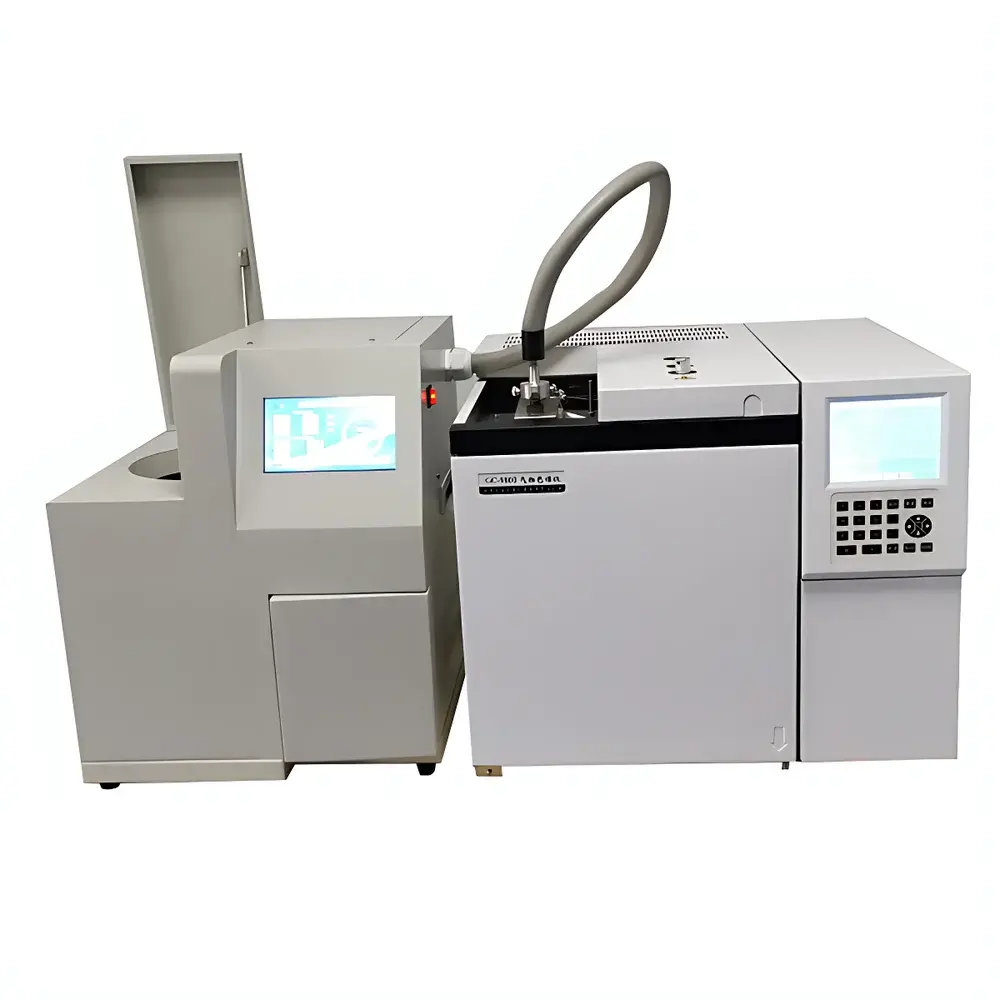
Sanpu 2AHS-20A Plus Fully Automated Static Headspace Sampler for Ethylene Oxide Residue Analysis in Medical Face Masks
| Brand | Sanpu |
|---|---|
| Origin | Beijing, China |
| Manufacturer Type | Direct Manufacturer |
| Instrument Type | Static Headspace Sampler |
| Automation Level | Fully Automatic |
| Vial Heating Range | Ambient to 200 °C (1 °C increments) |
| Valve Temperature Control Range | 40–220 °C (±1 °C accuracy) |
| Sample Loop Volume | 1 mL |
| Sample Capacity | 20 positions |
| Compatible Vial Sizes | 10 mL or 20 mL vials |
Overview
The Sanpu 2AHS-20A Plus is a fully automated static headspace sampler engineered for precise, reproducible quantification of residual ethylene oxide (EO) in single-use medical face masks and other sterilized healthcare products. It operates on the principle of equilibrium headspace gas-phase extraction, where EO residues volatilize from solid or semi-solid samples into the sealed headspace above the sample matrix under controlled temperature and time conditions. The equilibrated vapor is then transferred via a thermostated sampling valve and quantitative loop into a gas chromatograph (GC) equipped with a flame ionization detector (FID). This methodology complies with the fundamental analytical framework specified in ISO 10993-7:2015 (identical to GB/T 16886.7–2015), which mandates headspace-GC as the reference method for EO residue testing in medical devices. The system’s robust thermal architecture—featuring independent, high-stability heating zones for vials, transfer lines, and the injection valve—ensures minimal analyte loss, excellent peak shape, and long-term method robustness across regulatory QC environments.
Key Features
- Fully automated 20-position carousel with programmable sequence control, enabling unattended batch analysis of up to 20 samples per run
- Independent temperature control for vial block (ambient–200 °C, ±0.5 °C uniformity) and sampling valve (40–220 °C, ±1 °C stability), critical for optimizing EO partitioning and preventing condensation
- 1 mL fixed-volume quantitative loop ensures consistent injection volume and eliminates manual syringe variability
- Integrated pressure-balanced vial pressurization system minimizes carryover and improves transfer efficiency for low-boiling, highly volatile EO
- Intuitive touchscreen interface with password-protected method storage, audit trail logging, and real-time status monitoring
- Modular design compatible with all major GC platforms (Agilent, Shimadzu, Thermo, and domestic GC-9860 series), supporting seamless integration into existing laboratory workflows
Sample Compatibility & Compliance
The 2AHS-20A Plus accommodates standard 10 mL and 20 mL crimp-top headspace vials, allowing direct analysis of extracted mask specimens without solvent dilution or derivatization. Its thermal performance meets the stringent requirements of ISO 10993-7:2015 Annex B for EO determination in polypropylene-based surgical masks and N95 respirators. When paired with a GC-FID system operating under validated conditions (e.g., SE-54 or SE-30 capillary column, nitrogen carrier gas at constant pressure, FID at 250 °C), the complete workflow satisfies GLP and GMP documentation standards. Full traceability is supported through electronic method files, instrument event logs, and user-accessible calibration records—features aligned with FDA 21 CFR Part 11 expectations for data integrity in regulated quality control laboratories.
Software & Data Management
The sampler operates via Sanpu’s proprietary HS-Control software, designed for method development, sequence programming, and real-time diagnostics. Each run generates a timestamped metadata file containing vial position, equilibration time/temperature, injection time, valve temperature history, and error flags. Raw method parameters—including vial heat time, agitation speed (if enabled), pressurization duration, and loop fill/flush cycles—are exportable in CSV format for LIMS integration. Software updates are provided free of charge for the instrument’s lifetime, with version-controlled release notes and compatibility verification reports available upon request. All software modules undergo internal validation per IQ/OQ protocols prior to deployment.
Applications
Primary applications include residual EO quantification in Class I–III medical devices such as surgical masks, gowns, drapes, catheters, and syringes. The system is also employed in raw material screening (e.g., nonwovens, adhesives, packaging films), process validation studies for EO sterilization cycles, and stability testing during post-sterilization aging (aeration). Beyond medical use, it supports environmental monitoring of EO emissions from sterilization facilities and occupational hygiene assessments in manufacturing cleanrooms—where detection limits down to 0.1 µg/g (ppm) are routinely achieved using optimized GC-FID parameters and certified reference standards.
FAQ
What is the recommended equilibration temperature and time for mask samples?
Standard protocols specify 70 °C for 60 minutes, though method optimization may extend to 80 °C for 45 minutes depending on fabric density and EO diffusion kinetics.
Can the 2AHS-20A Plus be used with cryogenic trapping or cold injection techniques?
No—it is configured exclusively for static headspace analysis; dynamic headspace or purge-and-trap configurations require separate instrumentation.
Is method transfer support available for laboratories migrating from manual or semi-automated headspace systems?
Yes. Sanpu provides documented SOPs, comparative precision studies, and on-site method verification services as part of its turnkey implementation package.
How is system suitability verified before routine analysis?
Daily verification includes repeated injections of a 2 µg/mL EO standard to confirm retention time stability (±0.2 min), peak area RSD ≤3%, and absence of ghost peaks indicative of carryover.
Does the instrument comply with ISO/IEC 17025 requirements for accredited testing laboratories?
When operated within a validated method and supported by documented calibration certificates, maintenance logs, and analyst training records, the system fulfills technical requirement clauses 6.4 (equipment) and 6.6 (traceability) of ISO/IEC 17025:2017.





