
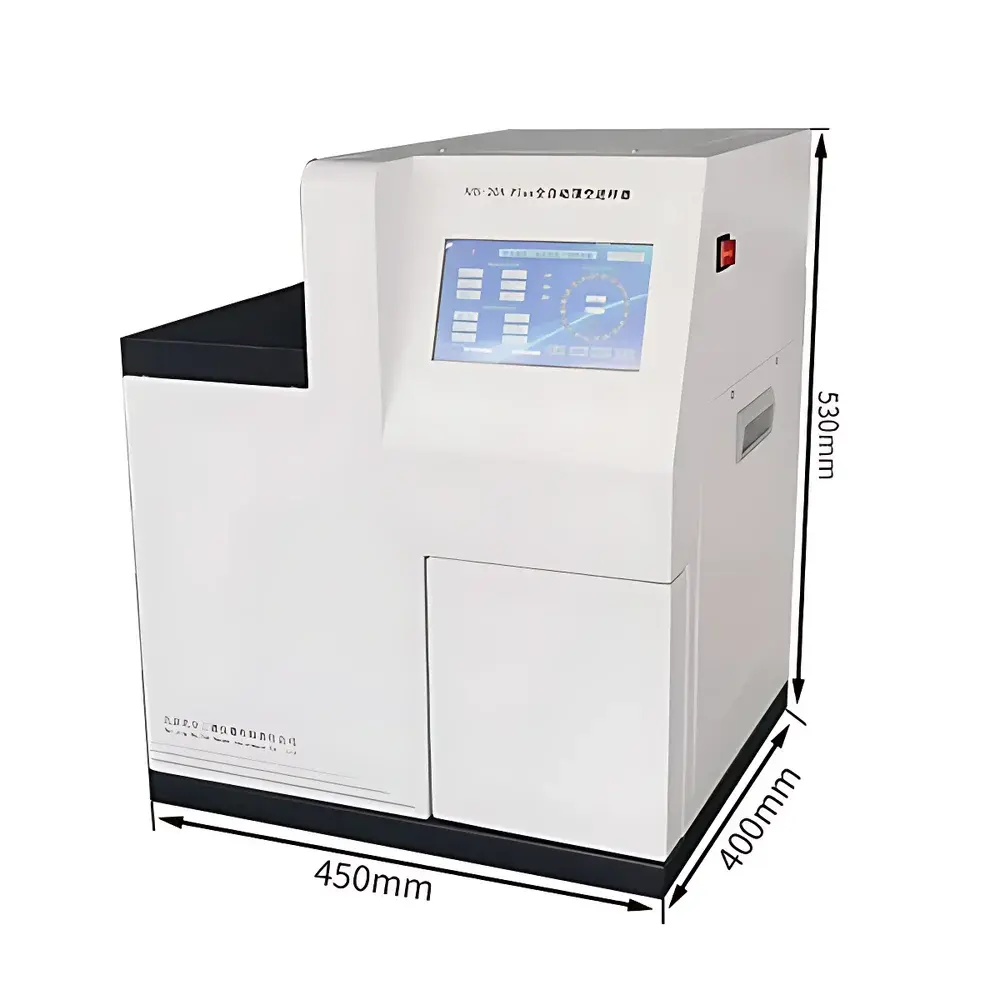
Sanpu AHS-20A Plus Fully Automated Static Headspace Sampler
| Brand | Sanpu |
|---|---|
| Origin | Beijing, China |
| Manufacturer Type | Direct Manufacturer |
| Instrument Type | Static Headspace Sampler |
| Automation Level | Fully Automated |
| Sample Vial Heating Range | 40–220 °C (±1 °C) |
| Valve Heating Range | 40–220 °C (±1 °C) |
| Transfer Line Heating Range | 40–220 °C (±1 °C) |
| Temperature Stability | < ±0.5 °C |
| Temperature Accuracy | ±0.1 °C |
| Pressurization Time | 0–999 s |
| Sampling Time | 0–30 min |
| Injection Time | 0–999 s |
| Bake-out Time | 0–30 min |
| Minimum Time Resolution | 1 ms |
| Pressurization Pressure | 0–0.25 MPa (continuously adjustable) |
| Loop Volume | 1 mL (optional: 0.5 mL, 2 mL, 3 mL, 5 mL) |
| Vial Capacity | 20 positions |
| Vial Sizes Supported | 10 mL and 20 mL (customizable up to 100 mL) |
| RSD | < 1.0% (measured with 100 ppm ethanol in water) |
| Purge Flow Rate | 0–100 mL/min (continuously adjustable) |
| Synchronization | GC trigger, data system start, external event input |
| Communication Interface | USB 2.0 |
| Display | 7-inch TFT LCD with Chinese/English UI |
| Power Supply | AC 220 V ± 10%, 50/60 Hz |
Overview
The Sanpu AHS-20A Plus Fully Automated Static Headspace Sampler is an engineered solution for reproducible, high-throughput volatile organic compound (VOC) analysis in compliance with standardized gas chromatography (GC) workflows. It operates on the principle of static headspace equilibrium—where a sealed sample vial is heated to promote partitioning of analytes between the condensed phase (liquid or solid matrix) and the vapor phase above it. Following thermal equilibration, a precise volume of headspace gas is pressurized into a thermostatted six-port valve and transferred via heated transfer lines directly into the GC injection port. This method eliminates solvent interference, minimizes matrix effects, and ensures compatibility with flame ionization detection (FID), electron capture detection (ECD), mass spectrometry (MS), and other GC-compatible detectors. Designed for routine QC laboratories, environmental testing facilities, pharmaceutical stability studies, and forensic toxicology labs, the AHS-20A Plus delivers robust performance under GLP/GMP-aligned operational conditions.
Key Features
- Fully automated 20-position carousel with automatic vial recognition and positional fault avoidance—prevents mechanical collision during unattended operation.
- Triple-zone independent temperature control: sample vial oven (40–220 °C), six-port valve (40–220 °C), and transfer line (40–220 °C), all maintained within ±0.1 °C stability and ±1 °C accuracy.
- High-inertness fluidic path: de-activated fused-silica or SilcoNert®-treated stainless-steel tubing throughout the sampling loop, valve, and transfer line to eliminate carryover and adsorption artifacts.
- Zero-dead-volume six-port valve configuration with internal loop integration—ensures quantitative precision and long-term repeatability (RSD < 1.0% at 100 ppm ethanol in water).
- Positive-pressure sampling architecture: enables direct analysis of liquids, slurries, powders, and semi-solids without derivatization or extraction; maintains baseline stability during GC injection due to atmospheric-pressure introduction.
- Motor-driven actuation system—no external carrier gas or pneumatic supply required—reduces infrastructure dependencies and improves lab safety.
- Configurable timing parameters: pressurization (0–999 s), equilibration (0–30 min), sampling (0–999 s), and bake-out (0–30 min) with millisecond-level resolution (1 ms step).
- Integrated USB 2.0 interface supporting bidirectional communication with third-party GC data systems (e.g., Agilent OpenLab, Thermo Chromeleon, Shimadzu LabSolutions) for synchronized method execution and audit-trail generation.
Sample Compatibility & Compliance
The AHS-20A Plus accommodates standard 10 mL and 20 mL crimp-top or screw-cap headspace vials, with optional support for 50 mL and 100 mL formats upon request. It is validated for use with aqueous solutions, biological fluids (urine, serum), polymers, soils, food matrices, and pharmaceutical dosage forms. The instrument conforms to key regulatory expectations for analytical instrumentation, including alignment with ASTM D6866 (bio-based content), USP (residual solvents), ISO 17025 (method validation requirements), and FDA 21 CFR Part 11 (electronic records and signatures) when deployed with compliant GC software and procedural controls. Its thermal uniformity, pressure regulation fidelity, and inert flow path meet the technical prerequisites for ICH Q2(R2)-guided method robustness assessments.
Software & Data Management
Local operation is managed through a 7-inch graphical TFT-LCD interface featuring bilingual (Chinese/English) menus, animated workflow guidance, and real-time status monitoring—including vial position indexing, temperature profiles, elapsed cycle time, and system error logs. All method parameters—including temperature ramps, timing sequences, purge flows (0–100 mL/min), and pressure setpoints (0–0.25 MPa)—are programmable either via front-panel navigation or remote USB command protocol. When connected to GC data systems, the sampler supports hardware-triggered acquisition initiation and timestamp-synchronized event logging. Audit trails—including user ID, parameter changes, run start/stop timestamps, and fault codes—are retained in non-volatile memory and exportable as CSV for QA review. Optional EPC (Electronic Pressure Control) module enhances long-term pressure consistency and reduces manual recalibration frequency.
Applications
- Pharmaceutical residual solvent analysis per ICH Q3C guidelines (e.g., acetone, dichloromethane, ethyl acetate in APIs and excipients).
- Environmental VOC screening in groundwater, wastewater, and soil extracts (EPA Method 502.2, 524.4, 8260D).
- Food and beverage quality control: ethanol quantification in beverages, flavor compound profiling, packaging migration studies.
- Forensic toxicology: blood alcohol concentration (BAC) determination and volatile drug metabolite screening.
- Polymer and coating manufacturing: monomer residue detection, catalyst removal verification, and outgassing characterization.
- Chemical process monitoring: reaction headspace composition tracking for kinetic modeling and endpoint detection.
FAQ
Is the AHS-20A Plus compatible with all major GC brands?
Yes—it interfaces seamlessly with Agilent, Thermo Fisher, Shimadzu, PerkinElmer, and国产 GC systems via TTL-level trigger signals and USB-based parameter synchronization.
Can the instrument perform multiple injections from a single vial?
Yes—supports single-vial multi-injection mode with user-defined intervals, enabling replicate analysis without manual intervention.
What maintenance is required for long-term reliability?
Routine tasks include quarterly inspection of septa and O-rings, annual calibration of temperature sensors using NIST-traceable references, and periodic cleaning of the transfer line and valve with appropriate solvents.
Does the system support 21 CFR Part 11 compliance?
The hardware supports electronic signature and audit trail functions; full Part 11 compliance requires implementation of validated GC software, access controls, and procedural SOPs per laboratory quality system requirements.
Are custom vial heating configurations available?
Yes—extended temperature range (up to 300 °C) and dual-zone vial heating (for heterogeneous samples) are available as factory-configured options.
Related Products




