
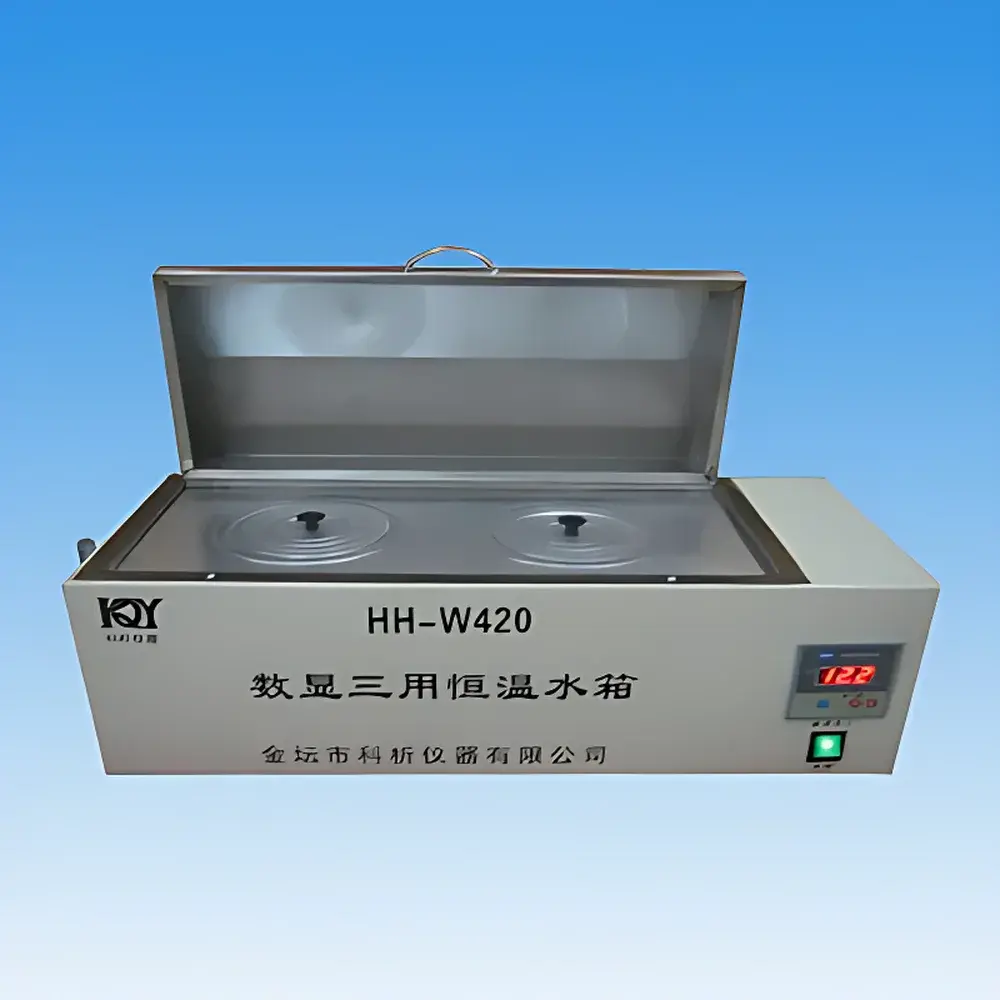
Sanpu HH-W420 Digital Display Constant-Temperature Water Bath
| Brand | Sanpu |
|---|---|
| Model | HH-W420 |
| Type | Benchtop Water Bath |
| Heating Power | 1000 W |
| Tank Dimensions (L×W×H) | 420 × 180 × 200 mm |
| Temperature Range | Ambient to 100 °C |
| Control Accuracy | ±0.5 °C (typical) |
| Power Supply | 220 V AC, 50 Hz |
| Construction | Inner tank — 304 stainless steel |
| Sensor | Immersed stainless steel RTD probe |
| Compliance | CE-marked design principles, compatible with GLP laboratory workflows |
Overview
The Sanpu HH-W420 Digital Display Constant-Temperature Water Bath is a precision-engineered benchtop thermal platform designed for stable, uniform heat transfer in routine laboratory applications. Operating on the principle of convective thermal equilibrium within a water medium, it delivers consistent temperature control across its stainless-steel bath chamber—enabling reproducible conditions essential for sample incubation, solvent evaporation, enzymatic reactions, chemical hydrolysis, and reagent warming. Its analog-digital hybrid control architecture integrates a platinum resistance thermometer (PT100-type) sensor directly immersed in the water column, coupled with a microprocessor-based PID controller that minimizes overshoot and stabilizes setpoints within ±0.5 °C under standard ambient conditions. Unlike circulating baths, the HH-W420 employs a static water reservoir configuration optimized for simplicity, energy efficiency, and low-maintenance operation—making it especially suitable for teaching labs, QC environments, and preparatory workflows where precise yet non-dynamic thermal exposure is required.
Key Features
- Digitally calibrated temperature control interface with LED display, enabling direct setpoint entry from ambient (RT) to 100 °C in 0.1 °C increments
- High-efficiency 1000 W heating element embedded centrally within the water volume for rapid thermal response and minimized vertical temperature gradients
- Corrosion-resistant 304 stainless-steel inner tank (420 × 180 × 200 mm) fabricated via full TIG welding to ensure leak integrity and long-term chemical compatibility
- Dual-layer housing: powder-coated cold-rolled steel exterior provides mechanical durability and electrical insulation; integrated grounding terminal supports IEC 61000-6-3 EMC compliance
- Over-temperature cut-off circuit and dry-run protection logic prevent heater activation when water level falls below minimum immersion depth
- No external pump or tubing required—eliminates maintenance points associated with recirculating systems while maintaining thermal homogeneity via natural convection
Sample Compatibility & Compliance
The HH-W420 accommodates standard laboratory glassware including beakers (up to 1000 mL), Erlenmeyer flasks, test tubes, and reaction vials placed directly into the water bath. Its open-top design allows unrestricted access for stirring rods, thermometers, or sampling probes. The unit complies with fundamental safety requirements aligned with IEC 61010-1 for electrical equipment used in laboratory settings. While not certified to UL/CSA standards out-of-the-box, its grounding configuration, insulated heater mounting, and thermal cutoff mechanisms meet baseline GLP infrastructure expectations. For regulated environments, users may document calibration procedures per ISO/IEC 17025 guidelines using traceable NIST-traceable reference thermometers. It is routinely deployed in accordance with ASTM D1217 (density of liquids), USP (aseptic compounding support), and ISO 8573-1 (compressed air testing pre-conditioning).
Software & Data Management
The HH-W420 operates as a standalone analog-digital instrument without embedded firmware connectivity or remote interface capabilities. Temperature logging requires external data acquisition—typically achieved via integration with third-party USB thermocouple interfaces or wireless PT100 transmitters. However, its stable thermal output and repeatable ramp-hold profiles make it fully compatible with LIMS-integrated validation protocols. When used in GMP-compliant facilities, operators perform periodic verification using calibrated secondary standards, with records maintained manually or entered into electronic lab notebooks (ELNs) supporting 21 CFR Part 11 audit trails. The controller’s auto-tuning function eliminates manual PID coefficient adjustment, reducing operator dependency during routine qualification.
Applications
- Controlled-temperature sample preparation prior to HPLC, GC, or spectrophotometric analysis
- Hydration/dehydration studies of hydrogels and polymer matrices
- Standardized dissolution testing of pharmaceutical tablets (as auxiliary heating stage)
- Cell culture reagent equilibration at 37 °C or other physiologically relevant temperatures
- Accelerated stability testing per ICH Q1A(R3) guidelines (e.g., 40 °C/75% RH preconditioning of packaging materials)
- Distillation support for low-boiling-point solvents in organic synthesis workflows
FAQ
What is the minimum safe water level required before powering on the HH-W420?
The water level must fully submerge the heating element—approximately 50 mm above the tank base. Operation below this threshold risks irreversible heater damage and electrical hazard.
Can the HH-W420 maintain temperature uniformity across the entire bath volume?
Yes—under static conditions and with proper loading (≤75% tank capacity), radial and vertical temperature deviation remains ≤±0.8 °C at 37 °C and ≤±1.2 °C at 100 °C, verified per ASTM E1112 methodology.
Is the unit suitable for use with corrosive solutions such as acidic or alkaline buffers?
Only short-term exposure is recommended. While the 304 stainless steel resists mild corrosion, prolonged contact with pH 10 solutions may degrade weld integrity over time. Use glass inserts for aggressive chemistries.
Does the HH-W420 support external temperature probe input for independent verification?
No—the controller accepts only its internal RTD signal. For independent monitoring, deploy a calibrated external probe adjacent to the load zone and record deviations manually.
How often should the unit undergo performance verification?
Per ISO/IEC 17025 Annex A.2, verification is recommended before each critical batch, after relocation, and at least daily in regulated QC labs—using a reference thermometer with ±0.1 °C uncertainty.



