
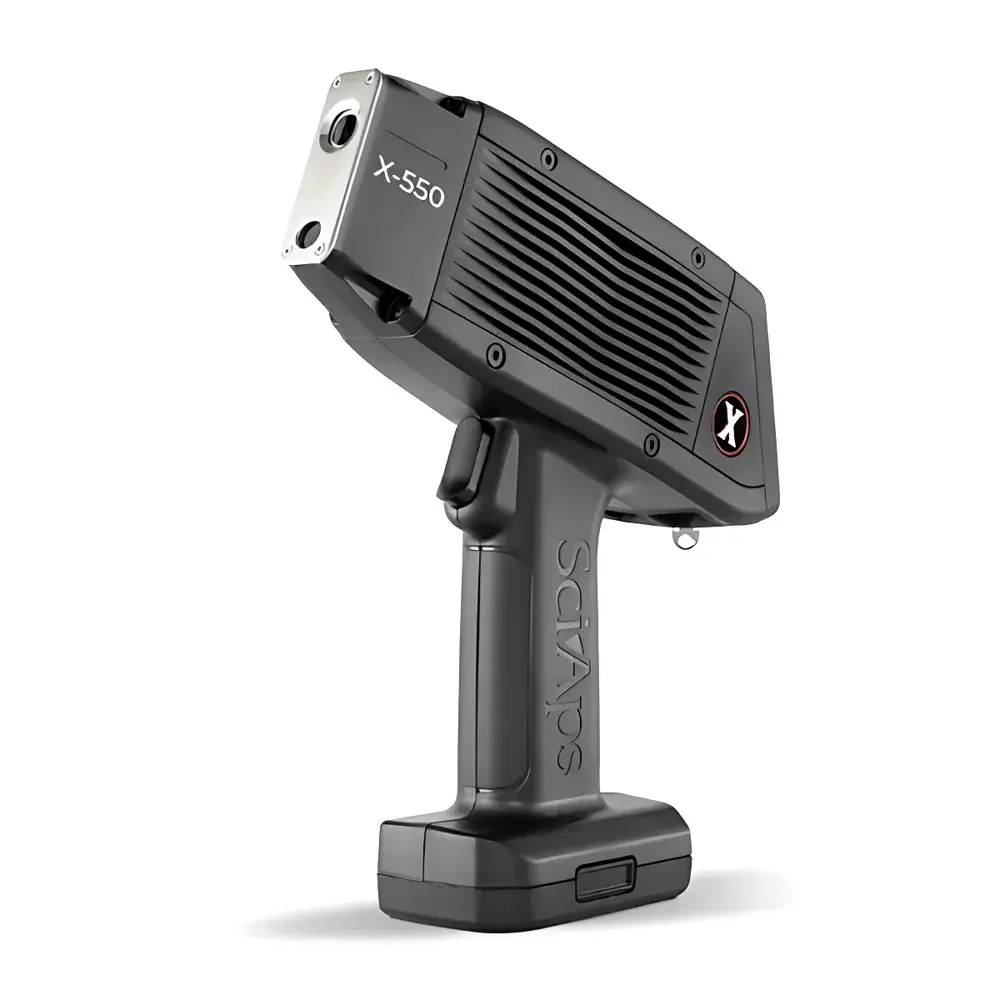
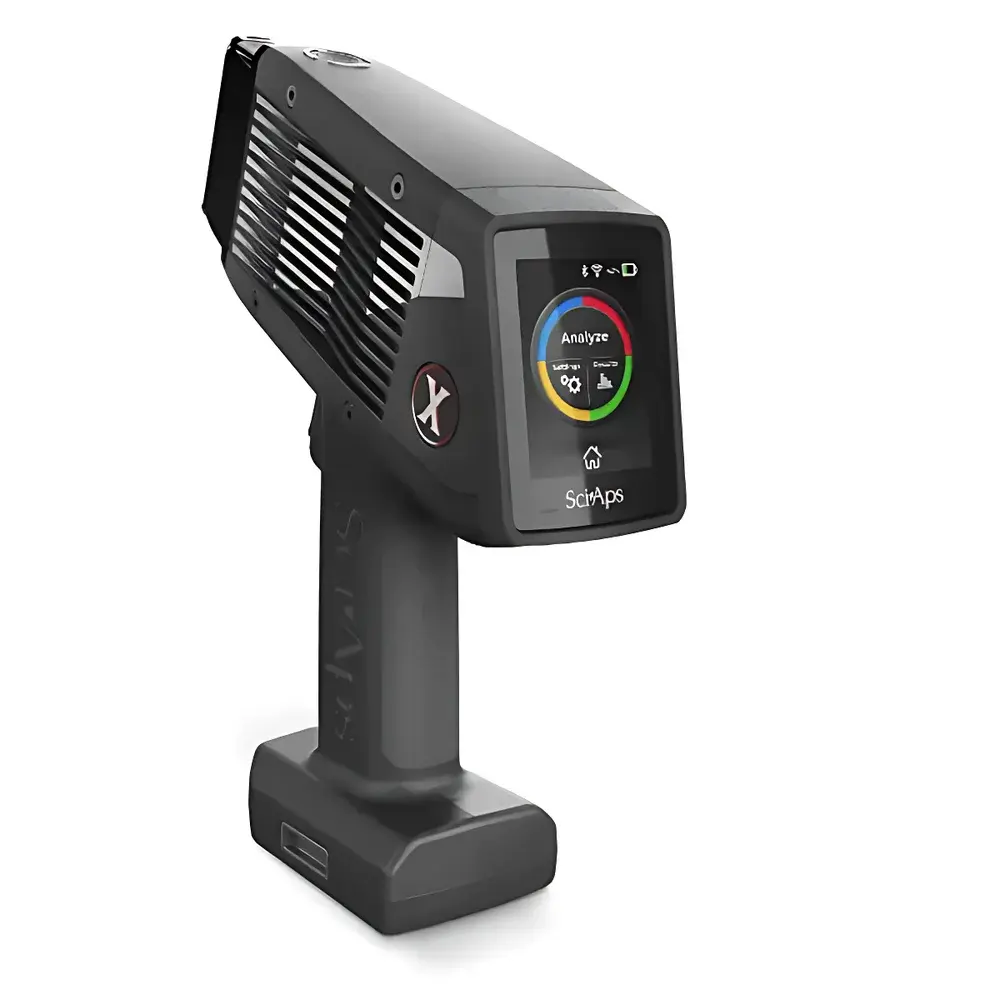
SciAps X-550 Portable Energy Dispersive X-Ray Fluorescence (ED-XRF) Spectrometer
| Brand | SciAps |
|---|---|
| Origin | USA |
| Model | X-550 |
| Detector | 20 mm² Silicon Drift Detector (SDD), 140 eV FWHM resolution at 5.95 keV Mn Kα |
| Excitation Source | Rh anode (40 kV / 200 µA for alloys |
| Elemental Range | Standard 32 elements (Mg–U), configurable per application |
| Sample Form | Solid, powdered, or coated surfaces (non-destructive) |
| Weight | 1.35 kg (2.98 lb) with battery |
| Dimensions | 216 × 241 × 61 mm (8.5 × 9.5 × 2.4 in) |
| Display | 2.7″ color capacitive touchscreen, sunlight-readable |
| Processor | 1.2 GHz quad-core ARM Cortex-A53 (64/32-bit), 2 GB LP-DDR3 RAM, 16 GB eMMC storage |
| Battery | Rechargeable Li-ion, hot-swappable (≤60 s swap time) |
| Regulatory Compliance | CE, RoHS, US FDA 21 CFR Part 820 registered, ISED Canada RED compliant |
| Operating Temperature | –4 °C to 54 °C (25 °F to 130 °F) at 10% duty cycle |
| Calibration Method | Fundamental Parameters (FP) with optional Compton normalization and empirical calibration |
| Filter Wheel | 4-position motorized filter wheel for beam optimization |
| Pulse Processor | 12-bit, 80 MSPS digitization rate, 8K-channel MCA, FPGA-based digital pulse shaping (20 ns – 24 µs peaking time) |
| Software | SciAps ProfileBuilder for library management and method development |
| Applications | Alloy PMI, geochemical exploration, environmental soil screening (EPA Method 6200), RoHS/Br/Cl compliance, catalyst analysis, precious metals assay, lead-based paint (HUD), and empirical custom analysis |
Overview
The SciAps X-550 is a field-deployable, handheld energy dispersive X-ray fluorescence (ED-XRF) spectrometer engineered for rapid, non-destructive elemental quantification across industrial, geological, environmental, and regulatory compliance applications. Utilizing a high-efficiency silicon drift detector (SDD) with 140 eV full-width half-maximum (FWHM) resolution at the Mn Kα line (5.95 keV), the instrument delivers high spectral fidelity and low detection limits—particularly critical for light elements such as Mg, Al, Si, P, S, and Cl. Its dual-anode excitation system (Rh and Au) enables adaptive beam optimization: Rh anode operation at lower kV is calibrated for high-precision alloy positive material identification (PMI), while the higher-energy Au anode configuration supports robust quantification of low-Z elements in soils, ores, and environmental matrices. The X-550 operates on fundamental parameters (FP) calibration, with optional Compton normalization and empirical calibration pathways—ensuring traceability, reproducibility, and adaptability across heterogeneous sample types without requiring matrix-matched standards.
Key Features
- High-resolution 20 mm² SDD detector with 140 eV FWHM resolution at 5.95 keV, enabling accurate peak deconvolution and improved light-element sensitivity.
- Dual-anode X-ray tube (Rh and Au) with programmable kV/mA settings: 10 kV/500 µA for aluminum sorting; 40 kV/200 µA for alloy PMI; 50 kV/200 µA for geological and environmental analysis.
- Motorized 4-position filter wheel for real-time beam hardening and background suppression—critical for optimizing signal-to-noise in complex matrices.
- Integrated 2.7″ capacitive touchscreen with outdoor-readable display and dedicated rear-view screen for ergonomic operation in confined or overhead locations.
- Onboard 1.2 GHz quad-core ARM Cortex-A53 processor, 2 GB RAM, and 16 GB eMMC storage—supporting concurrent spectral acquisition, real-time FP modeling, and multi-application switching.
- Hot-swappable Li-ion battery system with ≤60-second safe swap window—enabling uninterrupted operation during extended field surveys or plant inspections.
- FPGA-accelerated pulse processing architecture: 12-bit ADC, 80 MSPS sampling rate, and digitally optimized peaking times (20 ns – 24 µs) for high count-rate stability and dead-time correction.
Sample Compatibility & Compliance
The X-550 is validated for direct analysis of solid metal alloys, crushed rock powders, soil cores, painted surfaces, catalyst pellets, and polymer components—without sample digestion or pelletization. It meets ASTM E1621–22 for PMI of metallic materials and complies with EPA Method 6200 for field screening of RCRA metals (As, Cd, Cr, Cu, Pb, Hg, Ni, Zn) and 11 of the 12 EPA priority pollutant metals (excluding Be, which requires LIBS). For RoHS enforcement, it satisfies IEC 62321-5:2013 requirements for Pb, Cd, Hg, Cr(VI) (as total Cr), Br (as total bromine), and Cl (for halogen-free verification). All firmware and data handling modules conform to 21 CFR Part 11 principles—including audit trail logging, user-level password protection (operator/admin tiers), electronic signature support, and immutable result archiving.
Software & Data Management
SciAps’ proprietary software suite includes ProfileBuilder for PC-based method development, grade library curation, and calibration validation. On-device firmware supports over-the-air (OTA) application updates—including Alloy, Mining, Soil, RoHS, Precious Metals, Catalyst, HUD Lead Paint, and Empirical modes. Each application embeds pre-validated FP models, element-specific excitation conditions, and matrix-appropriate interelement corrections. Spectral data are stored in vendor-neutral .spc and .csv formats, with embedded metadata (GPS coordinates, operator ID, timestamp, calibration ID, and instrument health logs). Data export supports direct integration into LIMS environments via USB 2.0 or Wi-Fi (optional module), and all reports include traceable uncertainty estimates per ISO/IEC 17025 guidance.
Applications
- Positive Material Identification (PMI): Sub-second alloy verification per ASTM A956 and ASME B31.3—optimized for weld inspection, piping integrity programs, and high-temperature alloy verification (Inconel, Hastelloy, titanium).
- Geochemical Exploration: Real-time Mg–U quantification in drill core, trench samples, and stream sediments; supports pathfinder element mapping (e.g., As–Sb–Au associations) and lithological discrimination.
- Environmental Soil Screening: Field quantification of EPA 6200 analytes including As, Cd, Cr, Cu, Pb, Hg, Ni, Zn, plus S, P, and Ca for acid-base accounting and contaminant source attribution.
- RoHS & Halogen-Free Compliance: Rapid screening of Pb, Cd, Hg, total Cr, Br, and Cl in electronics assemblies, cables, and molded polymers—fully aligned with IEC 62321-5 and JEDEC J-STD-709.
- Precious Metals & Catalysts: Quantitative analysis of Pt, Pd, Rh, Ru in automotive catalytic converters and jewelry alloys—with detection limits <10 ppm for Au and Pt in stainless steel matrices.
- Empirical Custom Analysis: User-defined beam parameters, ROI selection, and calibration curves for proprietary materials—validated via reference standards traceable to NIST SRMs.
FAQ
Does the X-550 comply with EPA Method 6200 for field soil analysis?
Yes—the X-550 is validated for in-situ screening of EPA 6200 metals (As, Cd, Cr, Cu, Pb, Hg, Ni, Zn) and additional priority pollutants including S, P, and Ca. It supports Compton normalization for variable soil moisture and organic content.
Can the instrument detect light elements such as magnesium and phosphorus in geological samples?
Yes—optimized Au-anode excitation at 50 kV, combined with vacuum-purge capability (optional accessory), enables reliable detection and quantification of Mg, Al, Si, P, S, and Cl down to single-digit ppm levels in homogenized powders.
Is spectral data export compatible with third-party LIMS or QA/QC platforms?
Yes—all spectra and results are exported in ASCII-compatible .csv and industry-standard .spc formats, with embedded metadata fields required for GLP/GMP-compliant reporting and LIMS ingestion.
How is calibration verified in the field?
Each unit ships with a traceable 316 stainless steel check standard for daily energy-scale and intensity verification. ProfileBuilder software generates calibration verification reports with pass/fail criteria based on ISO 17025-recommended control charts.
What safety certifications apply to the X-550?
The instrument carries CE marking (EMC & LVD), RoHS 2011/65/EU compliance, US FDA 21 CFR Part 820 registration, and ISED Canada Radio Equipment Directive (RED) certification. Radiation safety conforms to ANSI N43.3 and IEC 62495.
Related Products






