
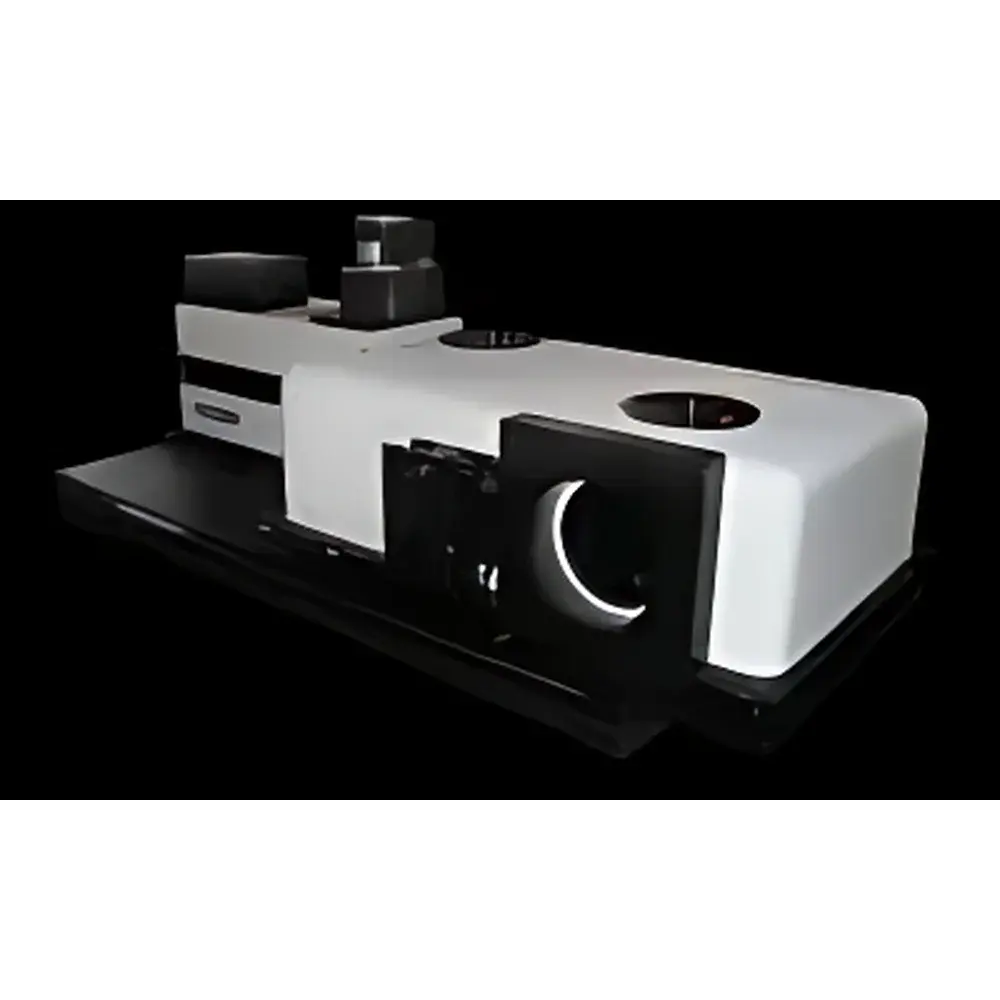
Sciencetech SS1.6KW Full-Reflection Solar Simulator
| Brand | Sciencetech |
|---|---|
| Origin | Canada |
| Model | SS1.6KW |
| Lamp Type | 1.6 kW Ozone-Free Xenon Arc Lamp |
| Cooling | Air-Cooled Lamp Tower |
| Filter Holder | Accepts 76 mm × 76 mm (3″ × 3″) Filters (adaptable to other sizes) |
| Beam Orientation | Horizontal or Vertical (user-selectable at time of order) |
| Optical Design | All-Reflective, Mirror-Based Homogenization |
| Component Category | Light Source |
| Compliance | Designed for ASTM E927-22, IEC 60904-9 Ed. 3, and ISO 9022-18 optical stability requirements |
Overview
The Sciencetech SS1.6KW Full-Reflection Solar Simulator is an engineered light source system designed to replicate terrestrial and extraterrestrial solar spectral irradiance with high spatial uniformity and temporal stability. Unlike refractive-based simulators that rely on diffusing lenses or homogenizing rods—introducing chromatic aberration, absorption losses, and thermal degradation—the SS1.6KW employs an all-reflective optical architecture. This design utilizes precision-polished elliptical and parabolic mirrors to collect, collimate, and uniformly redistribute radiation from a 1.6 kW ozone-free xenon arc lamp without transmissive optics. The result is a broadband output (280–2500 nm) capable of meeting Class AAA performance per IEC 60904-9 Ed. 3 when paired with appropriate spectral filters. Its air-cooled lamp tower enables continuous operation under controlled thermal conditions, making it suitable for photovoltaic device characterization, accelerated aging studies, and optical sensor calibration where spectral fidelity and irradiance reproducibility are critical.
Key Features
- All-reflective optical path eliminates chromatic dispersion, transmission loss, and UV-induced degradation common in fused silica or quartz lens systems
- 1.6 kW ozone-free xenon short-arc lamp delivering high radiant flux density with stable DC or pulsed operation modes
- Air-cooled lamp tower with integrated thermal management ensures long-term radiometric stability and lamp lifetime extension
- Modular filter holder accepts standard 76 mm × 76 mm (3″ × 3″) interference, AM0/AM1.5G, and custom spectral filters; mechanical adaptability supports non-standard dimensions
- Beam orientation configurable as horizontal (side-emitting) or vertical (downward-emitting) during system integration; field-reversible via mounting hardware
- Integrated LED-display power supply with built-in igniter, real-time voltage/current monitoring, and soft-start sequencing to minimize electrode sputtering
- Optional 90° folding mirror kit enables dynamic beam redirection—upward, downward, left, or right—without compromising irradiance uniformity or spectral integrity
Sample Compatibility & Compliance
The SS1.6KW accommodates samples up to 200 mm × 200 mm within its uniform irradiance field (±2% over central 90% area, measured per ASTM E927-22). It supports flat-panel PV cells, multijunction concentrator receivers, thin-film substrates, and optoelectronic sensors mounted on temperature-controlled stages or environmental chambers. The system complies with key international standards for solar simulation: spectral match (Class A per IEC 60904-9 Ed. 3), spatial uniformity (Class A), and temporal instability (Class A). Its all-reflective construction inherently meets ISO 9022-18 requirements for optical component resistance to thermal shock and UV exposure. When operated with NIST-traceable reference cells and calibrated spectroradiometers, the simulator supports GLP-compliant testing protocols required for certification labs accredited to ISO/IEC 17025.
Software & Data Management
While the SS1.6KW operates as a standalone analog source, its power supply includes analog voltage and current output signals (0–10 V) compatible with third-party data acquisition systems (e.g., LabVIEW, MATLAB, Python-based DAQ platforms). Optional digital interface modules support RS-485 or Ethernet communication for remote start/stop, lamp status reporting, and interlock monitoring. All operational parameters—including ignition cycles, cumulative lamp-on time, and thermal fault logs—are stored locally and exportable in CSV format for audit trails. For laboratories subject to FDA 21 CFR Part 11, the system can be integrated into validated workflows using external electronic lab notebooks (ELNs) with role-based access control and electronic signature capability.
Applications
- Calibration and validation of reference solar cells and pyranometers against primary standards
- Current-voltage (I-V) characterization of single-junction, tandem, and perovskite solar cells under standardized illumination conditions
- Photostability and degradation testing of organic photovoltaics (OPV) and dye-sensitized solar cells (DSSC)
- Spectral responsivity mapping of imaging sensors, satellite Earth observation payloads, and space-grade photodetectors
- Accelerated UV-Vis-NIR exposure testing of polymer encapsulants, anti-reflective coatings, and frontsheet materials
- Development and verification of spectral correction algorithms for quantum efficiency measurement systems
FAQ
What spectral classes does the SS1.6KW achieve with standard AM1.5G filtering?
With a certified AM1.5G bandpass filter installed, the system achieves Class A spectral match (IEC 60904-9 Ed. 3), Class A spatial uniformity, and Class A temporal instability—fully compliant for PV device certification testing.
Can the simulator be used in vacuum or inert-gas environments?
The lamp tower and reflector assembly are rated for ambient operation only; however, the output window can be interfaced with vacuum feedthroughs or nitrogen-purged enclosures using custom flange adapters (available upon request).
Is lamp replacement user-serviceable?
Yes—the xenon arc lamp is field-replaceable using manufacturer-provided alignment jigs and torque specifications; full optical realignment is recommended after lamp change and documented in the included maintenance log.
Does Sciencetech provide NIST-traceable calibration reports?
Calibration services—including spectral irradiance distribution, spatial uniformity mapping, and temporal stability assessment—are available through Sciencetech’s ISO/IEC 17025-accredited metrology laboratory, with traceability to NIST SRM 2271a.
How is beam direction adjusted post-installation?
A factory-installed 90° folding mirror mount allows reorientation of the output beam in any cardinal direction without disassembly; angular adjustment is performed manually using micrometer-driven kinematic mounts.



