
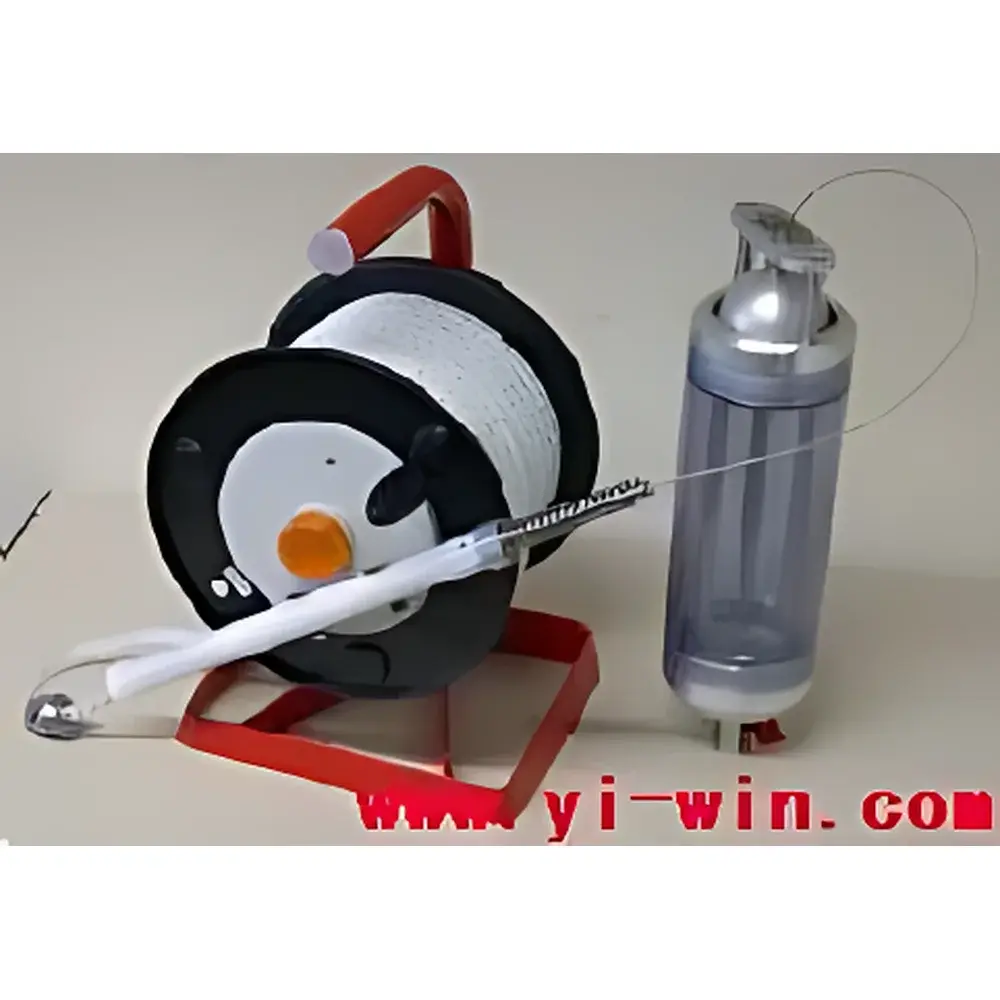
SEBA KLL-S Groundwater and Light Non-Aqueous Phase Liquid (LNAPL) Sampler
| Brand | SEBA |
|---|---|
| Origin | Germany |
| Model | KLL-S |
| Sampling Capacity | 0.5 L (for 2″ wells), 1.0 L (for 4″ wells) |
| Well Diameter Compatibility | 2″ (50.8 mm) and 4″ (101.6 mm) boreholes |
| Standard Cable Length | 15–500 m (groundwater), 30 m (LNAPL, extendable) |
| Integrated Water Level Measurement | Yes |
| Optional Accessories | Tripod support frame, gasoline-powered air compressor (10 bar, 350 L/min, 3.7 kW, 72 kg), SU-2-N submersible pump system (30 m discharge hose with 50 cm graduations, mobile hose reel, venting & exhaust lines, 34 kg) |
Overview
The SEBA KLL-S is a dual-function, field-deployable groundwater and light non-aqueous phase liquid (LNAPL) sampler engineered for high-reliability environmental site assessment and regulatory compliance monitoring. Designed in accordance with ISO 5667-3:2018 (Water quality — Sampling — Part 3: Guidance on the preservation and handling of water samples) and ASTM D6771-22 (Standard Guide for Determination of LNAPL Thickness and Interface Elevation), the KLL-S operates on a pneumatic displacement principle: compressed air is delivered via surface-mounted tubing to actuate a sealed sampling chamber at depth, enabling discrete, depth-specific collection without cross-contamination. Its integrated water level sensor—based on pressure transduction calibrated against local barometric reference—provides simultaneous static water table measurement during deployment, eliminating the need for sequential leveling operations. The device supports both single-point and multi-depth sampling protocols across standard monitoring well casings (2″ and 4″), making it suitable for routine aquifer characterization, plume delineation, and post-remediation verification under EPA Region 9 and EU WFD (Water Framework Directive) frameworks.
Key Features
- Dual-mode sampling architecture: Dedicated configurations for saturated-zone groundwater (0.5 L capacity in 2″ wells; 1.0 L in 4″ wells) and floating-phase LNAPL (e.g., petroleum hydrocarbons, diesel, gasoline) with optimized chamber geometry to minimize emulsification and phase disturbance.
- Modular cable system: Stainless-steel reinforced polyurethane cable rated to 500 m depth; optional 30 m extended-length cable for LNAPL interface targeting, marked at 50 cm intervals for precise vertical positioning.
- Integrated digital water level measurement: Piezoresistive transducer with ±1 cm accuracy (full-scale), temperature-compensated output, and RS-485 interface for direct logging into SEBA’s AquiLog software or third-party SCADA platforms.
- Field-serviceable pneumatic drive: Compatible with SEBA’s gasoline-powered air compressor (10 bar max, 350 L/min free air delivery, 4-stroke engine, safety clutch, wheeled chassis) or external shop-air sources meeting ISO 8573-1 Class 2 purity requirements.
- Submersible pump integration: Includes SU-2-N stainless-steel centrifugal pump (34 kg total system weight), 30 m reinforced PVC discharge hose with metric graduations, vent/bleed manifold, and portable hose reel—enabling purging prior to low-flow sampling per US EPA Method 502.2 and ISO 5667-10.
Sample Compatibility & Compliance
The KLL-S is validated for use with potable water, brackish groundwater, and hydrocarbon-contaminated matrices containing ≤10% v/v free-phase LNAPL. All wetted components—including the sampling bladder, valve seats, and pressure transducer diaphragm—are constructed from FDA-compliant EPDM and 316L stainless steel, ensuring chemical resistance to BTEX, MTBE, chlorinated solvents, and common surfactants. The system meets EN 14066:2016 (Environmental characterization of soils and groundwater — Requirements for equipment used in sampling) and supports GLP-compliant data traceability when paired with SEBA’s audit-logged firmware (21 CFR Part 11–ready configuration available upon request). Calibration certificates for pressure sensors and flow meters are provided with each unit, traceable to PTB (Physikalisch-Technische Bundesanstalt) standards.
Software & Data Management
Data acquisition is managed through SEBA’s AquiLog v4.2 desktop application (Windows 10/11), which records timestamped water level, depth, ambient pressure, and pump runtime parameters in CSV and SQLite formats. The software enforces structured metadata entry—including well ID, operator name, sampling depth, and QA/QC flags—and exports directly to LIMS-compatible templates (ASTM E1447, ISO/IEC 17025 Annex A). Field data can be synchronized via encrypted USB transfer or Bluetooth 5.0 (optional module); no cloud dependency is required to maintain data sovereignty per GDPR Article 44 and EPA Order 2017-01.
Applications
- Regulatory groundwater monitoring networks (e.g., RCRA Subpart F, UST Corrective Action)
- LNAPL thickness profiling and recovery volume estimation at brownfield sites
- Pre- and post-remediation validation sampling per ITRC LNAPL-1 guidance
- Long-term trend analysis in municipal well fields under DIN 38405-12
- Academic hydrogeological studies requiring stratified sampling in unconfined aquifers
FAQ
Can the KLL-S collect samples from artesian wells under pressure?
Yes—the sealed chamber design and 10 bar pneumatic rating allow safe operation in confined aquifers with up to 100 m hydraulic head.
Is the SU-2-N pump certified for explosive atmospheres (ATEX)?
No; it is rated IP68 for submersion but not ATEX-certified. For volatile organic compound (VOC) environments, nitrogen-purged purge-and-sample protocols are recommended.
Does the system support automated depth positioning?
Not natively; depth is set manually using cable markings. However, optional encoder-based winch integration (SEBA WinchControl Module) enables repeatable depth targeting with ±5 cm repeatability.
What maintenance intervals are recommended for field deployment?
Bladder inspection and O-ring replacement every 200 deployments or annually; pressure sensor recalibration every 12 months or after exposure to >50°C thermal shock.
Is training provided for ISO 5667-3 compliant sampling procedures?
Yes—SEBA offers on-site or virtual technician certification courses aligned with ISO/IEC 17025 competency requirements, including documentation review and field demonstration.
Related Products







