
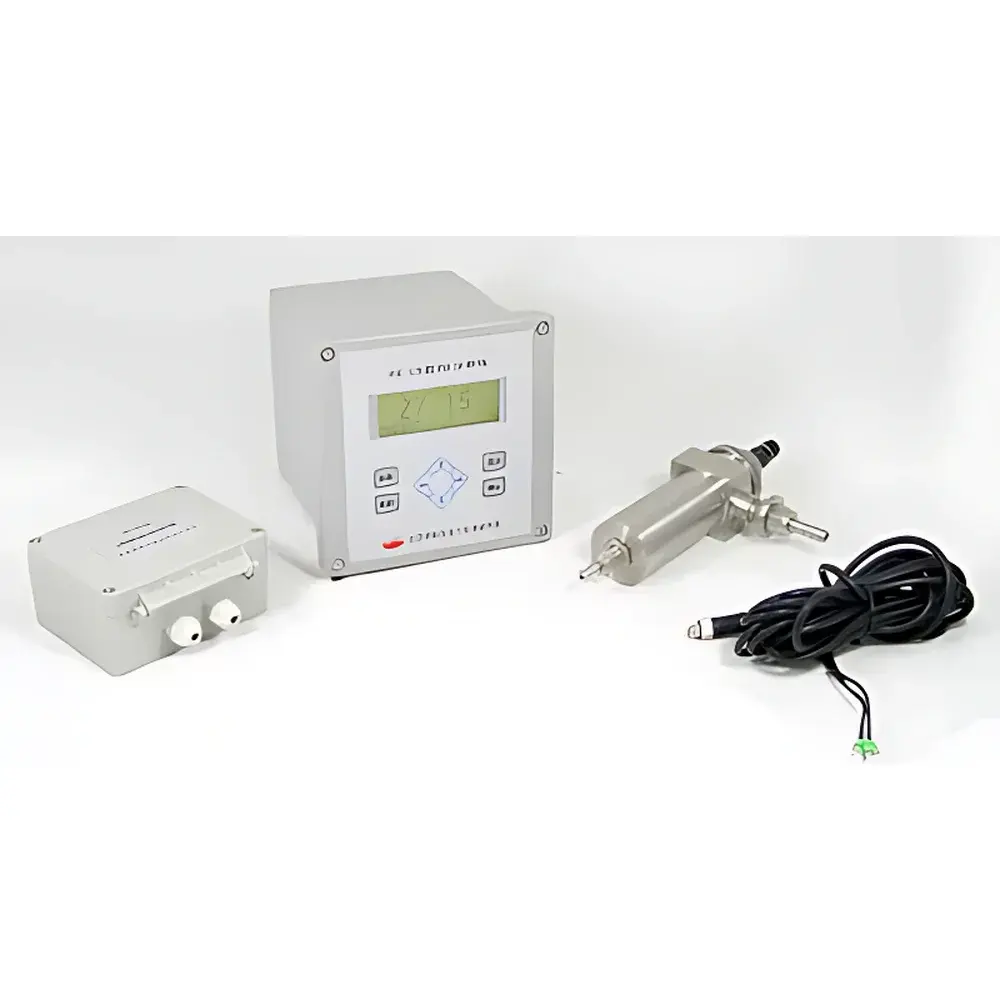
SENHK-328 pH Analyzer
| Origin | Beijing, China |
|---|---|
| Manufacturer Type | Distributor |
| Origin Category | Domestic |
| Model | SENHK-328 |
| Price | Upon Request |
| pH Range | 0.00–14.00 pH |
| mV Range | −1000 to +1000 mV |
| Temperature Range | 0.0–99.9 °C |
| ATC Range | 0.1–60 °C |
| pH Resolution | 0.01 pH |
| mV Resolution | 0.1 mV |
| Temperature Resolution | 0.1 °C |
| pH Accuracy | ±0.02 pH |
| Temperature Accuracy | ±0.5 °C |
| Response Time (90%) | ≤90 s at 25 °C |
| Isolated Current Output | 0–10 mA / 0–20 mA / 4–20 mA (dual channel, configurable for pH or temperature) |
| Output Current Accuracy | ±0.1 mA |
| Max Load Resistance | 800 Ω (at 20 mA) |
| Alarm Outputs | 2 programmable relay outputs |
| Communication Interface | CAN bus (optional) |
| Sample Temp. | 5–50 °C |
| Sample Flow Rate | ≤6 L/h |
| Max Solid Content | ≤5 µm (no colloids, no oil/grease) |
| Ambient Temp. | 5–45 °C |
| Ambient Humidity | ≤90% RH (non-condensing) |
| Storage Temp. | −25 to +55 °C (electrode stored separately above 0 °C) |
| Dimensions (W×H×D) | 158×158×170 mm |
| Power Supply | 198–242 VAC, 50 Hz ±1 Hz |
| Power Consumption | ≤8 VA |
| Insulation Withstand | 1500 VAC/1 min (power-to-chassis) |
| Weight | 2 kg |
Overview
The SENHK-328 pH Analyzer is a high-stability, microprocessor-based electrochemical measurement system engineered for continuous, reliable pH and temperature monitoring in industrial process streams, water treatment facilities, and laboratory-grade quality control environments. It operates on the fundamental principle of potentiometric measurement: detecting the potential difference between a pH-sensitive glass electrode and a stable reference electrode immersed in an aqueous solution—converted via the Nernst equation into a calibrated pH value. Designed for long-term deployment under variable flow and temperature conditions, the analyzer integrates a low-impedance membrane pH electrode optimized for pure water applications, minimizing sodium error and drift while ensuring rapid equilibration (<90 s to 90% response at 25 °C). Its dual isolated current outputs, programmable alarm relays, and optional CAN bus interface support seamless integration into distributed control systems (DCS), SCADA architectures, and automated data acquisition networks compliant with industrial communication protocols.
Key Features
- Embedded single-chip microcontroller architecture with surface-mount technology (SMT) for enhanced thermal stability and long-term reliability
- 192×64 dot-matrix LCD display supporting both English and Chinese user interfaces for international operational flexibility
- Dual-channel isolated 4–20 mA (or 0–10/0–20 mA) analog outputs—individually assignable to pH or temperature signals, with ±0.1 mA output accuracy and 800 Ω max load capability
- Two fully programmable relay outputs for high/low limit alarms, rate-of-change alerts, or maintenance reminders; configurable via secure 4-digit password protection
- Extended electrode cable support enabling remote sensor installation up to 50 meters without signal degradation, facilitated by high-impedance buffering and noise-suppressed signal conditioning
- Robust ABS enclosure with internal conductive shielding layer—providing EMI/RFI immunity, static dissipation, and mechanical durability in demanding plant-floor environments
- Onboard operational logging function records timestamped events including calibration actions, parameter changes, alarm triggers, and power cycles—enabling traceability for GLP/GMP-aligned workflows
Sample Compatibility & Compliance
The SENHK-328 is validated for use with aqueous samples meeting defined physical constraints: temperature between 5 °C and 50 °C, flow rates up to 6 L/h, and suspended solids limited to ≤5 µm particle diameter. Colloidal suspensions, emulsified oils, and greasy matrices are excluded to prevent fouling of the glass membrane and junction clogging. The analyzer complies with IEC 61000-6-2 (immunity) and IEC 61000-6-4 (emission) standards for industrial environments. While not certified to ISO/IEC 17025 as a standalone metrological instrument, its measurement performance aligns with ASTM D1293 (Standard Test Methods for pH of Water) and USP guidelines when paired with traceably calibrated electrodes and proper SOPs. For regulated pharmaceutical or food-grade applications, users must validate system-level performance per FDA 21 CFR Part 11 requirements—including audit trail configuration, electronic signature controls, and data integrity safeguards implemented at the host SCADA or LIMS level.
Software & Data Management
The SENHK-328 does not include embedded PC software but provides standardized analog and CAN bus interfaces compatible with third-party data historians (e.g., Siemens Desigo CC, Emerson DeltaV, Ignition SCADA). Its serial communication option supports Modbus RTU over RS-485 for integration with PLC-based control systems. All configuration parameters—including calibration constants (offset/slope), alarm thresholds, output scaling, and ATC settings—are stored in non-volatile memory and protected by a four-digit access code to prevent unauthorized modification. The built-in event log retains ≥1,000 chronological entries with timestamps, facilitating root-cause analysis during QA audits or process deviation investigations. No cloud connectivity or proprietary cloud platform is supported; data sovereignty remains fully under end-user control.
Applications
- Continuous pH monitoring in municipal and industrial wastewater treatment plants (influent, bioreactors, effluent)
- Process control in chemical synthesis reactors, boiler feedwater systems, and cooling tower chemistry management
- Quality assurance in beverage production, dairy processing, and pharmaceutical water-for-injection (WFI) loops
- Environmental monitoring stations requiring ruggedized, low-maintenance field instrumentation
- Academic and industrial research laboratories conducting kinetic studies, titration endpoint detection, or buffer stability assessments
FAQ
What is the maximum recommended distance between the SENHK-328 transmitter and the pH electrode?
Up to 50 meters using shielded, twisted-pair cable rated for high-impedance electrochemical signals.
Does the analyzer support automatic temperature compensation (ATC)?
Yes—integrated ATC accepts input from Pt100 or thermistor probes within 0.1–60 °C; compensation follows the standard NIST pH-temperature coefficient curve.
Can the two current outputs be configured independently?
Yes—each output can be assigned to either pH or temperature, with independent zero/span calibration and load resistance verification.
Is firmware upgrade capability available?
Firmware updates require direct connection via service-mode serial interface and authorized engineering tools; no over-the-air or USB-based update path is provided.
What documentation is supplied for regulatory validation?
Factory calibration report, electrical safety test certificate (IEC 61010-1), and RoHS/CE declarations are included; full 21 CFR Part 11 compliance requires external validation of connected IT infrastructure.




