
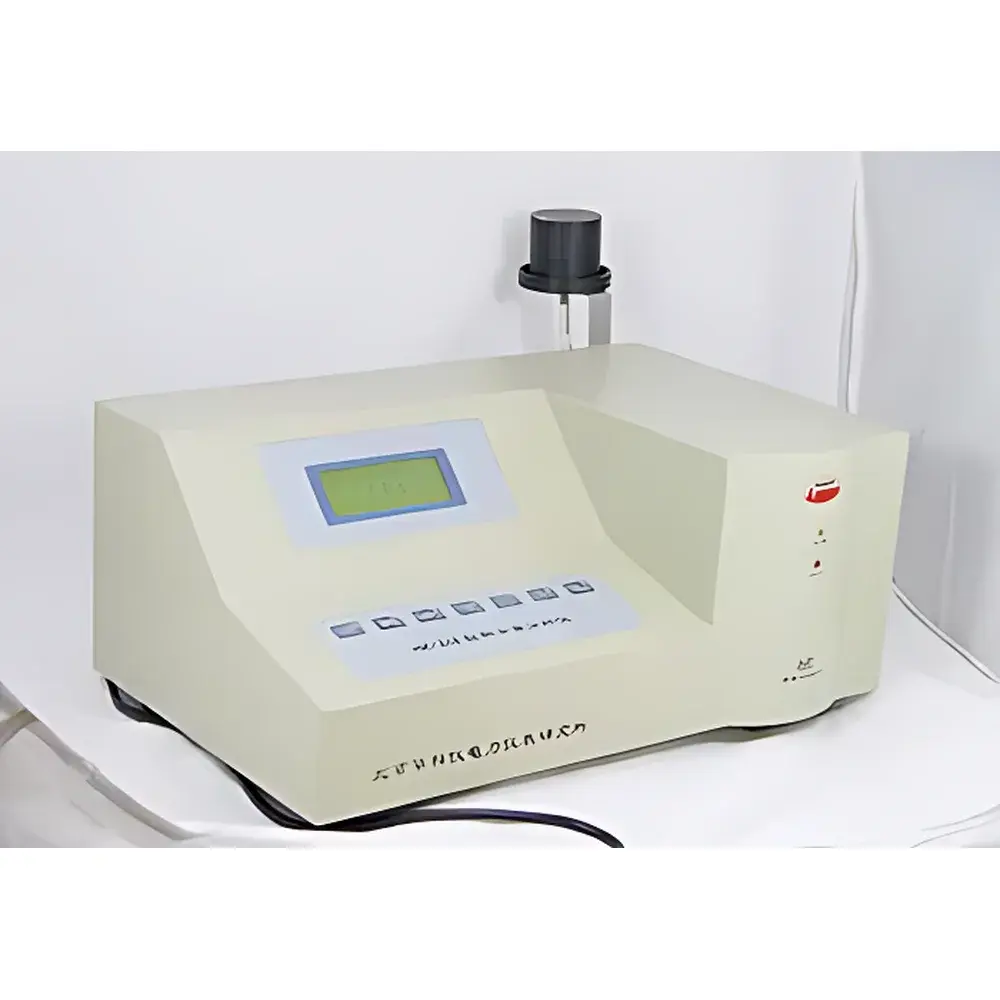
SENHK-518 Copper Content Analyzer
| Origin | Beijing, China |
|---|---|
| Manufacturer Type | Authorized Distributor |
| Origin Category | Domestic (PRC) |
| Model | SENHK-518 |
| Price | Upon Request |
| Display | Chinese-language dot-matrix LCD |
| Range | 0–200 μg/L |
| Accuracy | ≤ ±2% F.S. |
| Resolution | 0.1 μg/L |
| Repeatability | ≤ 1% |
| Stability | ≤ ±2% F.S. / 4 h |
| Operating Temperature | 5–45 °C |
| Relative Humidity | ≤ 90% RH (non-condensing) |
| Dimensions (L×W×H) | 420 × 190 × 280 mm |
| Power Supply | 198–242 VAC, 50 Hz ±1 Hz |
| Power Consumption | 30 VA |
| Weight | 5 kg |
| Light Source | Imported U.S. monochromatic LED |
| Photodetector | Imported U.S. silicon photodiode |
| Calibration | Zero-point calibration with reagent-free deionized water |
| Calibration Method | Selectable multi-point calibration curve |
| Security | Password-protected operational interface |
| Data Storage | 6-channel historical data logging |
Overview
The SENHK-518 Copper Content Analyzer is a benchtop photometric analyzer engineered for precise, trace-level quantification of dissolved copper ions (Cu²⁺) in aqueous samples—primarily targeting applications in power plant boiler feedwater, semiconductor ultrapure water (UPW), pharmaceutical water systems (PW/WFI), and environmental monitoring laboratories. It operates on the principle of visible-light absorbance photometry, utilizing a stable, narrow-band monochromatic LED light source centered at a wavelength optimized for the copper–bathocuproine complex (or equivalent chromogenic reaction pathway). Unlike conventional colorimetric analyzers requiring hazardous or unstable reagents, the SENHK-518 is designed for reagent-free zero-point calibration using only high-purity deionized water, significantly reducing operational complexity and consumables dependency while maintaining metrological integrity across its 0–200 μg/L measurement range.
Key Features
- High-stability optical architecture: Features an imported U.S.-sourced monochromatic LED with spectral half-width < 15 nm and output drift < 0.5% over 1,000 hours—ensuring long-term baseline consistency without thermal recalibration.
- Low-noise detection system: Employs a calibrated silicon photodiode with temperature-compensated transimpedance amplifier, delivering signal-to-noise ratios > 4,000:1 at 100 μg/L Cu²⁺.
- Intuitive human-machine interface: 128×64 dot-matrix LCD with full Chinese character support, hierarchical menu navigation, and context-sensitive prompts—designed for rapid operator training and error-resistant operation in shift-based industrial labs.
- Trace-level resolution and repeatability: 0.1 μg/L digital resolution coupled with ≤1% RSD (n=6, 50 μg/L standard) under controlled ambient conditions (25±2 °C, <60% RH).
- Multi-point calibration flexibility: Supports up to six user-defined calibration points (including zero), enabling non-linear response compensation across the full dynamic range—critical for maintaining accuracy near detection limits and upper-range saturation thresholds.
- Operational security and data governance: Password-protected access levels (operator, supervisor, administrator) restrict parameter modification, calibration execution, and data deletion—aligning with GLP documentation requirements and internal QA audit protocols.
Sample Compatibility & Compliance
The SENHK-518 accepts standard 10-mm pathlength quartz or high-transmittance optical glass cuvettes (not included). It is validated for use with low-conductivity water matrices (≤ 1 μS/cm), including ASTM D1193 Type I/II reagent water, USP Purified Water, and EP Water for Injection. Sample introduction is manual; no integrated autosampler or peristaltic pump is provided. The instrument complies with IEC 61010-1:2010 for electrical safety in laboratory equipment and meets EMC immunity requirements per IEC 61326-1:2020 (industrial environment). While not certified to ISO/IEC 17025 as a standalone testing device, its calibration traceability supports alignment with ISO 8573-1 (compressed air purity) and ASTM D511 (copper in water) when used within a documented, validated analytical method.
Software & Data Management
Data acquisition and storage are fully embedded: the unit logs six independent measurement channels—each storing timestamp, measured value (μg/L), operator ID (if entered), and calibration status flag. Historical records persist for ≥12 months (approx. 50,000 entries) without external memory. No proprietary PC software is required; however, ASCII-formatted export via RS-232 serial interface (DB9 male, 9600 bps, N-8-1) enables integration into LIMS or SCADA systems. Audit trails—including calibration events, password changes, and configuration modifications—are time-stamped and immutable. For regulated environments (e.g., FDA-regulated pharmaceutical manufacturing), users may implement procedural controls to satisfy 21 CFR Part 11 requirements for electronic records, including handwritten signature equivalents and review/approval workflows outside the instrument firmware.
Applications
- Boiler feedwater monitoring in thermal power generation to prevent copper oxide deposition in superheater tubes (per ASME PTC 19.11 and EPRI guidelines).
- In-line verification of copper leaching from UPW distribution piping (e.g., PVDF, stainless steel 316L) in semiconductor fab facilities.
- QC release testing of purified water in pharmaceutical cleanrooms per USP and EU GMP Annex 1.
- Baseline copper profiling in municipal drinking water treatment plants prior to chloramination.
- Educational laboratories for teaching fundamental principles of atomic absorption alternatives and photometric assay validation.
FAQ
What is the detection limit of the SENHK-518?
The practical quantitation limit (PQL) is 0.5 μg/L, determined per ICH Q2(R2) criteria (signal-to-noise ≥ 10:1 and precision ≤ 20% RSD at PQL level).
Can the instrument measure copper in seawater or wastewater?
No—matrix interference from chloride, organic matter, and suspended solids exceeds the design scope. It is validated exclusively for low-TDS (<10 mg/L), low-turbidity (<0.1 NTU), and low-oxidant (Cl₂ < 0.1 mg/L) aqueous streams.
Is NIST-traceable calibration standard included?
No. Users must procure certified copper reference standards (e.g., AccuStandard CUS-1000 or Inorganic Ventures ICV-100) and prepare dilutions gravimetrically or volumetrically per ISO Guide 35.
Does the analyzer support automatic temperature compensation?
No. Ambient temperature control (20–25 °C) is required during operation; sample equilibration to room temperature is mandatory prior to measurement.
How often does the optical path require cleaning or maintenance?
The LED and photodiode are sealed and maintenance-free for ≥5 years under normal lab conditions. Cuvette holder surfaces should be wiped with lint-free tissue and isopropanol after each use to prevent residue buildup.



