
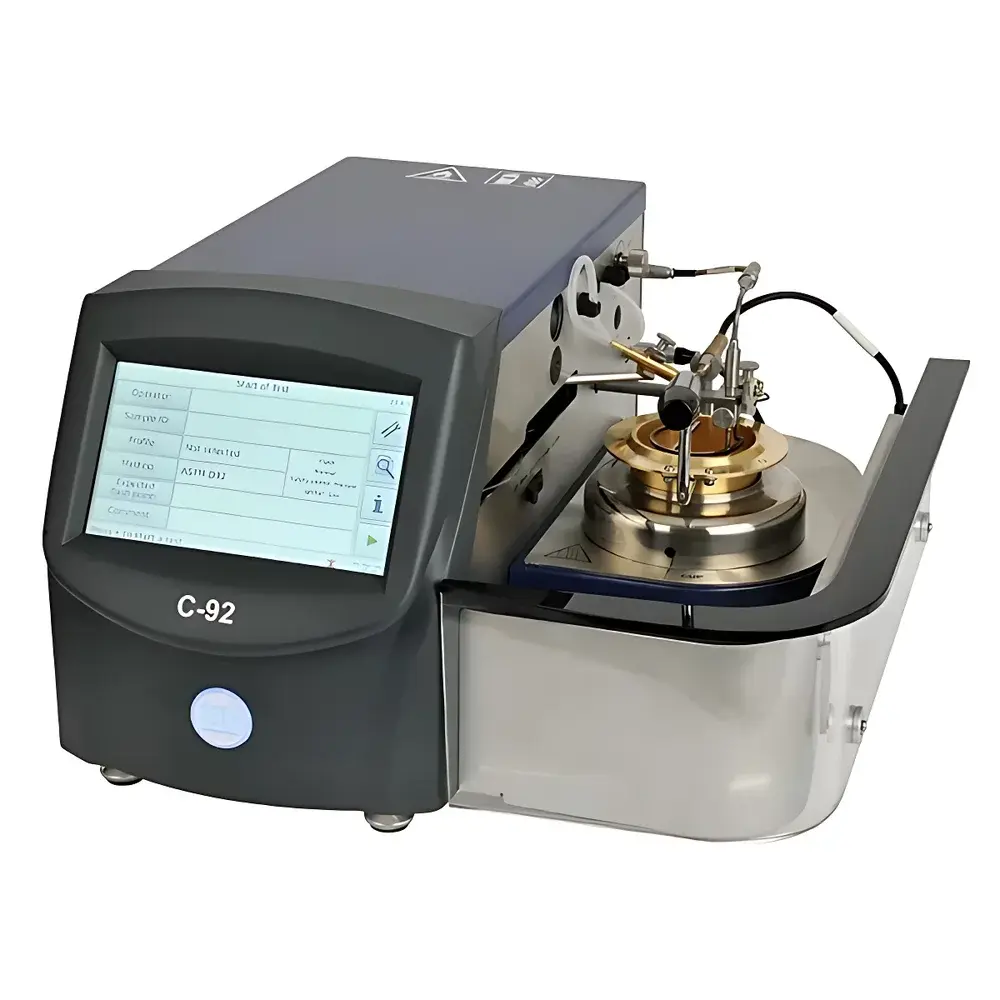
SETA 35300-0 Cleveland Open Cup Flash Point and Fire Point Tester
| Brand | SETA |
|---|---|
| Origin | United Kingdom |
| Model | 35300-0 |
| Test Method | Cleveland Open Cup (COC) |
| Automation Level | Fully Automatic |
| Ignition Sources | Interchangeable Gas and Electric Ignition |
| Safety Features | Motorized Lid Ejection, Integrated Fire Suppression, Rapid Cooling System |
| Enclosure | Integrated Draft Shield |
| Standards Compliance | ASTM D92, ASTM D8254, IP 36, ISO 2592, DIN 51376, NF T60-118, JIS K 2265-4, AASHTO T48, GB/T 3536 |
| Data Interface | USB, LIMS-compatible, QR Code Export |
| Storage | High-capacity Internal Memory |
| Software | QC-Ready with Audit Trail, ISO/IEC 17025 Method Validation Support |
| Maintenance | Tool-free Component Access, Quick-Clean Crucible Assembly |
Overview
The SETA 35300-0 Cleveland Open Cup Flash Point and Fire Point Tester is a fully automated, standards-compliant instrument engineered for precise determination of flash point and fire point of petroleum products, bituminous materials, and other combustible liquids using the Cleveland Open Cup (COC) method. Based on the principle of controlled heating and sequential ignition source application over an open test cup, the instrument measures the lowest temperature at which vapors above the sample ignite momentarily (flash point) and the temperature at which sustained combustion occurs (fire point), per internationally recognized thermodynamic and combustion criteria. Designed for routine quality control and regulatory compliance in refinery laboratories, independent testing facilities, and R&D centers, the 35300-0 integrates thermal management, ignition control, and real-time vapor detection into a single robust architecture—ensuring high reproducibility across operator shifts and environmental conditions.
Key Features
- Fully automatic operation with programmable heating rate, ignition timing, and endpoint detection—eliminating manual intervention and reducing operator-induced variability.
- Interchangeable ignition modules: precision-engineered gas flame (butane/propane) and electric spark igniters—both calibrated to meet ASTM D92 and ISO 2592 energy delivery requirements.
- Motorized lid ejection mechanism activates instantly upon flash detection or user-defined safety threshold, isolating the test cup from ambient air to suppress flame propagation.
- Integrated fire suppression system delivers inert gas pulse within <1.2 seconds of uncontrolled ignition, verified per internal thermal runaway protocols.
- Rapid cooling subsystem reduces crucible temperature from 400 °C to 50 °C in under 90 seconds—enabling consecutive tests without thermal soak delay.
- One-piece draft shield with laminar airflow design ensures stable thermal environment, minimizing convective interference during critical vapor formation stages.
- Tool-free crucible assembly with ceramic-coated aluminum construction enables full disassembly and cleaning in <60 seconds—supporting high-throughput lab workflows.
Sample Compatibility & Compliance
The SETA 35300-0 accommodates standard COC test cups (63.5 mm diameter × 33 mm depth) and accepts samples ranging from low-viscosity naphthas to high-boiling residual fuels and asphalt binders. It supports viscous samples up to 500 cSt at 100 °C without preheating dilution. All operational parameters—including ramp rate (0.5–10 °C/min), ignition interval (0.5–2.0 °C), and final hold time—are configurable to match specific product matrices and regulatory constraints. The instrument is factory-validated against ASTM D92 Annex A1 (precision statement), ISO/IEC 17025 Clause 7.7 (method validation), and GLP-relevant traceability requirements. Full compliance documentation—including calibration certificates traceable to NPL (UK) and uncertainty budgets—is supplied with each unit.
Software & Data Management
The embedded firmware includes a validated Windows-based control suite supporting multi-user role assignment (Operator, Supervisor, Administrator), electronic signature capture, and 21 CFR Part 11–compliant audit trail generation. Test methods are stored as editable XML profiles, enabling rapid adaptation to updated standards (e.g., ASTM D8254 revisions). Results are timestamped, digitally signed, and exportable via USB drive in CSV, PDF, or XML formats—with embedded QR codes linking directly to raw sensor logs and calibration metadata. LIMS integration uses ASTM E1384-compliant messaging, allowing bidirectional data exchange with laboratory information management systems without middleware dependency. Internal memory retains ≥10,000 test records with cyclic overwrite protection for critical QA batches.
Applications
- Refinery process control: monitoring flash point stability of intermediate cuts (e.g., kerosene, diesel fractions) during distillation and blending.
- Fuel specification verification: conformance testing of aviation turbine fuel (Jet A-1), marine distillate (DMA), and heavy fuel oil (HFO) per ISO 8217.
- Bitumen and asphalt binder qualification: flash point assessment per ASTM D36 and EN 1427 to ensure safe handling during paving operations.
- Regulatory submission support: generating auditable data packages for EPA, ECHA REACH dossiers, and transport classification (UN 3334, Class 3).
- Method transfer and interlaboratory studies: standardized COC execution across global sites, supported by cross-platform software version consistency and reference material traceability.
FAQ
Does the SETA 35300-0 support both ASTM D92 and ASTM D8254? Why are two standards listed?
Yes—the instrument executes both methods using identical hardware but distinct firmware-controlled ramp profiles, ignition intervals, and pass/fail logic. D8254 introduces tighter repeatability requirements and mandatory digital temperature logging; the 35300-0 meets both through dual-mode calibration and certified firmware revision.
Is external ventilation required for safe operation?
No—integrated fume extraction with activated carbon filter and pressure-balanced exhaust ducting satisfies local occupational exposure limits (OELs) for hydrocarbon vapors without connection to building HVAC.
Can test methods be exported and shared between multiple instruments?
Yes—method profiles (.xml) and calibration templates are portable across all SETA 35300-series units running firmware v4.2 or later, enabling harmonized SOP deployment across multi-site labs.
How is measurement uncertainty quantified for accreditation purposes?
Uncertainty budgets follow EURACHEM/CITAC Guide CG4, incorporating contributions from platinum resistance thermometer calibration, ignition timing jitter, cup geometry tolerance, and operator response latency—all documented in the supplied UKAS-accredited validation report.
What maintenance intervals are recommended for ISO/IEC 17025 compliance?
Crucible inspection every 200 tests, ignition source verification weekly, and full system calibration annually—each logged automatically in the audit trail with technician ID and certificate reference.






