
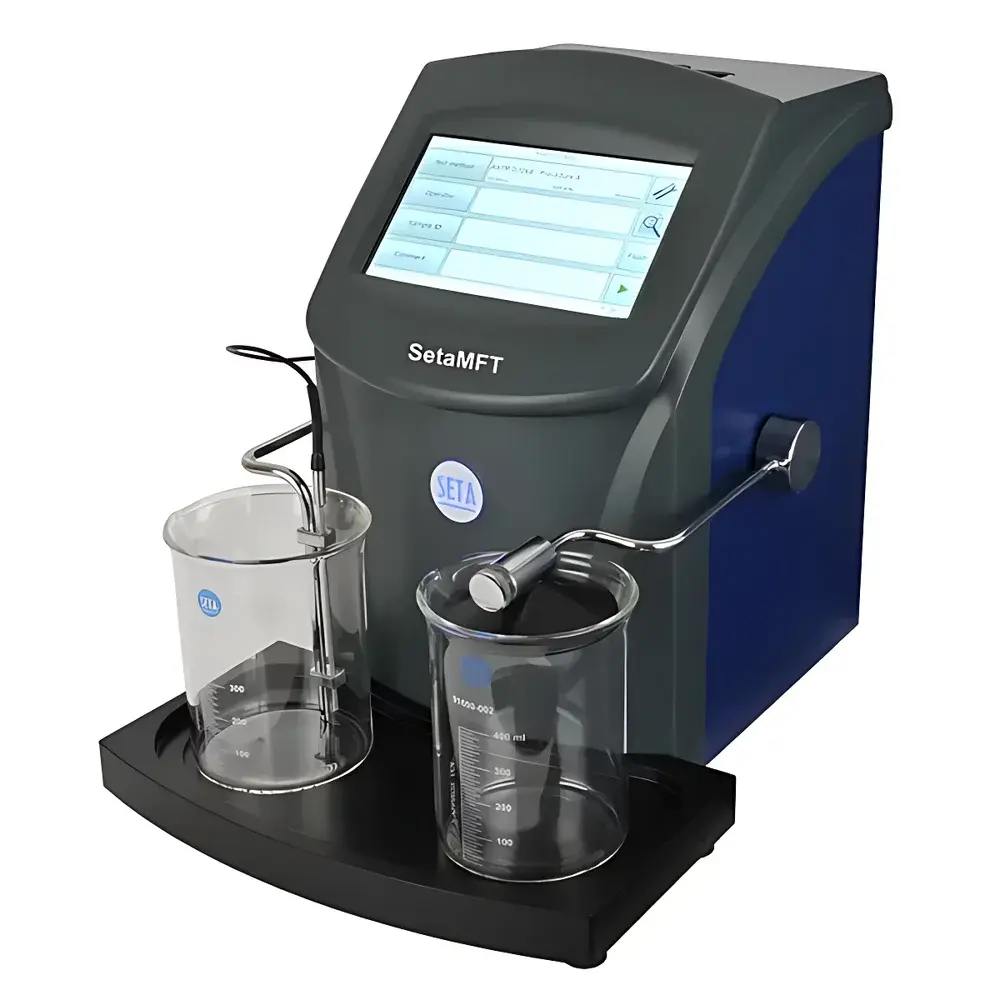
SETA 91600-4 Filter Blocking Tendency Tester
| Brand | SETA |
|---|---|
| Origin | United Kingdom |
| Model | 91600-4 |
| Standards Compliance | ASTM D2068, EN 590, IP 387, IP PM EA/13, NB/SH/T 0895 |
| Test Duration | ≤15 min per sample |
| Interface | RS-232 and USB for PC connectivity |
| Optional Accessory | SETA Remote Alarm System |
| Calibration | Field-verifiable with certified reference fluids |
Overview
The SETA 91600-4 Filter Blocking Tendency Tester is a precision-engineered instrument designed to quantify the propensity of distillate fuel oils—including conventional diesel, biodiesel blends (B5–B20), and hydrotreated vegetable oil (HVO)—to cause filter plugging under controlled low-temperature conditions. It operates on the principle of pressure-driven filtration through a standardized stainless-steel mesh screen (typically 40 µm nominal pore size) at a defined temperature (e.g., −20 °C or −30 °C per test method), measuring the time required for a fixed volume (e.g., 30 mL) of fuel to pass under constant vacuum or regulated differential pressure. This time-based metric—expressed as Filter Blocking Time (FBT) in seconds—is directly correlated with particulate load, wax crystallization behavior, and insoluble contaminant formation during cold storage or handling. The instrument is not a particle counter nor a cloud point analyzer; rather, it delivers functional performance data aligned with real-world fuel system operability, making it indispensable for refinery quality assurance, fuel additive evaluation, and compliance verification against international specification limits.
Key Features
- Compact, benchtop-portable architecture engineered for laboratory, field depot, and mobile testing environments—no external chiller or cryogenic bath required;
- Integrated Peltier-cooled test chamber maintaining stable temperature control within ±0.5 °C across the operational range (−35 °C to +30 °C);
- Automated vacuum regulation with digital pressure feedback loop ensuring consistent ΔP (typically 1.0 kPa) throughout each test cycle;
- Dual-mode operation: manual start/stop for routine screening or fully automated sequence execution via PC interface;
- Real-time pressure and elapsed time logging with automatic endpoint detection based on flow cessation criteria defined in ASTM D2068;
- Front-panel LED indicators and audible alerts for test completion, temperature deviation, and vacuum fault conditions;
- Modular design supporting rapid screen replacement and cleaning without tools—reducing cross-contamination risk between samples.
Sample Compatibility & Compliance
The 91600-4 accommodates standard 100 mL glass sample vials and accepts fuels with kinematic viscosity up to 5.0 mm²/s at 40 °C. It is validated for use with petroleum-derived diesel (EN 590, ASTM D975), FAME-based biodiesel (EN 14214), and synthetic hydrocarbon fuels (e.g., Fischer–Tropsch liquids). Its methodology satisfies mandatory testing requirements in multiple regulatory frameworks: ASTM D2068 (Standard Test Method for Filterability of Diesel Fuels by Low-Temperature Flow Test), EN 590 Annex D (Cold Filter Plugging Point—CFPP alternative assessment), IP 387 (Determination of Filter Blocking Tendency of Diesel Fuel Oils), and China’s NB/SH/T 0895 (Test Method for Filter Blocking Tendency of Distillate Fuel Oils). Instrument validation adheres to ISO/IEC 17025 principles, and routine calibration employs traceable reference fuels certified by NIST-equivalent national metrology institutes.
Software & Data Management
The optional SETA PC Control Software (v3.2+) provides full remote operation, method configuration, and audit-ready data export. It supports user-defined test protocols, multi-sample batch sequencing, and automatic generation of PDF reports compliant with GLP documentation standards. All raw sensor timestamps, pressure traces, and calculated FBT values are stored with immutable metadata—including operator ID, sample ID, ambient conditions, and calibration certificate expiry date. The software implements role-based access control and maintains full electronic audit trails satisfying FDA 21 CFR Part 11 requirements when configured with digital signature and secure login modules. Export formats include CSV (for LIMS integration), XML (for enterprise QA systems), and print-ready PDF with embedded instrument serial number and firmware revision.
Applications
- Refinery final product release testing to verify conformance with cold-weather operability specifications;
- Evaluation of detergent/dispersant additive efficacy in mitigating filter fouling during long-term fuel storage;
- Assessment of biodiesel blend stability during seasonal transitions—particularly relevant for “cold soak” filtration per EN 14214 Annex B;
- Root-cause analysis of field-reported fuel filter blockages using forensic comparison against baseline FBT trends;
- Supporting R&D efforts in alternative fuel formulation where wax inhibition and cold flow improver performance must be quantified objectively;
- Third-party certification testing for fuel distributors and blending facilities subject to EN 590 or ASTM D975 contractual obligations.
FAQ
What is the minimum sample volume required for a valid test?
A minimum of 30 mL of homogenized, moisture-free fuel is required. Samples must be pre-conditioned per method-specified thermal history (e.g., cold soak at −20 °C for 18 h prior to filtration).
Does the instrument require annual recalibration by an authorized service center?
No. The 91600-4 is designed for user-performed verification using certified reference fuels and documented procedures included in the Operation Manual. Full recalibration is recommended only after mechanical impact or extended operation beyond 2,000 test cycles.
Can the system be integrated into an existing LIMS environment?
Yes—via configurable ASCII or HL7-compliant output over RS-232 or TCP/IP. SETA provides documented API specifications and sample integration scripts for common LIMS platforms including Thermo Fisher SampleManager and LabVantage.
Is the 40 µm test screen supplied with the instrument?
Yes—two stainless-steel mesh screens (ASTM E11 Grade 400) are included. Replacement screens are available as consumables (SETA P/N 91600-SCN) and must be replaced after every 50 tests or upon visible deformation.





