
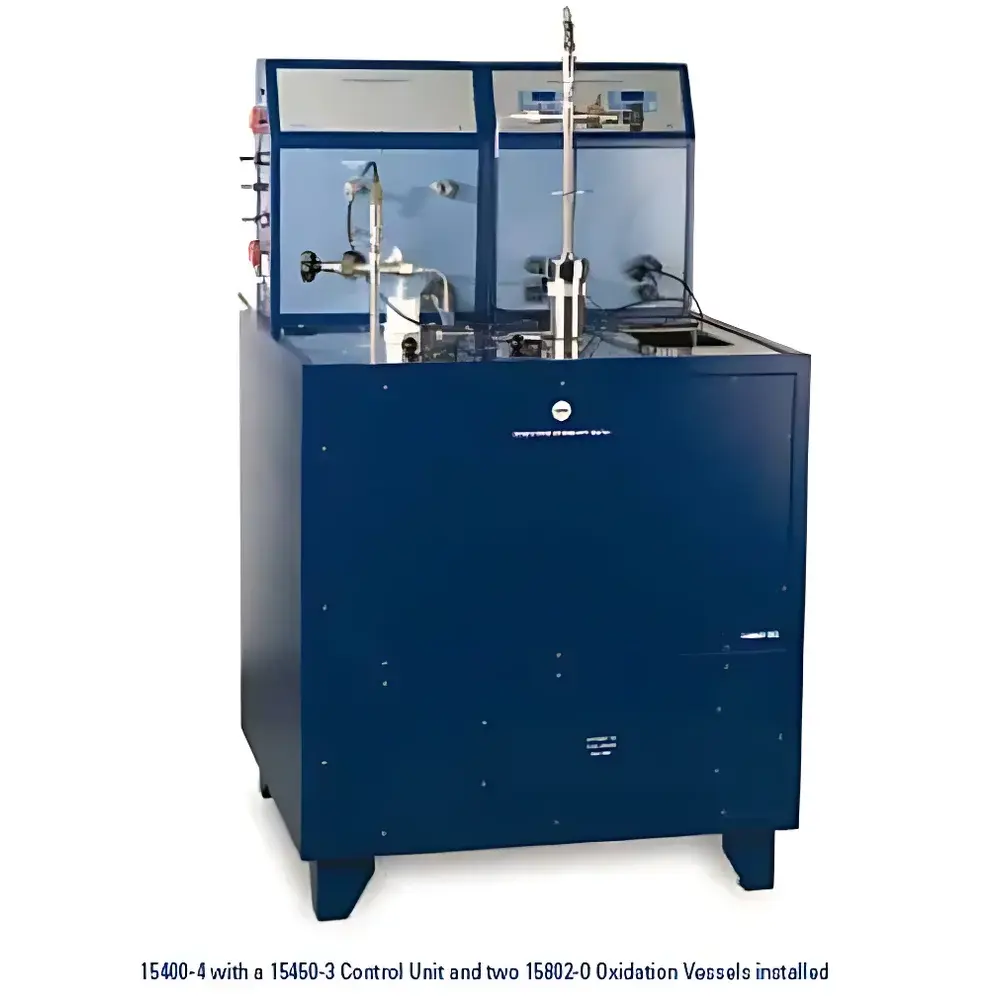
SETA Model 15400-5 Gasoline Oxidation Stability Tester (Induction Period Method)
| Brand | SETA |
|---|---|
| Origin | United Kingdom |
| Model | 15400-5 |
| Bath Volume | 60 L |
| Operating Temperature | 100 °C ± 0.1 °C |
| Test Positions | 4 |
| Maximum Bomb Charging Pressure | 1380 kPa |
| Cooling Method | Dedicated Water-Cooled Quenching Trough |
| Voltage | 110/120 V or 220/240 V, 50/60 Hz |
| Power Consumption | 3 kW |
| Dimensions (W×D×H) | 135 × 83 × 77 cm |
| Weight | 87 kg |
| Compliance | ASTM D525, D873, IP 40, IP 138, ISO 7536, EN 7536, GB/T 8018, JIS K2287, NF M07-012/013, FTM 791-3352/3354, BS 2000-40/138 |
Overview
The SETA Model 15400-5 Gasoline Oxidation Stability Tester is a precision-engineered instrument designed to determine the oxidation stability of gasoline and aviation turbine fuels via the induction period method—commonly referred to as the “Rancimat” principle adapted for petroleum distillates. It operates on the fundamental principle that hydrocarbon oxidation under accelerated conditions (elevated temperature and pressurized oxygen) produces volatile acidic by-products, leading to a measurable pressure drop in a sealed oxygen bomb system. This pressure decay marks the end of the induction period—the critical metric used to assess fuel resistance to oxidative degradation during storage and handling. The instrument conforms rigorously to internationally harmonized test standards including ASTM D525 (for gasoline), ASTM D873 (for aviation fuels), ISO 7536, EN 7536, and GB/T 8018, ensuring data integrity across global regulatory and quality assurance frameworks.
Key Features
- Four-position parallel testing configuration enables high-throughput evaluation of replicate or multi-sample batches without operator intervention between runs.
- Stainless-steel water bath with 60 L capacity, maintained at a stable 100 °C ± 0.1 °C using PID-controlled heating and continuous level regulation via an integrated constant-level device.
- Dual-safety liquid level monitoring: automatic low-water detection halts heating if bath volume falls below operational threshold, preventing dry-heating damage and thermal runaway.
- Integrated dedicated water-cooled quenching trough for rapid post-test cooling of oxygen bombs—reducing turnaround time and minimizing residual thermal stress on bomb components.
- Automated oxygen charging system (optional integrated module) delivers precise, repeatable pressurization up to 1380 kPa, eliminating manual regulator dependency and inter-operator variability.
- Modular monitoring architecture supporting three operational modes: fully automated (with SETA OXS software and 15450-3 control unit), semi-automated (using Oxford portable pressure recorder 15611-2), and manual (via analog SETA oxygen pressure gauge 15600-0).
Sample Compatibility & Compliance
The 15400-5 accommodates standard ASTM/ISO-compliant oxygen bombs (typically 500 mL capacity) and is validated for use with gasoline, reformulated gasoline blends (including ethanol-containing formulations up to E15), and aviation turbine fuels (Jet A/A-1). Its design supports optional solid-phase test bath configurations for specialized applications requiring non-aqueous thermal environments. All operational protocols align with Good Laboratory Practice (GLP) requirements, and raw pressure-time datasets generated under automated mode include embedded timestamps, operator ID fields, and audit-trail metadata compatible with FDA 21 CFR Part 11–compliant data management systems. Certification documentation includes traceable calibration certificates for temperature sensors (NIST-traceable Pt100 RTDs) and pressure transducers (IEC 61298-2 Class 0.1).
Software & Data Management
The SETA OXS software suite (v3.2+) provides full lifecycle data handling: real-time synchronized pressure logging from all four bombs, automatic endpoint detection based on user-defined pressure decay thresholds (e.g., ≥14 kPa/min over 5 min), and dynamic curve-fitting algorithms compliant with ASTM D525 Annex A1. Export formats include CSV, PDF reports with embedded chromatogram-style plots, and XML files structured for LIMS integration. Audit trails record every parameter change, start/stop command, and calibration event—with digital signatures required for modification of critical settings. Software validation packages (IQ/OQ/PQ) are available upon request for regulated environments operating under GMP or ISO/IEC 17025 accreditation.
Applications
- Quality control laboratories verifying conformance of refinery-blended gasoline to specification limits for induction period (e.g., minimum 480 min per ASTM D525).
- R&D departments evaluating antioxidant package efficacy (e.g., hindered phenols, amines) under accelerated aging protocols.
- Fuel certification bodies conducting third-party verification for military (MIL-DTL-83133) and civil aviation (DEF STAN 91-91) fuel approvals.
- Regulatory agencies performing surveillance testing of retail gasoline stocks for oxidative instability indicators linked to deposit formation and carburetor fouling.
- Extended testing of jet fuel stability per ASTM D873, including post-test gravimetric analysis of gum and sediment residues—enabled by optional balance integration and standardized evaporation procedures.
FAQ
What standards does the 15400-5 fully support without modification?
ASTM D525, D873, IP 40, IP 138, ISO 7536, EN 7536, GB/T 8018, JIS K2287, BS 2000-40/138, NF M07-012/013, and FTM 791-3352/3354.
Is the instrument supplied with oxygen bombs and associated consumables?
Standard delivery includes four stainless-steel oxygen bombs, sealing gaskets, and bomb caps; oxygen cylinders, regulators, and high-purity oxygen gas are customer-supplied per local safety regulations.
Can the system be integrated into an existing LIMS environment?
Yes—OXS software supports ASTM E1394-compliant data export and offers configurable OPC UA connectivity for direct LIMS synchronization.
What maintenance intervals are recommended for pressure transducers and bath heaters?
Annual verification of pressure sensor accuracy against dead-weight tester (±0.05% FS) and biannual inspection of heater element continuity and insulation resistance (≥10 MΩ @ 500 VDC).
Is solid-bath configuration available as a factory-installed option or field retrofit?
Solid thermal bath modules are available as factory-installed options only; retrofitting requires recalibration and mechanical revalidation per ISO/IEC 17025 clause 5.5.2.




