
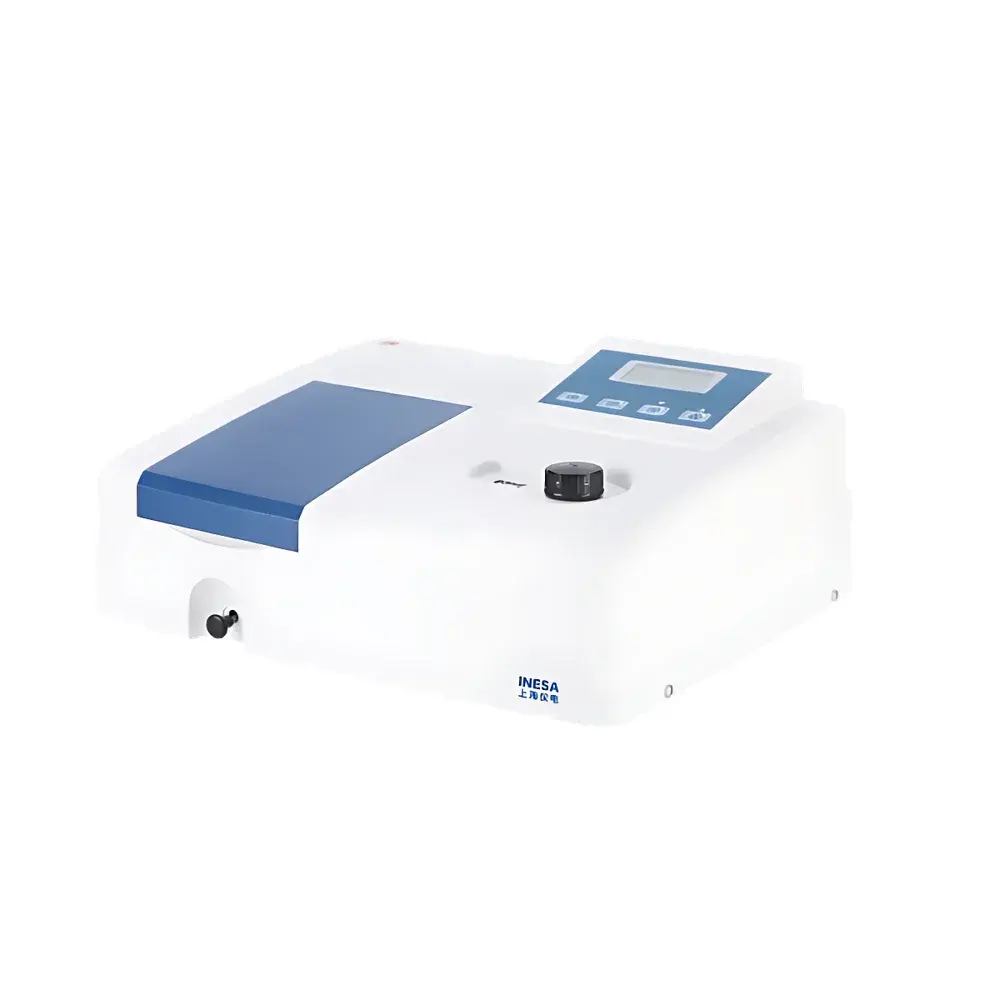
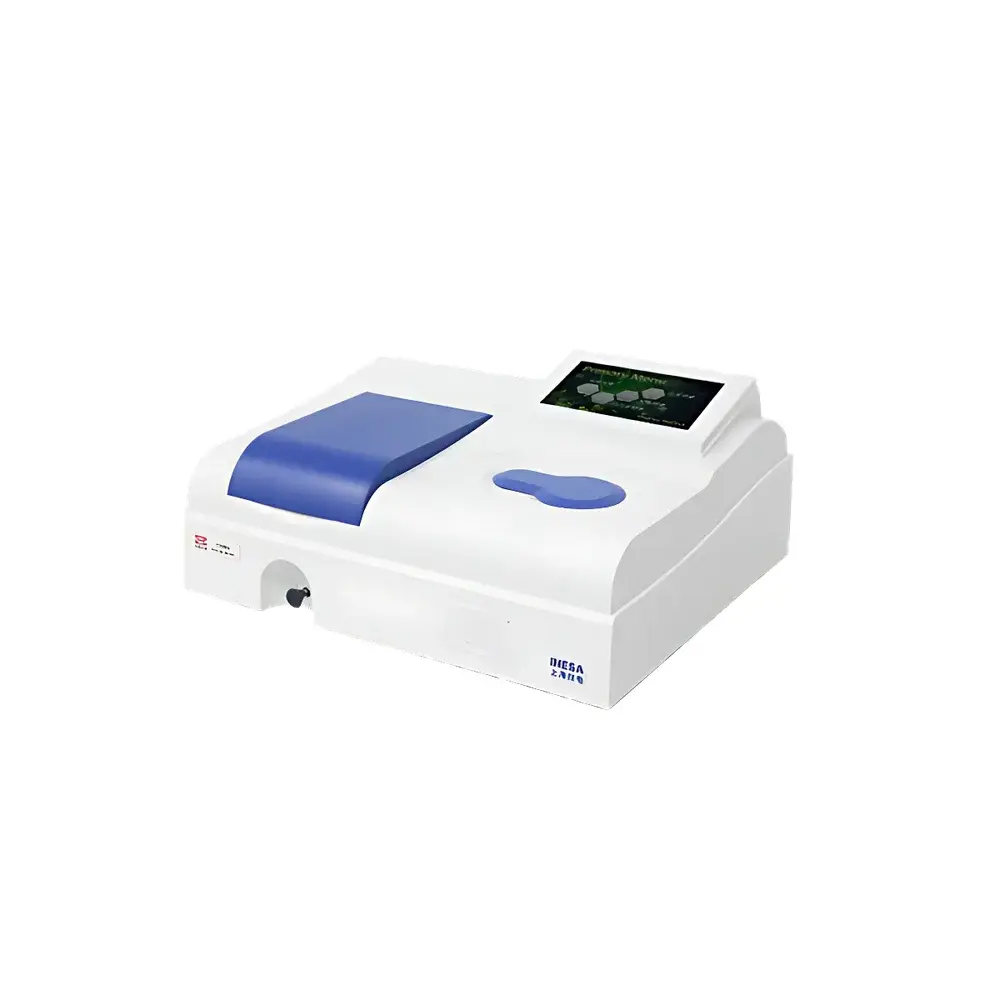
Shanghai INESA Analytical Instrument 721 Series & L-Series Visible Spectrophotometers
| Brand | INESA |
|---|---|
| Origin | Shanghai, China |
| Model Range | 721, 721N, 721G, 721G-100, 722G, 722S, 722N, 7230G, 723N, N2, N2S, N3S, L3, L3S |
| Wavelength Range | 325–1000 nm (typical for visible spectrophotometers) |
| Optical System | Single-beam with fixed slit and grating monochromator |
| Detector | Silicon photodiode |
| Display | Analog meter (721/722 series) or digital LCD (N/L-series) |
| Absorbance Range | 0–2.0 A (linear up to 1.999 A) |
| Stray Light | ≤0.5% T at 360 nm |
| Repeatability | ±0.002 A (at 1.0 A, typical) |
| Power Supply | AC 220 V ±10%, 50 Hz |
Overview
The Shanghai INESA Analytical Instrument 721 Series and L-Series Visible Spectrophotometers are precision single-beam optical instruments engineered for quantitative absorbance and transmittance measurements in the visible spectral region (typically 325–1000 nm). Based on classical grating monochromator architecture with fixed-slit optics and silicon photodiode detection, these instruments deliver stable photometric performance suitable for routine quality control, educational laboratories, and industrial process monitoring where UV capability is not required. The design adheres to fundamental principles of Beer–Lambert law-based quantification, enabling reliable concentration determination of colored analytes in solution across academic, pharmaceutical, food, and environmental testing environments.
Key Features
- Robust mechanical construction with temperature-stabilized optical bench and calibrated wavelength drive mechanism
- Single-beam configuration optimized for simplicity, ease of maintenance, and operational reliability in non-GMP settings
- Graduated analog pointer display (721/722 series) or high-contrast digital LCD (N- and L-series) with direct A/T readout
- Manual or semi-automatic wavelength selection via precision worm-gear drive; repeatability verified per ISO 8579-1 for mechanical positioning accuracy
- Integrated cuvette holder accommodating standard 10 mm pathlength cells; optional holders available for 5 mm or 20 mm cells
- Zero-adjust and 100% transmittance calibration functions accessible via front-panel controls, supporting daily instrument verification protocols
- Low-stray-light optical path (<0.5% T at 360 nm), minimizing spectral interference in samples with broad absorption bands
Sample Compatibility & Compliance
These spectrophotometers accept standard quartz or optical glass cuvettes (10 × 10 mm cross-section) and are compatible with aqueous, organic, and mildly corrosive solvent-based samples. Sample volume requirements range from 2.5 mL to 3.5 mL depending on cell geometry. While not designed for regulated GMP environments requiring full 21 CFR Part 11 compliance, the N- and L-series models support basic audit trail documentation via external data logging. Instrument operation aligns with ASTM E275 and ISO 6223 guidelines for visible spectrophotometer verification, including wavelength accuracy (±2 nm), photometric linearity (0–1.999 A), and baseline stability (<±0.003 A/h).
Software & Data Management
The base 721/722 models operate without embedded software or computer interface—data recording is manual or via external chart recorder integration. In contrast, the N2, N3S, L3, and L3S variants include RS-232 or USB interfaces compatible with Windows-based INESA SpectraView™ software (v3.2+). This application enables real-time absorbance scanning, kinetic measurement capture, multi-wavelength quantitation, and export to CSV or Excel formats. All software modules implement user-level access control and generate timestamped measurement logs compliant with GLP documentation standards. No cloud connectivity or remote access functionality is provided; data remains resident on local host systems.
Applications
- Routine analysis of transition metal complexes (e.g., Fe²⁺/Fe³⁺, Cu²⁺, Co²⁺) in water quality testing
- Quantification of dyes, pigments, and food colorants in beverage and textile manufacturing
- Enzyme kinetics assays (e.g., NADH/NADPH oxidation at 340 nm) in teaching laboratories
- Pharmaceutical excipient purity checks using reference standards traceable to NIST SRM 930e
- Soil extract analysis for nitrate, phosphate, and ammonium via colorimetric derivatization
- Calibration verification of higher-end UV-Vis systems using certified neutral density filters
FAQ
What is the typical wavelength accuracy specification for the 721G model?
Wavelength accuracy is ±2.0 nm across the 325–1000 nm range, verified using holmium oxide or didymium glass reference filters per ISO 6223 Annex B.
Can the L3S model be used for regulatory submissions under FDA or EU pharmacopoeia requirements?
No—the L3S does not provide electronic signature capability, full audit trail, or system suitability testing automation required for USP or Ph. Eur. 2.2.25 compliance; it is intended for internal QC and R&D use only.
Is a PC required to operate the N2 spectrophotometer?
No—N2 operates fully standalone with onboard digital display and keypad; PC connection is optional for data export and advanced scanning.
What cuvette materials are recommended for measurements below 360 nm?
Standard optical glass cuvettes transmit down to ~350 nm; for measurements below 350 nm, fused silica cuvettes are required—but note that the 721-series instruments lack sufficient intensity and stray light control for reliable sub-350 nm work.
Does INESA provide factory calibration certificates traceable to national metrology institutes?
Yes—certificates of calibration (traceable to SIM/NIM, China) are available as an optional add-on service for all N- and L-series models at time of purchase.






