
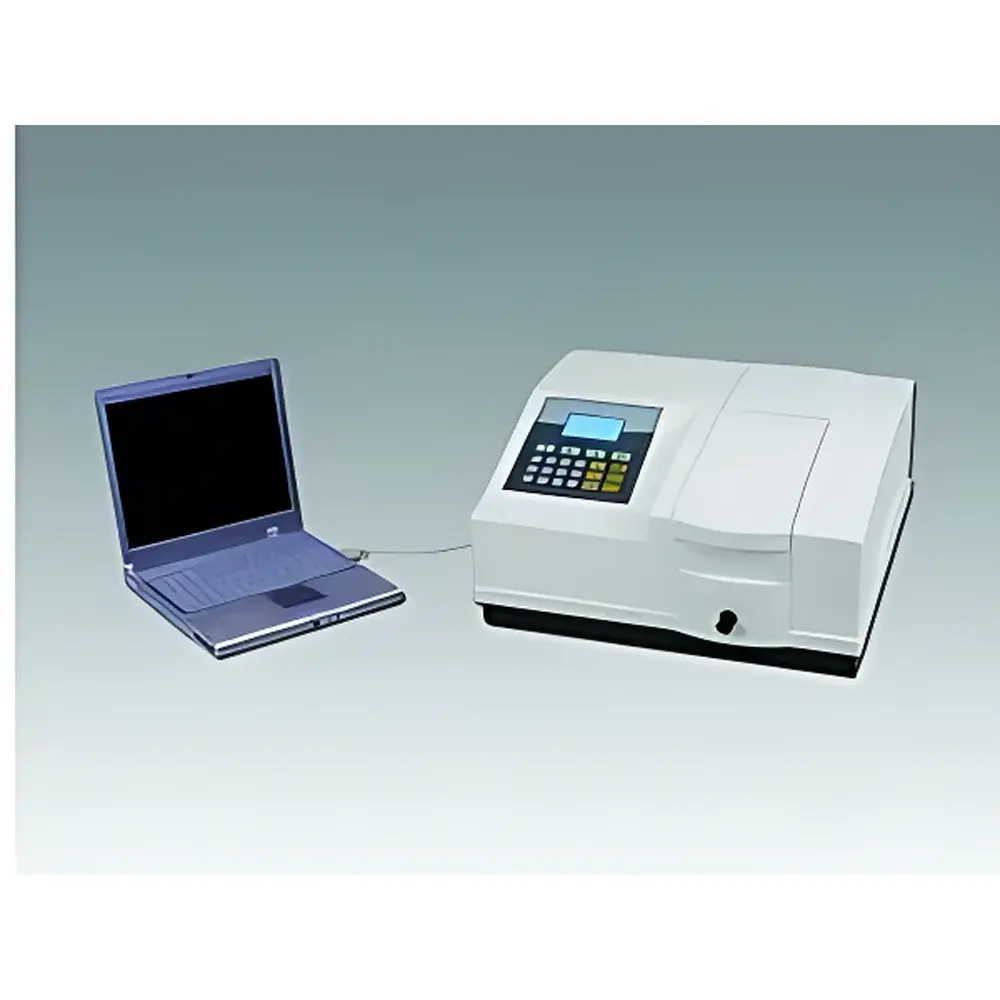
Shanghai SOPTOP 756PC UV-Vis Spectrophotometer
| Brand | SOPTOP |
|---|---|
| Origin | Shanghai, China |
| Model | 756PC |
| Optical Design | Single-beam |
| Detector | Photodiode Array (PDA) |
| Wavelength Range | 190–1100 nm |
| Spectral Bandwidth | 2 nm |
| Wavelength Accuracy | ±1.0 nm |
| Wavelength Repeatability | 0.5 nm |
| Stray Light | ≤0.15% T (at 220 nm and 340 nm) |
| Absorbance Range | –0.5 to 3.000 A |
| Transmittance Range | –1.0 to 200.0% T |
| Photometric Accuracy | ±0.5% T |
| Photometric Repeatability | ±0.2% T |
| Baseline Linearity | ±0.004 A |
| Baseline Drift | ±0.003 A/h |
| Display | 128 × 64 LCD |
| Dimensions | 455 × 430 × 220 mm |
| Interface | USB port |
| Software | UV-Solution 2.0 workstation software |
Overview
The Shanghai SOPTOP 756PC UV-Vis Spectrophotometer is a single-beam, microprocessor-controlled analytical instrument engineered for routine quantitative analysis across the ultraviolet and visible spectral regions (190–1100 nm). Based on Beer–Lambert law principles, it measures absorbance (A), transmittance (%T), and concentration (C) of liquid-phase samples using photodiode array detection, enabling rapid spectral acquisition and high reproducibility in standard laboratory environments. Its design emphasizes operational stability, ease of calibration, and compliance with fundamental performance criteria defined in ISO 8579, ASTM E275, and USP for spectrophotometric instrumentation. The system incorporates automatic wavelength initialization upon startup, internal dark-current compensation, and real-time baseline correction—features critical for maintaining measurement integrity during extended batch analyses or multi-user workflows.
Key Features
- Single-beam optical architecture with optimized light path geometry for consistent photometric response and reduced thermal drift.
- Photodiode array detector providing full-spectrum acquisition capability with 0.1 nm wavelength step resolution and enhanced signal-to-noise ratio.
- Integrated 128 × 64 monochrome LCD display with intuitive menu navigation and real-time parameter feedback.
- Pre-programmed wavelength shortcuts: six commonly used analytical wavelengths accessible via dedicated front-panel keys (e.g., 260 nm for nucleic acid quantification, 280 nm for protein assays).
- Onboard curve-fitting algorithms supporting up to 12-point calibration standards; linear, zero-order, and first-order regression models with correlation coefficient (R²) calculation and display.
- Internal memory storage for up to 50 calibration curves and 200 individual sample measurements, each timestamped via built-in real-time clock.
- USB interface compliant with USB 2.0 specifications for direct data export to external PCs running UV-Solution 2.0 software.
- Automated lamp switching logic that selects deuterium (UV) or tungsten-halogen (VIS) source based on user-defined wavelength thresholds—ensuring optimal spectral continuity and source longevity.
Sample Compatibility & Compliance
The 756PC accommodates standard 10 mm pathlength quartz or glass cuvettes (including matched pairs for reference/blank subtraction), as well as optional micro-volume adapters compatible with 50–500 µL sample volumes. It meets essential metrological requirements for educational, QC, and R&D laboratories operating under GLP-aligned protocols. While not certified for GMP-regulated production environments without additional validation, its firmware supports audit-ready operation—including traceable wavelength and photometric calibration logs, user-accessible calibration history, and configurable password protection for method parameters. The instrument satisfies key performance benchmarks referenced in ISO/IEC 17025:2017 Annex A.3 for spectrophotometric verification, including stray light limits (≤0.15% T at 220 nm and 340 nm), wavelength repeatability (≤0.5 nm), and photometric accuracy (±0.5% T).
Software & Data Management
UV-Solution 2.0 is a Windows-based workstation software package designed specifically for SOPTOP spectrophotometers. It provides comprehensive control over instrument functions—including kinetic scanning, time-course monitoring, multi-wavelength quantitation, and full-spectrum scanning from 190 to 1100 nm. Data files are saved in proprietary .uvd format with embedded metadata (date/time stamp, operator ID, instrument serial number, calibration status), and can be exported to CSV, TXT, or Excel-compatible formats for integration into LIMS or statistical analysis platforms. The software supports FDA 21 CFR Part 11-compliant configurations when deployed with validated IT infrastructure—enabling electronic signatures, audit trails, and role-based access control for regulated users.
Applications
- Quantitative determination of nucleic acids (A260) and proteins (A280/A260 ratio) in molecular biology labs.
- Colorimetric enzyme assays (e.g., ELISA, LDH, ALP) requiring precise endpoint or kinetic absorbance readings.
- Water quality testing per APHA Standard Methods (e.g., nitrate at 220 nm, phosphate via molybdenum blue at 880 nm).
- Pharmaceutical excipient and active ingredient assay validation in accordance with USP general chapters and .
- Food and beverage analysis—including anthocyanin content in juices, caffeine in soft drinks, and preservative concentrations (e.g., benzoic acid at 228 nm).
- Educational use in undergraduate chemistry and biochemistry curricula for teaching spectroscopic fundamentals and calibration methodology.
FAQ
Does the 756PC support dual-beam functionality?
No—the 756PC employs a single-beam optical configuration. Dual-beam operation requires hardware-level beam splitting and reference channel detection, which is not implemented in this model.
Can the instrument perform spectral scanning below 190 nm?
No—its usable lower limit is 190 nm due to atmospheric oxygen absorption and quartz cuvette cutoff characteristics; vacuum UV (<190 nm) requires purged or evacuated optical paths not supported by this platform.
Is UV-Solution 2.0 compatible with Windows 11 and 64-bit systems?
Yes—version 2.0.17 and later support Windows 10 and Windows 11 (64-bit) with signed drivers and TLS 1.2-compliant network communication modules.
How often should wavelength calibration be performed?
SOPTOP recommends wavelength verification using NIST-traceable holmium oxide or didymium filters at least once per month in routine use, or prior to any critical regulatory submission.
What is the maximum sampling rate during kinetic mode?
The instrument records absorbance values at intervals configurable from 0.1 s to 600 s per point, with typical stable acquisition rates of 1–2 Hz depending on integration time and smoothing settings.





