
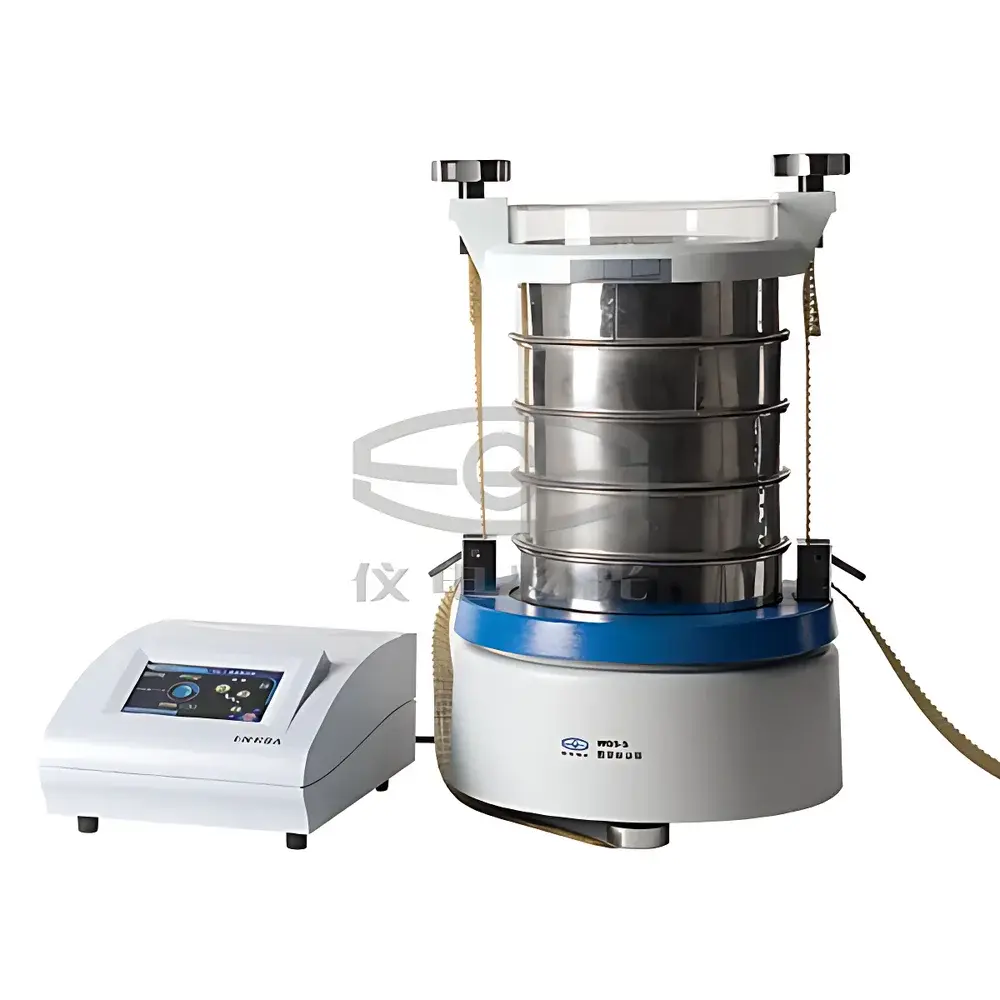
Shanghai YDWG WQS-S Digital Vibratory Sieve Analyzer
| Brand | YDWG |
|---|---|
| Origin | Shanghai, China |
| Model | WQS-S |
| Vibration Frequency | 3000 or 6000 cycles/min |
| Amplitude Range | 0–3 mm (continuously adjustable) |
| Vibration Modes | Micro-vibration, Intermittent, Continuous (all with precise timing and auto-lock shutdown) |
| Timer Range | 0–99 min |
| Power Supply | 220 V ± 22 V, 50 Hz ± 1 Hz, 150 W |
| Dimensions (Vibration Unit) | Ø300 × 210 mm |
| (Control Unit) | 280 × 200 × 140 mm |
| Weight | 24 kg |
| Sieve Compatibility | Standard 200 mm diameter × 50 mm height sieves (up to 6 layers max) |
Overview
The Shanghai YDWG WQS-S Digital Vibratory Sieve Analyzer is a laboratory-grade mechanical particle sizing instrument engineered for reproducible dry-sieving analysis of granular and powdered materials. It operates on the principle of controlled vibratory energy transmission—utilizing electromagnetic excitation to induce precise vertical oscillation of stacked sieve decks. Unlike rotary or horizontal shaker systems, the WQS-S employs a vertically oriented micro-vibration mechanism that minimizes particle agglomeration and ensures uniform sample distribution across sieve apertures. This architecture supports standardized sieve analysis in accordance with ASTM E11, ISO 3310-1, and USP , making it suitable for QC laboratories requiring compliance with GLP and GMP documentation protocols. Designed for routine use in regulated environments—including pharmaceutical manufacturing, food safety testing, and fine chemical production—the instrument delivers consistent amplitude and frequency control without mechanical wear from rotating components.
Key Features
- Three programmable vibration modes: micro-vibration (low-energy settling), intermittent (pulsed agitation), and continuous (steady-state sieving)—each configurable with user-defined timing and automatic termination.
- Digital amplitude adjustment from 0 to 3 mm in fine increments, enabling optimization for fragile, cohesive, or high-density particulates.
- Two fixed-frequency settings (3000 and 6000 cycles/min) calibrated against NIST-traceable reference standards to ensure inter-laboratory comparability.
- Auto-lock shutdown function retains last-used parameters and initiates power cutoff upon timer completion—critical for unattended operation during extended sieving cycles.
- Modular design separates the vibration unit (Ø300 × 210 mm) from the dedicated control unit (280 × 200 × 140 mm), facilitating maintenance, calibration verification, and spatial integration into fume hoods or laminar flow workstations.
- No rotating parts or belts—reducing mechanical drift, maintenance intervals, and long-term calibration uncertainty.
Sample Compatibility & Compliance
The WQS-S accommodates standard 200 mm diameter × 50 mm height test sieves conforming to ISO 3310-1 and ASTM E11 specifications. Users may stack up to six nested sieves per run, supporting multi-fraction particle size distribution (PSD) profiling across ranges from coarse aggregates (>2 mm) down to ultrafine powders (≤45 µm, equivalent to 325 mesh). The system is validated for use with non-hygroscopic, free-flowing, and mildly cohesive materials including sucrose crystals, lactose monohydrate, milled flour, cosmetic pigments, metal powders, and ceramic precursors. All operational parameters—including timer duration, amplitude setting, frequency selection, and vibration mode—are logged internally with timestamping, satisfying basic audit trail requirements under FDA 21 CFR Part 11 when paired with external data capture software.
Software & Data Management
While the WQS-S operates as a standalone hardware platform with an integrated LED display and tactile keypad interface, its parameter memory and repeatable execution support structured manual data recording workflows. For laboratories implementing electronic lab notebooks (ELN) or LIMS integration, the instrument’s deterministic behavior—repeatable amplitude/frequency combinations, fixed timing resolution (±1 s), and stable mechanical response—enables traceable correlation between physical sieving conditions and downstream analytical results (e.g., laser diffraction validation or SEM particle imaging). Optional third-party automation scripts can trigger external cameras or balance systems via TTL signal synchronization (available via auxiliary I/O port on request).
Applications
- Pharmaceutical solid dosage development: Excipient flowability assessment, granule size distribution prior to tableting, and API particle classification per USP .
- Food quality control: Sugar crystal grading, flour fineness verification, and spice particle homogeneity screening.
- Chemical manufacturing: Catalyst support particle sizing, pigment dispersion pre-screening, and polymer powder classification before extrusion.
- Metallurgy R&D: Metal injection molding (MIM) feedstock characterization and additive manufacturing powder qualification (per ASTM F3049).
- Agricultural product testing: Grain milling residue analysis and seed coating uniformity evaluation.
FAQ
Are test sieves included with the WQS-S unit?
No. The instrument ships with only the vibration unit, control unit, and sieve cover. Users must procure ISO/ASTM-compliant 200 mm × 50 mm sieves separately.
What is the maximum number of sieve layers supported?
Up to six stacked sieves may be used simultaneously, provided total stack height remains within mechanical tolerance limits and mass loading does not exceed 500 g per run.
Can the WQS-S be used for wet sieving?
No. This is a dry-sieving instrument only. Wet sieving requires sealed fluid handling, corrosion-resistant construction, and drainage infrastructure not present in this design.
Is calibration certification provided with delivery?
A factory performance verification report is included, documenting amplitude linearity, frequency stability, and timer accuracy at time of shipment. Third-party ISO/IEC 17025 calibration services are available upon request.
Does the instrument meet electromagnetic compatibility (EMC) requirements for EU laboratories?
Yes. The WQS-S complies with EN 61326-1:2013 for laboratory equipment and carries CE marking for EMC and low-voltage directive conformity.



