
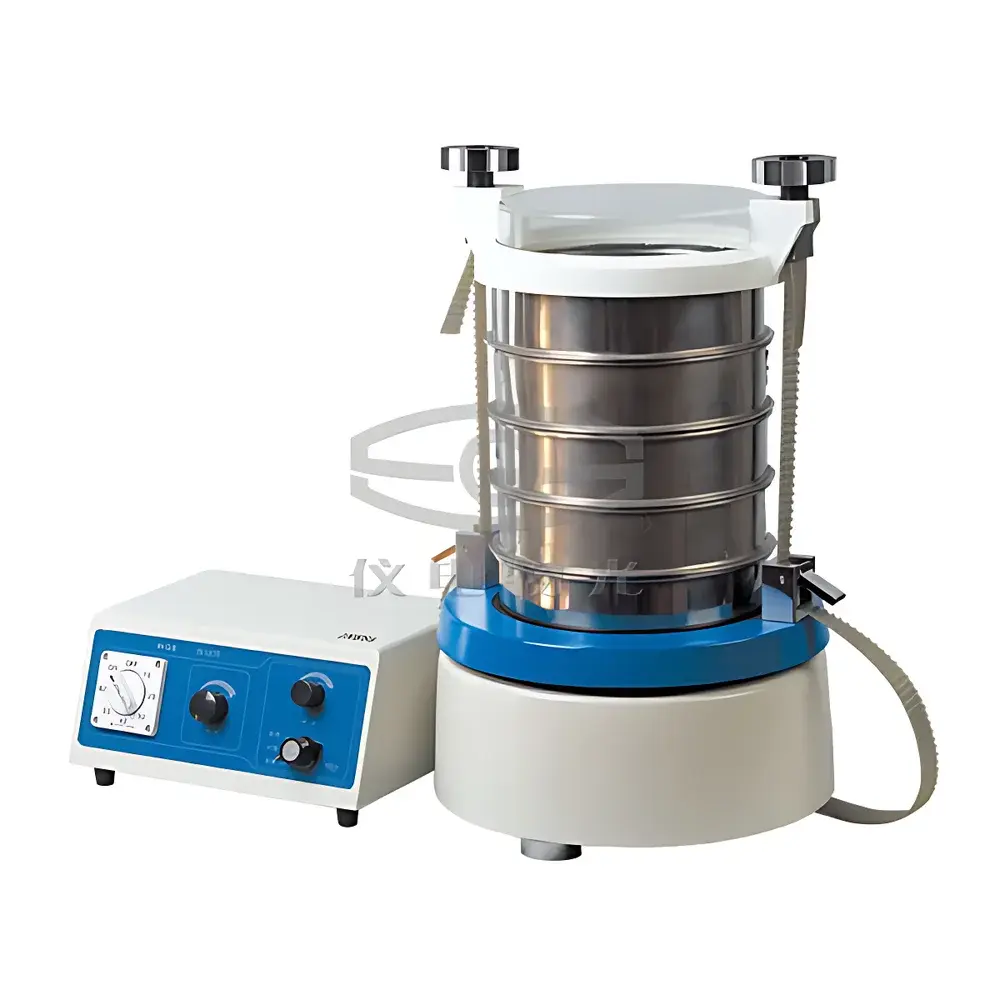
Shanghai YDWG WQS Vibratory Sieve Analyzer
| Brand | YDWG |
|---|---|
| Origin | Shanghai, China |
| Model | WQS |
| Vibration Frequency | 3000 or 6000 cycles/min |
| Adjustable Amplitude | 0–3 mm |
| Vibration Modes | Micro-vibration, Intermittent, Continuous |
| Timer Range | 0–60 min |
| Power Supply | 220 V ± 22 V, 50 Hz ± 1 Hz, 150 W |
| Dimensions (Vibration Unit) | Ø300 × 210 mm |
| Dimensions (Control Unit) | 270 × 220 × 130 mm |
| Weight | 24 kg |
| Sieve Compatibility | Standard 200 mm diameter × 50 mm height sieves (up to 6 layers) |
| Compliance | Designed for ASTM E11, ISO 3310-1, and USP <786> sieve analysis protocols |
Overview
The Shanghai YDWG WQS Vibratory Sieve Analyzer is an electromechanically controlled dry-sieving instrument engineered for precise particle size distribution analysis of free-flowing powders and granular materials. It operates on the principle of mechanical vibrational energy transmission—where controlled oscillatory motion induces stratification and percolation of particles through stacked sieve meshes—enabling reproducible separation across defined nominal aperture ranges. Designed for routine quality control and R&D applications in regulated manufacturing environments, the WQS delivers consistent kinetic energy input via its dual-frequency motor drive (3000 or 6000 cycles/min), coupled with continuously adjustable amplitude (0–3 mm), ensuring optimal particle mobility without agglomeration disruption or over-grinding artifacts. Its modular architecture separates the vibration unit (sieve stack platform) from the dedicated control unit, facilitating cleanroom integration, maintenance access, and long-term operational stability.
Key Features
- Dual selectable vibration frequencies (3000 or 6000 cycles/min) optimized for coarse-to-fine particle separation across diverse material densities and flow characteristics.
- Continuously variable amplitude control (0–3 mm) enables fine-tuning of energy input to match sample cohesiveness, moisture content, and static charge behavior.
- Three programmable vibration modes: micro-vibration (low-energy settling), intermittent (pulse-based stratification), and continuous (high-throughput classification)—each configurable via front-panel digital interface.
- Precision-engineered timing circuitry supports 1-minute increments across a 0–60 minute range, supporting method validation under GLP/GMP-aligned SOPs.
- Modular design isolates electromagnetic interference-sensitive control electronics from high-vibration mechanical components, enhancing signal integrity and long-term calibration retention.
- Compact footprint (vibration unit: Ø300 × 210 mm; control unit: 270 × 220 × 130 mm) accommodates benchtop deployment in QC labs with limited space and strict ESD/EMC requirements.
Sample Compatibility & Compliance
The WQS analyzer accommodates standard 200 mm diameter × 50 mm height test sieves conforming to ISO 3310-1 and ASTM E11 specifications—including stainless steel woven wire mesh (e.g., 20 µm to 325 mesh / ~45 µm), perforated plate, and polymer-coated variants. Up to six sieve layers may be stacked simultaneously, enabling multi-fractional analysis in a single run. The system is routinely deployed in pharmaceutical solid dosage form development (per USP ), food ingredient grading (Codex Alimentarius standards), cosmetic powder blending verification, and sugar crystal uniformity assessment. All electronic controls comply with IEC 61000-4 immunity standards; mechanical construction meets ISO 14644-1 Class 8 cleanroom compatibility when operated with appropriate sieve handling protocols.
Software & Data Management
While the WQS operates via standalone hardware controls, its timing, frequency, amplitude, and mode settings are fully documentable within laboratory notebooks or LIMS-integrated workflows. For audit-ready environments, users may record instrument parameters alongside sieve lot numbers, sample IDs, and environmental conditions (temperature/humidity) in accordance with FDA 21 CFR Part 11 principles—though native electronic signature or audit trail functionality is not embedded. Calibration verification is performed using certified reference sieves traceable to NIST or equivalent national metrology institutes; annual mechanical inspection of motor coupling and spring suspension is recommended to maintain amplitude linearity and frequency stability.
Applications
- Pharmaceutical: Excipient and API particle sizing prior to wet/dry granulation; blend uniformity screening; capsule fill weight consistency checks.
- Food & Beverage: Flour, starch, and powdered dairy product grading; sugar crystal distribution analysis for texture and dissolution control.
- Cosmetics: Talc, mica, and pigment particle size profiling for opacity, spreadability, and skin adhesion performance.
- Chemicals & Catalysts: Zeolite, silica gel, and activated carbon sieve analysis for surface area correlation and reactor bed packing validation.
- Agriculture: Feed pellet fines content measurement; seed coating uniformity verification.
FAQ
What sieve sizes are compatible with the WQS system?
Standard 200 mm diameter × 50 mm height sieves meeting ISO 3310-1 tolerances are supported—including stainless steel, brass, and nylon meshes ranging from 20 µm to 325 mesh (45 µm).
Is calibration certification included with the instrument?
No factory-issued calibration certificate is provided; users must perform initial verification using certified reference sieves and document results per internal SOP.
Can the WQS be integrated into a networked LIMS environment?
The unit lacks Ethernet or USB data export; however, all operational parameters are manually recordable and compatible with structured LIMS data entry templates.
What maintenance is required for long-term accuracy?
Biannual inspection of suspension springs and motor mounting bolts is recommended; annual verification of timer accuracy and frequency output using a calibrated tachometer is advised.
Does the WQS support wet sieving?
No—this is a dry-sieving instrument only. Wet sieving requires separate equipment with liquid containment and pump systems.
Related Products



