
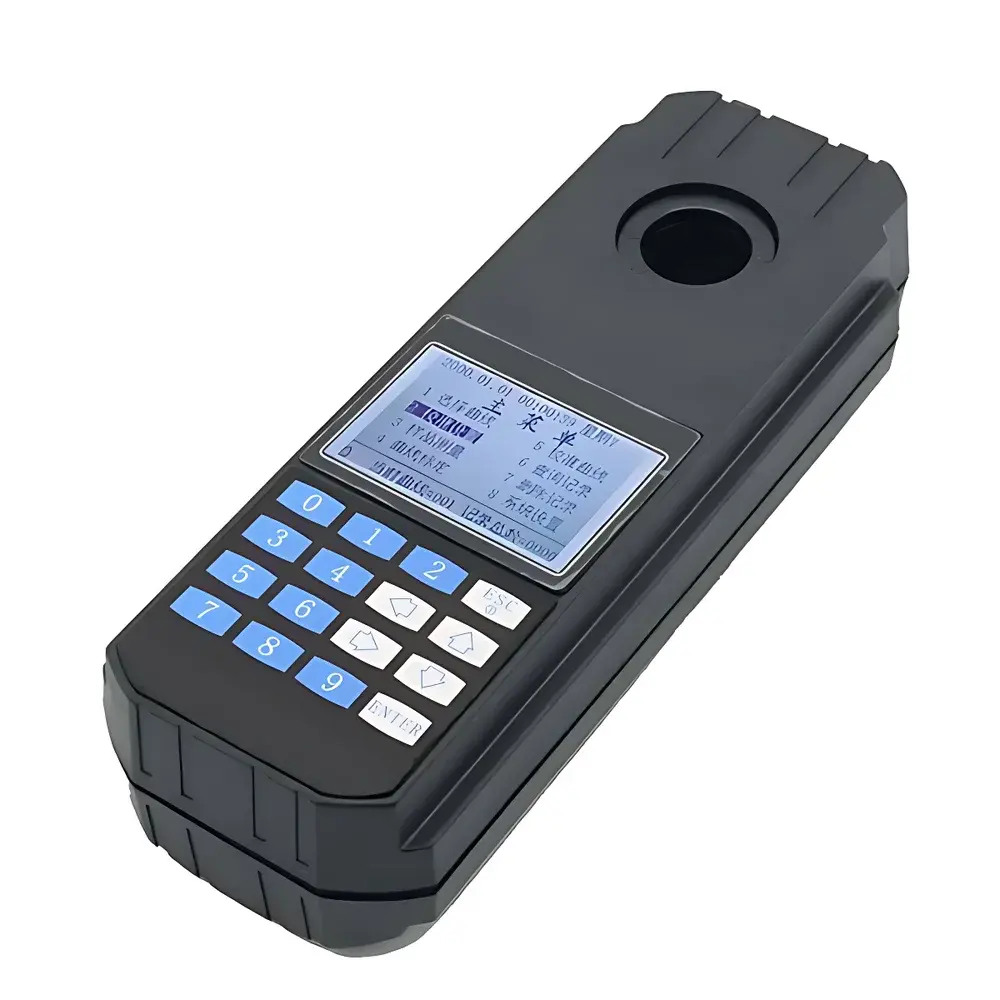
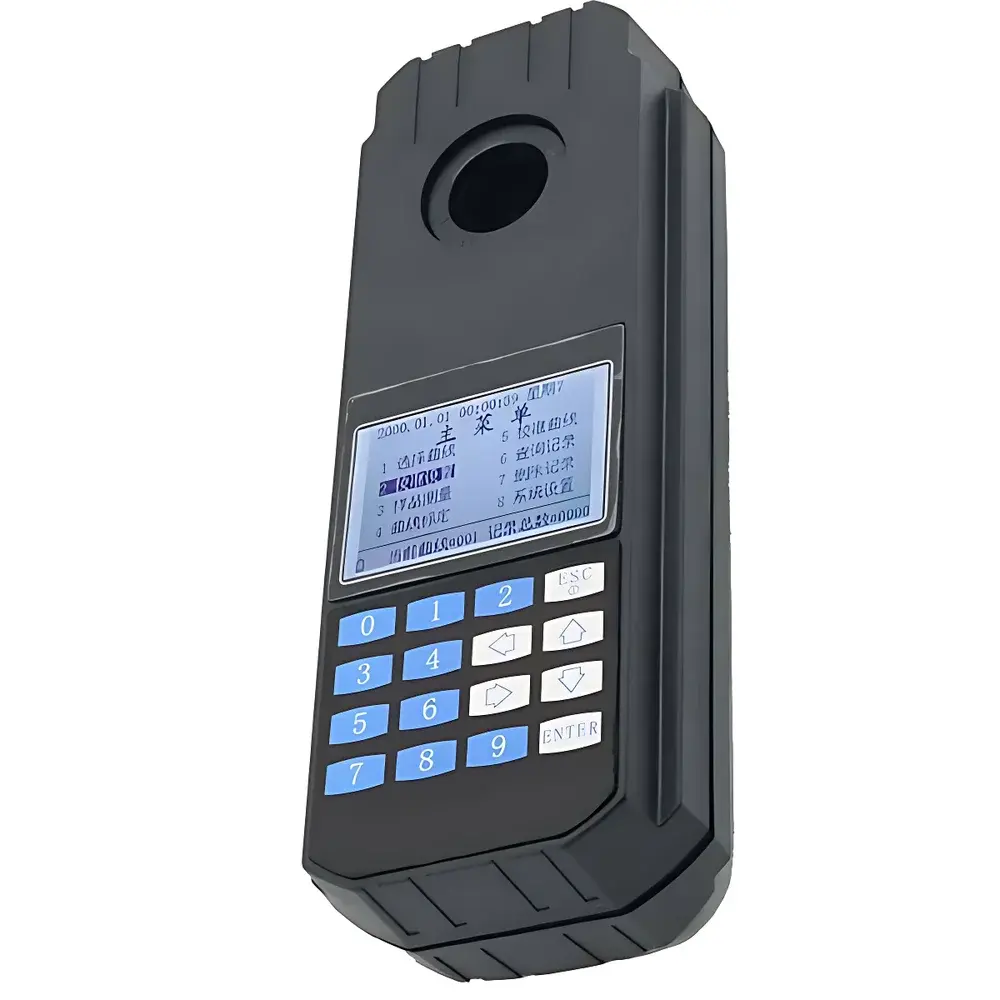
Shenchanghong PCHSIO2-260 Silica Analyzer
| Brand | Shenchanghong |
|---|---|
| Origin | Shenzhen, China |
| Manufacturer Type | Direct Manufacturer |
| Country of Origin | China |
| Model | PCHSIO2-260 |
| Price | Upon Request |
| Measurement Range | 0.01–5.00 mg/L |
| Accuracy (Abs. Error) | ≤±5% |
| Repeatability | ≤3% |
| Optical Drift | <0.002 A in 20 min |
| Dimensions | 80 mm × 230 mm × 55 mm |
| Weight | 500 g |
| Operating Temperature | 5–40 °C |
| Relative Humidity | ≤85% |
| Power Supply | 4 × AA batteries |
| Data Storage | 20 calibration curves + 199 timestamped measurements (year/month/day/hour/minute/second, absorbance, transmittance, SiO₂ concentration) |
| Protection Rating | IP65 |
| Optical System | Monochromatic cold light source with narrow-band interference filter |
Overview
The Shenchanghong PCHSIO2-260 Silica Analyzer is a portable, microprocessor-controlled photometric instrument engineered for the quantitative determination of dissolved silica (SiO₂) in aqueous matrices using the molybdenum blue colorimetric method. It operates on the principle of selective complexation between silicic acid and ammonium molybdate under acidic conditions, followed by reduction to form a stable heteropoly blue complex measurable at 650 nm. Designed for field-deployable and laboratory-based water quality monitoring, the analyzer delivers trace-level sensitivity (0.01 mg/L detection limit) and high analytical reproducibility—critical for compliance with regulatory frameworks governing drinking water (e.g., WHO Guidelines, GB 5749–2022), surface water classification (GB 3838–2002), and industrial effluent discharge standards (GB 8978–1996). Its compact architecture, battery-powered operation, and robust optical design enable reliable performance in ambient environments without access to mains power or climate-controlled labs.
Key Features
- Monochromatic cold light source coupled with narrow-band interference optical filtering ensures minimal spectral stray light and long-term photometric stability (<0.002 A drift over 20 minutes).
- 16-bit low-power microcontroller enables precise analog-to-digital conversion, real-time correction of baseline drift, and optimized energy management for extended field operation (up to 10,000 measurements per battery set).
- Backlit LCD display with intuitive menu navigation supports direct readout of SiO₂ concentration (mg/L), absorbance (A), and transmittance (%T), eliminating need for manual calibration curve interpolation.
- IP65-rated ABS polymer housing provides resistance to dust ingress, water splashes, and chemical corrosion—validated for use in wastewater treatment plants, cooling tower monitoring, and riverbank sampling stations.
- Onboard memory stores up to 20 user-defined calibration curves and 199 fully timestamped measurement records (including date, time, absorbance, %T, and calculated SiO₂ value), supporting audit-ready data traceability.
- Integrated data retention circuitry preserves stored parameters and measurement history during battery replacement or unexpected power loss.
Sample Compatibility & Compliance
The PCHSIO2-260 is validated for use with clarified, non-turbid water samples—including potable water, groundwater, surface water, municipal wastewater, and industrial process streams—provided suspended solids are removed via filtration (0.45 µm membrane) prior to analysis. It conforms to the fundamental methodology outlined in ISO 10530:1992 (Water quality — Determination of silica — Molybdenum blue spectrophotometric method) and aligns with procedural requirements of ASTM D859–22 (Standard Test Method for Silica in Water). While not certified for GLP or 21 CFR Part 11 compliance out-of-the-box, its timestamped data logging, non-volatile memory, and password-protected calibration editing support integration into auditable QA/QC workflows when paired with documented SOPs.
Software & Data Management
Data export is performed manually via timestamped on-device review or printed record (when used with optional thermal printer interface). The instrument does not feature Bluetooth, USB, or PC connectivity; however, its structured internal database—comprising full metrological metadata (time stamp, raw absorbance, %T, calibration ID)—facilitates manual transcription into LIMS or Excel-based trending tools. All stored calibrations retain slope, intercept, correlation coefficient (r²), and verification date, enabling periodic assessment of method performance against control chart limits per ISO/IEC 17025:2017 Clause 7.7.
Applications
- Drinking water utilities: Routine monitoring of silica to prevent scaling in distribution networks and membrane desalination pre-treatment systems.
- Power generation facilities: Boiler feedwater and condensate testing to mitigate silica deposition on turbine blades and heat exchanger surfaces.
- Electronics manufacturing: Ultrapure water (UPW) quality screening in semiconductor fab rinse processes where silica >10 ppb compromises wafer yield.
- Environmental agencies: Field quantification of silica flux in watershed studies and eutrophication assessments.
- Chemical and pharmaceutical plants: Effluent characterization prior to discharge permitting and environmental reporting obligations.
FAQ
What is the recommended sample pretreatment for turbid or colored water?
Filter samples through a 0.45 µm membrane syringe filter; if significant color interference persists, perform a reagent blank correction using acidified deionized water processed identically to the sample.
Can the PCHSIO2-260 measure colloidal silica?
No—the method quantifies dissolved reactive silica (monosilicic acid, H₄SiO₄); colloidal or particulate silica requires acid digestion (e.g., ASTM D3752–21) prior to analysis.
How often should the optical path be cleaned?
Wipe the cuvette chamber and light guide window with lint-free tissue moistened with ethanol after every 50 measurements or when visible residue accumulates.
Is factory calibration traceable to NIST standards?
Calibration solutions are prepared gravimetrically using NIST-traceable sodium silicate reference material (SRM 2783); instrument-specific calibration verification is performed at time of shipment and documented in the certificate of conformance.
Does the device support multi-point calibration?
Yes—users may program up to 20 independent calibration curves, each defined by 2–5 concentration points, with automatic linear or quadratic regression applied during measurement processing.







