
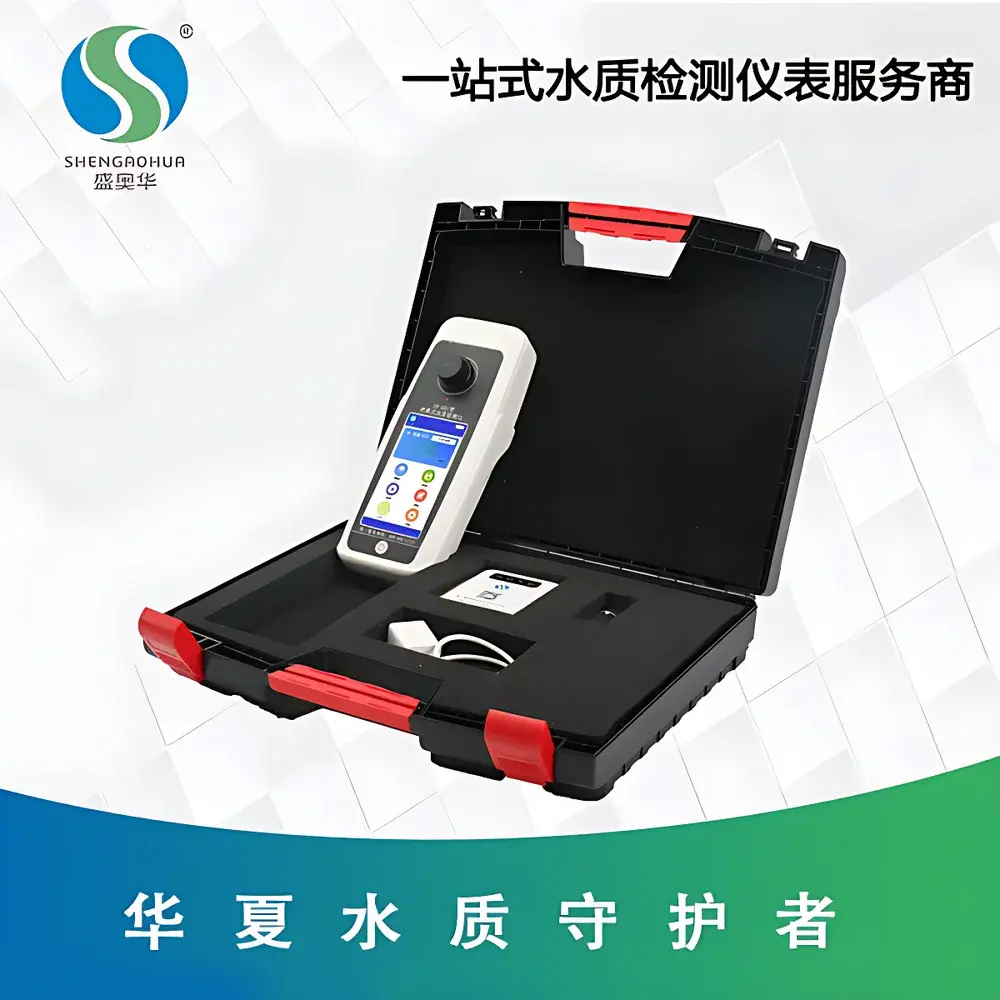
Shengaohua SH-50Z Portable Turbidimeter
| Brand | Shengaohua |
|---|---|
| Origin | Jiangsu, China |
| Manufacturer Type | Direct Manufacturer |
| Product Origin | Domestic (China) |
| Model | SH-50Z (New Release) |
| Product Type | Portable |
| Measurement Range | 0–1000 NTU |
| Resolution | 0.01/0.1 NTU with Automatic Range Switching |
| Operating Temperature | 0–50 °C (non-freezing) |
| Accuracy | <8% FS |
| Principle | 90° Nephelometric Scattering |
| Light Source | 850 nm Infrared LED |
| Response Time | 15 s |
| Drift | ≤0.02 NTU |
| Sample Cell | 25 mm Diameter Cuvette |
| Display | 5.0-inch IPS HD Touchscreen |
| Power Supply | Rechargeable Lithium-ion Battery |
| Dimensions | 251 × 102 × 55 mm |
| Net Weight | 700 g |
Overview
The Shengaohua SH-50Z Portable Turbidimeter is an engineered field-deployable instrument designed for rapid, on-site turbidity measurement in accordance with the Chinese environmental monitoring standard HJ 1075–2019. It operates on the principle of 90° nephelometric scattering—where incident light from an 850 nm infrared LED interacts with suspended particles in a liquid sample, and the intensity of scattered light measured at a right angle to the incident beam is directly proportional to turbidity concentration. This optical geometry minimizes interference from color absorption and particle settling effects, delivering high reproducibility in real-world water matrices. The instrument is optimized for routine monitoring tasks where portability, battery autonomy, and operational robustness are critical—such as wastewater outfall inspections, aquaculture pond management, municipal drinking water distribution system verification, and third-party environmental compliance audits.
Key Features
- Compliant 90° scattering optical path aligned with HJ 1075–2019, ensuring regulatory traceability in Chinese environmental testing workflows.
- Compact, ergonomic design (251 × 102 × 55 mm; 700 g net weight) with integrated rechargeable lithium-ion battery enabling >12 hours of continuous operation per charge.
- High-contrast 5.0-inch IPS capacitive touchscreen interface with intuitive icon-based navigation and real-time graphical display of measurement curves.
- Dual-range internal calibration curves (low-range: 0–20 NTU; high-range: 20–1000 NTU), automatically selected based on signal saturation thresholds to maintain optimal signal-to-noise ratio.
- Stable 850 nm infrared LED source with >50,000-hour service life, minimizing spectral drift and reducing maintenance frequency compared to tungsten or visible-light sources.
- Auto-sleep mode with wake-on-touch functionality conserves power during intermittent use without requiring manual power cycling.
- Multi-mode calibration support—including single-point (0 NTU and/or user-defined standard), two-point, and multi-point (up to 5 points) calibration—enabling traceable adjustment across heterogeneous sample types.
- Onboard microSD card slot (supports up to 32 GB) stores timestamped measurements with full metadata (date, time, operator ID, calibration status, temperature).
Sample Compatibility & Compliance
The SH-50Z accepts standard 25 mm diameter round glass or quartz cuvettes compliant with ISO 7027-1:2016 geometric specifications. It is validated for use with natural waters (surface, groundwater, effluent), process streams in food & beverage production, pharmaceutical rinse water, and industrial cooling loops. While not certified to ASTM D6508 or USP out-of-the-box, its 90° scattering architecture and documented linearity (R² ≥ 0.999 over 0–200 NTU) support method validation under GLP/GMP-aligned laboratory quality systems. Data logging meets basic audit-trail requirements, and optional GPS/BDS geotagging (via Bluetooth-connected smartphone) enables spatially referenced reporting for field survey applications.
Software & Data Management
Instrument data are exportable via USB-C or microSD card in CSV format, compatible with LIMS integration and statistical analysis platforms (e.g., Excel, JMP, Minitab). Optional companion Android/iOS application provides remote control, live streaming of readings, cloud backup (via encrypted HTTPS), and customizable report templates (PDF/Excel). Firmware updates are delivered OTA or via local file import, maintaining version control and regulatory documentation integrity. All stored records include immutable timestamps, operator identifiers, and calibration history logs—supporting basic 21 CFR Part 11 readiness when deployed with organizational access controls.
Applications
- Environmental monitoring: Field verification of discharge compliance per GB 8978–1996 and local ecological protection bureau mandates.
- Aquaculture: Daily assessment of pond turbidity to optimize feeding cycles and prevent hypoxia-induced stress.
- Municipal water utilities: Rapid screening of distribution system integrity and filter performance at valve chambers and reservoir outlets.
- Pharmaceutical manufacturing: Monitoring of purified water (PW) and water-for-injection (WFI) pre-filtration stages per Chinese GMP Annex 1 guidelines.
- Food & beverage QA: In-line verification of juice clarification, beer filtration, and dairy processing rinse water clarity.
- Third-party testing laboratories: Supporting accredited methods under CNAS-CL01:2018 where portable nephelometry is permitted by scope.
FAQ
What calibration standards are recommended for routine verification?
Certified formazin or polymer-based NTU standards traceable to NIST SRM 2134 are recommended. For field use, stable secondary standards (e.g., AMCO AEPA-1) may be employed with documented equivalency.
Is the instrument suitable for seawater or high-salinity samples?
Yes—provided samples are filtered through a 0.45 µm membrane prior to measurement to remove coarse particulates that may scatter light non-isotropically.
Does the SH-50Z support ISO 7027-compliant measurement protocols?
Its 90° scattering geometry and 850 nm LED source meet the fundamental optical requirements of ISO 7027-1:2016; however, formal ISO certification requires independent verification by an accredited body.
Can measurement data be synchronized with enterprise LIMS platforms?
Direct LIMS integration is not built-in, but CSV exports and structured metadata enable automated ingestion via middleware or custom API connectors.
What is the expected lifetime of the optical module under normal field use?
The LED light source is rated for ≥50,000 hours; detector responsivity degradation is less than 0.5% per year under typical operating conditions (25 °C, 60% RH).





