
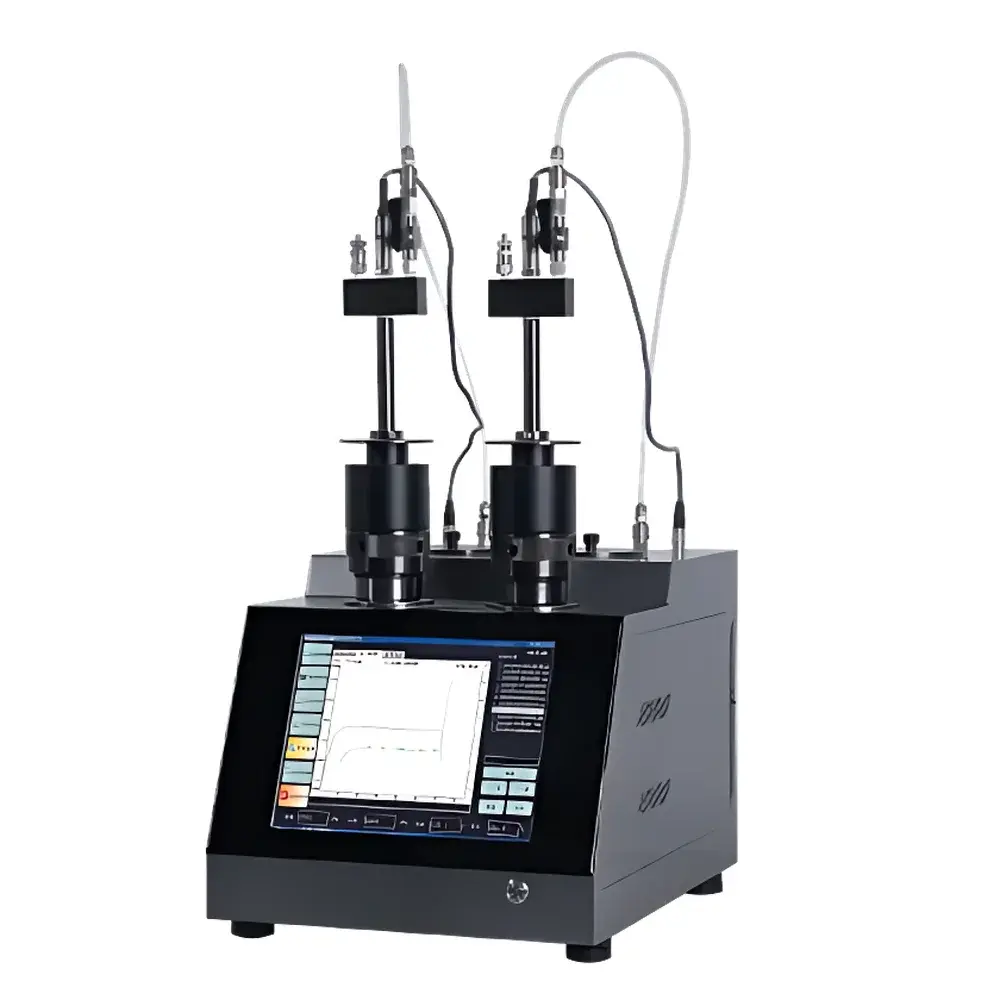
Shenkai SKY2101-IIA Automatic Gasoline Oxidation Stability Tester (Induction Period Method)
| Brand | Shenkai |
|---|---|
| Origin | Shanghai, China |
| Model | SKY2101-IIA |
| Test Method Compliance | ASTM D525, GB/T 8018, ISO 7536, IP 40 |
| Temperature Setpoint | 100 °C ± 0.1 °C |
| Pressure Range | 0–1.6 MPa (±0.1% FS) |
| Heating System | Solid Metal Bath |
| Display | 12″ Color Touchscreen |
| Data Storage Capacity | ≥5000 Test Records |
| Power Supply | AC 220 V ±10%, 50 Hz |
| Max Power Consumption | ≤1800 W |
| Dimensions (W×D×H) | 370 × 520 × 645 mm |
| Net Weight | 60 kg |
| Ambient Operating Conditions | 5–35 °C, 20–80% RH |
| Oxygen Supply | ≥99.6% purity, 800–850 kPa |
Overview
The Shenkai SKY2101-IIA Automatic Gasoline Oxidation Stability Tester (Induction Period Method) is a precision-engineered instrument designed for quantitative assessment of gasoline oxidation resistance under accelerated oxidative stress. It operates on the principle of oxygen uptake monitoring in a sealed, pressurized bomb system immersed in a thermally stable metal bath at 100 °C. As per ASTM D525, GB/T 8018, ISO 7536, and IP 40, the instrument determines the induction period—the time elapsed until a measurable, rapid pressure drop occurs—indicating the onset of autoxidation and hydroperoxide decomposition. This parameter directly correlates with fuel storage stability, deposit-forming tendency, and engine intake system cleanliness. The SKY2101-IIA replaces traditional liquid-bath systems with a solid-state metal heating block, eliminating volatile media, thermal stratification, and maintenance overhead while delivering superior temperature uniformity (<±0.1 °C) and long-term thermal stability over continuous 96-hour operation.
Key Features
- iSKvator™ intelligent automation architecture: fully autonomous sequence control—including bath pre-heat stabilization, bomb leak detection, oxygen charging (800–850 kPa), real-time pressure/temperature logging, inflection point recognition via derivative analysis, and automatic test termination.
- Dual independent bomb stations: each stainless-steel bomb is CNC-machined to ISO-grade tolerances; sealing components utilize fluoropolymer-elastomer hybrid gaskets rated for >1.6 MPa and 120 °C continuous exposure.
- 12-inch industrial-grade capacitive touchscreen HMI: displays live pressure vs. time curves, temperature deviation traces, system status flags, and alarm logs; interface supports multi-language firmware (English default) and GLP-compliant user access levels.
- Passive thermal insulation enclosure: minimizes surface temperature rise (<45 °C at ambient 25 °C), eliminates burn hazard during routine operation, and reduces laboratory HVAC load.
- Triple-layer safety protocol: (1) overpressure mechanical relief valve (set at 1.65 MPa), (2) solid-state overtemperature cutoff (105 °C threshold), and (3) post-test thermal shutdown with residual heat dissipation monitoring.
- Integrated digital pressure transduction: 0–1.6 MPa range, 0.25-class accuracy per EN 837-1, sampled at 2 Hz and compensated for zero drift and thermal hysteresis.
Sample Compatibility & Compliance
The SKY2101-IIA is validated for use with unleaded gasoline, ethanol-blended fuels (E10, E15), and reformulated gasoline components. Sample volume is standardized at 50 mL per bomb per ASTM D525. All wetted surfaces contact only 316L stainless steel or PTFE-lined components, ensuring chemical inertness toward peroxides, organic acids, and trace metals. Instrument design and firmware support full audit trail generation required for ISO/IEC 17025-accredited laboratories. Data integrity conforms to FDA 21 CFR Part 11 principles: electronic signatures, role-based permissions, immutable raw data storage, and time-stamped event logs for all critical actions (e.g., oxygen charging, pressure anomaly detection, test completion). Calibration certificates traceable to NIM (China) or NIST SRMs are provided with initial delivery.
Software & Data Management
Embedded Linux-based firmware enables local data retention of ≥5000 complete test records—including raw pressure/time arrays, annotated inflection points, operator ID, timestamp, ambient conditions, and pass/fail status against method-defined acceptance criteria. Export formats include CSV (for Excel/LabVIEW integration), PDF reports (with embedded curves and metadata), and XML (for LIMS ingestion via RJ-45 Ethernet). USB and RS-232 ports support offline backup and legacy instrument interfacing. Firmware updates are delivered via signed OTA packages with SHA-256 verification. Audit trail export includes all user-initiated changes to calibration parameters, method settings, or alarm thresholds—fully compliant with GLP documentation requirements.
Applications
- Refinery quality assurance: batch release testing of finished gasoline against specification limits for induction period (e.g., min. 480 min per GB/T 8018).
- Fuel additive evaluation: screening antioxidant efficacy (e.g., hindered phenols, amine derivatives) by comparative induction period extension.
- Stability modeling: generating Arrhenius-type degradation kinetics using multi-temperature runs (100 °C primary, optional 110 °C validation).
- Regulatory submission support: generating data packages for EPA Tier 3, CNPC product registration, or EU Fuel Quality Directive (2009/30/EC) compliance dossiers.
- R&D labs: correlating oxidation onset with hydrocarbon composition (e.g., olefin content via GC-FID) or trace metal contamination (Cu, Pb).
FAQ
What standards does the SKY2101-IIA fully comply with?
ASTM D525, GB/T 8018–2015, ISO 7536:1984, and IP 40:1979—all verified via interlaboratory round-robin testing with NIST SRM 2720a reference fuel.
Can the instrument operate unattended for extended periods?
Yes. Designed for continuous 96-hour duty cycles with thermal runaway protection, automatic oxygen replenishment logic, and watchdog-timer–monitored firmware execution.
Is LIMS integration supported out-of-the-box?
Yes. Native TCP/IP communication stack with configurable MODBUS TCP and HL7-compatible XML schema; no middleware required for major LIMS platforms (e.g., Thermo SampleManager, LabVantage).
How is pressure sensor accuracy maintained over time?
Each unit ships with factory-applied NIST-traceable calibration; field recalibration is performed using dead-weight tester inputs via service mode—no disassembly required.
What maintenance is required for the metal bath system?
None beyond periodic verification of thermal uniformity (recommended annually) and visual inspection of bomb O-rings; no fluid top-up, filtration, or corrosion mitigation steps are necessary.





