
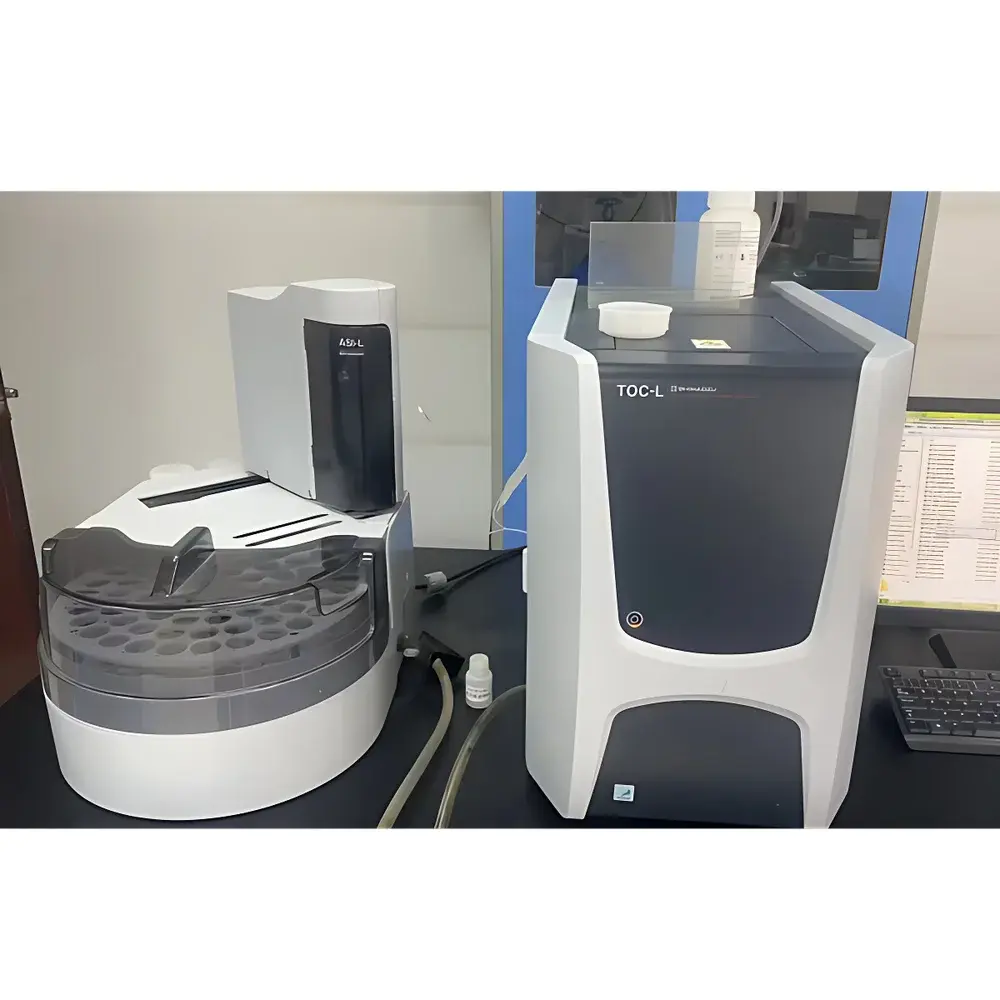
Shimadzu TOC-L Total Organic Carbon Analyzer
| Brand | Shimadzu |
|---|---|
| Origin | Japan |
| Manufacturer Type | Authorized Distributor |
| Origin Category | Imported |
| Model | TOC-L |
| Instrument Type | Laboratory TOC Analyzer |
| Detection Principle | Non-Dispersive Infrared (NDIR) Absorption |
| Oxidation Method | High-Temperature Catalytic Combustion at 680°C |
| Measurement Range | 4 µg/L to 30,000 mg/L |
| Accuracy | ±10% of reading |
| Resolution | 0.004 mg/L |
| Detection Limit | 0.05 mg/L |
| Repeatability | ±3% RSD |
Overview
The Shimadzu TOC-L Total Organic Carbon Analyzer is a laboratory-grade instrument engineered for precise, reliable quantification of total organic carbon in aqueous samples using high-temperature catalytic combustion oxidation coupled with non-dispersive infrared (NDIR) detection. Operating at a controlled 680°C combustion temperature with platinum-based catalysts, the system achieves complete oxidation of both soluble and insoluble organic compounds—including refractory, particulate, and humic substances—ensuring comprehensive carbon recovery. This principle enables trace-level sensitivity and broad dynamic range coverage, supporting applications from ultrapure water monitoring in semiconductor fabrication to wastewater characterization in municipal treatment plants. The analyzer complies with internationally recognized methodology standards including ASTM D7573, ISO 8245, and USP , and its design supports alignment with GLP and GMP data integrity requirements through secure audit trail functionality and user-access controls.
Key Features
- High-efficiency catalytic combustion at 680°C ensures >99% oxidation efficiency across diverse organic matrices, including recalcitrant compounds and suspended solids.
- Ultra-wide linear measurement range of 4 µg/L to 30,000 mg/L eliminates need for manual dilution or method switching between low- and high-concentration samples.
- NDIR detection system provides stable, drift-free CO₂ quantification with inherent specificity for carbon dioxide, minimizing interferences from chloride, sulfate, or inorganic carbon species.
- Integrated 7-inch high-resolution color LCD touchscreen interface enhances operational clarity and reduces training time; on-screen real-time chromatograms, calibration curves, and QC metrics are displayed without external software dependency.
- Energy-optimized architecture reduces power consumption by 36% under standard 40-hour/week operation versus prior-generation models; compact footprint (340 mm width) improves benchtop utilization in space-constrained labs.
- Modular top-mounted TN (Total Nitrogen) unit option enables concurrent TOC and TN analysis without additional instrumentation footprint or sample handling steps.
Sample Compatibility & Compliance
The TOC-L accommodates a wide spectrum of aqueous matrices—including deionized water, pharmaceutical process water, drinking water, surface water, wastewater effluents, seawater (with optional salt-tolerant hardware), and acid-digested environmental extracts. Its robust oxidation module tolerates up to 30 g/L chloride without performance degradation when configured with appropriate consumables. Instrument validation protocols support IQ/OQ/PQ execution per FDA 21 CFR Part 11 guidelines, with electronic signatures, audit trails, and configurable user roles. All firmware and method files are digitally signed and version-controlled to ensure regulatory traceability during inspections.
Software & Data Management
Data acquisition and reporting are managed via Shimadzu’s TOC-L Series Software (v3.x), compliant with FDA 21 CFR Part 11 for electronic records and signatures. The software supports automated calibration verification, spike recovery tracking, drift correction algorithms, and customizable report templates aligned with ISO/IEC 17025 documentation requirements. Raw data and processed results are exportable in CSV, PDF, and XML formats; USB storage integration allows offline backup and transfer to LIMS or ELN systems without network dependency. Audit trail logs record all user actions—including method edits, result overrides, and calibration events—with timestamps, operator IDs, and reason-for-change fields.
Applications
- Pharmaceutical water systems: USP compliance testing for Purified Water, Water for Injection (WFI), and Clean Steam condensate.
- Environmental monitoring: EPA Method 415.3 and ISO 8245 implementation for surface water, groundwater, and wastewater discharge reporting.
- Power generation: Boiler feedwater and condensate purity assurance in thermal and nuclear facilities.
- Electronics manufacturing: Monitoring TOC in ultrapure rinse water used in wafer cleaning processes (SEMI F57).
- Academic and research laboratories: Kinetic studies of organic pollutant degradation, carbon flux modeling, and method development for emerging contaminants.
FAQ
What oxidation method does the TOC-L use, and why is 680°C significant?
The TOC-L employs high-temperature catalytic combustion at 680°C using a Pt-coated ceramic catalyst. This temperature ensures quantitative oxidation of complex organics—including polyaromatic hydrocarbons and cellulose—without requiring aggressive chemical oxidants or UV/persulfate pretreatment.
Can the TOC-L measure TOC in seawater or brine samples?
Yes, when equipped with the optional high-salinity kit (including corrosion-resistant injector, quartz combustion tube, and chloride-scavenging trap), the system maintains accuracy and longevity in matrices with up to 3.5% NaCl.
How is data integrity ensured during routine operation?
All analytical sequences generate immutable digital audit trails; user authentication is enforced via role-based access control; and electronic signatures are required for critical actions such as result approval and calibration validation.
Is the instrument compatible with laboratory information management systems (LIMS)?
Yes, the TOC-L supports ASTM E1384-compliant data export and offers optional OPC UA connectivity for seamless bidirectional integration with enterprise LIMS and MES platforms.
What maintenance intervals are recommended for optimal performance?
Catalyst replacement is recommended every 12 months under normal usage; NDIR cell cleaning every 6 months; and annual full system verification per Shimadzu’s PQ protocol, which includes linearity, LOD/LOQ, and precision testing.
Related Products







