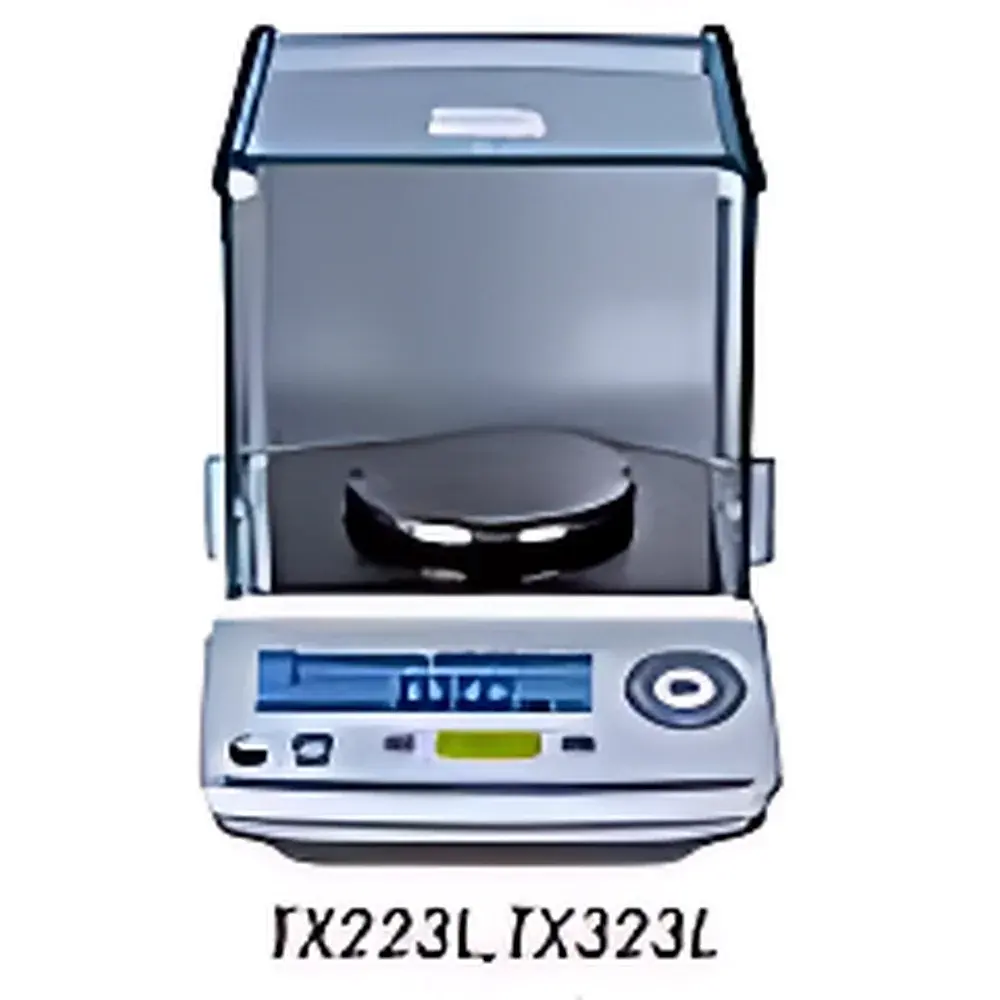
Shimadzu TX/TXB Series Precision Balance
| Brand | Shimadzu |
|---|---|
| Origin | Japan |
| Type | Precision Balance |
| Models | TX223L, TX323L, TX2202L, TX3202L, TXB222L, TXB422L, TXB622L, TXB621L, TXB2201L, TXB4201L, TXB6201L, TXB6200L |
| Weighing Range | 220 g – 6200 g |
| Readability | 0.001 g – 1 g |
| Pan Size | Ø110 mm or 167(W)×181(D) mm or Ø160 mm |
| Power Supply | AC adapter (TX/TXB series) or AC + rechargeable/dry-cell batteries (TXB series, up to ~40 h operation) |
| Interface | RS-232C with built-in Windows Direct Transfer software |
| Compliance | GLP/GMP-ready with audit trail support via EP-80 printer integration |
Overview
The Shimadzu TX/TXB Series Precision Balances are laboratory-grade analytical instruments engineered for high reproducibility, operational flexibility, and regulatory compliance in quality control, R&D, and routine weighing applications. Based on electromagnetic force compensation (EMFC) transduction technology, these balances deliver stable, drift-compensated measurements across a broad dynamic range—from milligram-level resolution (0.001 g) in the TX223L model to kilogram-scale capacity (6200 g) with 1 g readability in the TXB6200L. Designed and manufactured in Japan, the series adheres to stringent JIS B 7721 and ISO 9001 quality standards, with internal calibration routines traceable to NIST-certified reference masses. The TX models prioritize AC-powered stability for fixed-lab environments, while the TXB variants integrate dual-power architecture—supporting both AC operation and extended field use via standard alkaline or Ni-MH batteries (up to ~40 hours continuous runtime)—without compromising linearity or repeatability.
Key Features
- Intuitive Human-Machine Interface: Dedicated function keys separate from numeric input enable rapid access to tare, unit conversion, and calibration menus; a four-way directional keypad simplifies hierarchical navigation without requiring multi-step soft-key sequences.
- Real-Time Stability/Response Adjustment: During active weighing, users may dynamically modify filter response time (e.g., “Stable” vs. “Fast” mode) via dedicated hardware buttons—no interruption to ongoing measurement cycles is required, and LED indicators provide immediate visual feedback on current filtering state.
- Windows Direct Transfer (WDT) Technology: Proprietary embedded RS-232C interface and lightweight host-side receiver software allow seamless, driver-free transmission of weight data directly into Microsoft Excel, LabWare LIMS, or custom CSV-based databases—eliminating middleware installation, COM port configuration, or third-party drivers.
- Dual-Power Architecture (TXB only): Integrated battery compartment supports AA alkaline or rechargeable Ni-MH cells, enabling full-spec operation in mobile labs, cleanrooms with restricted power access, or field-deployed QA stations—while maintaining identical metrological performance as AC-powered operation.
- GLP/GMP-Ready Data Integrity: When paired with the optional Shimadzu EP-80 thermal printer, all weight events—including timestamps, operator IDs (via optional keypad login), tare values, and net/gross modes—are simultaneously logged to paper and mirrored to PC storage, satisfying 21 CFR Part 11 electronic record requirements for audit trails and data backup.
Sample Compatibility & Compliance
The TX/TXB series accommodates diverse sample forms—including powders, granules, liquids in containers, and solid components—across three pan configurations: compact Ø110 mm stainless steel pans (TX223L–TXB621L), rectangular 167 × 181 mm platforms (TX2202L/TX3202L), and large Ø160 mm heavy-duty pans (TXB2201L–TXB6200L). All models meet ISO 17025 calibration traceability requirements when serviced by Shimadzu-certified technicians using certified weights. Regulatory alignment includes support for ASTM E898 (standard practice for balance verification), USP and (balance performance testing), and EU GMP Annex 11 (computerized system validation) when deployed with WDT + EP-80 logging workflows.
Software & Data Management
No external software installation is required for basic data export: the onboard WDT module auto-detects active Windows applications via clipboard monitoring and injects tab-delimited weight strings upon user command. For advanced integration, Shimadzu provides optional API libraries (C/C++, .NET) enabling custom script-driven acquisition, statistical process control (SPC) charting, and automated pass/fail evaluation against tolerance limits. Audit logs generated via EP-80 linkage include immutable timestamps, instrument serial number, firmware revision, and user-defined sample IDs—fully compliant with ALCOA+ principles (Attributable, Legible, Contemporaneous, Original, Accurate, Complete, Consistent, Enduring, Available).
Applications
These balances serve critical roles in pharmaceutical formulation (API dispensing, excipient ratio verification), chemical synthesis (reaction stoichiometry checks), food safety testing (moisture loss-on-drying pre-weighing), environmental lab QC (filter mass determination pre/post extraction), and academic materials science (density calculation via mass/volume correlation). Their rapid stabilization algorithms and programmable auto-zero tracking make them particularly suited for volatile solvent handling and low-mass particulate analysis where air currents or thermal drift would otherwise compromise repeatability.
FAQ
Is calibration traceable to international standards?
Yes—factory calibration is performed using NIST-traceable reference masses; recalibration services include ISO/IEC 17025-accredited certificates with uncertainty budgets.
Can the TXB series operate solely on batteries during GLP audits?
Yes—battery operation maintains full functionality and data integrity; however, battery voltage level must be monitored to prevent unexpected shutdown during critical weighings.
Does Windows Direct Transfer support macOS or Linux?
No—WDT is Windows-native (Windows 95 through Windows 11); cross-platform connectivity requires RS-232 terminal emulation or third-party serial-to-CSV utilities.
What is the warm-up time required before first use?
Recommended stabilization period is 30 minutes after power-on under ambient temperature conditions (20–25 °C, ≤60% RH) to achieve specified repeatability and linearity.
Are draft shields included or optional?
Draft shields are optional accessories (models DS-TX1/DS-TX2); none are integrated into the base instrument housing.