
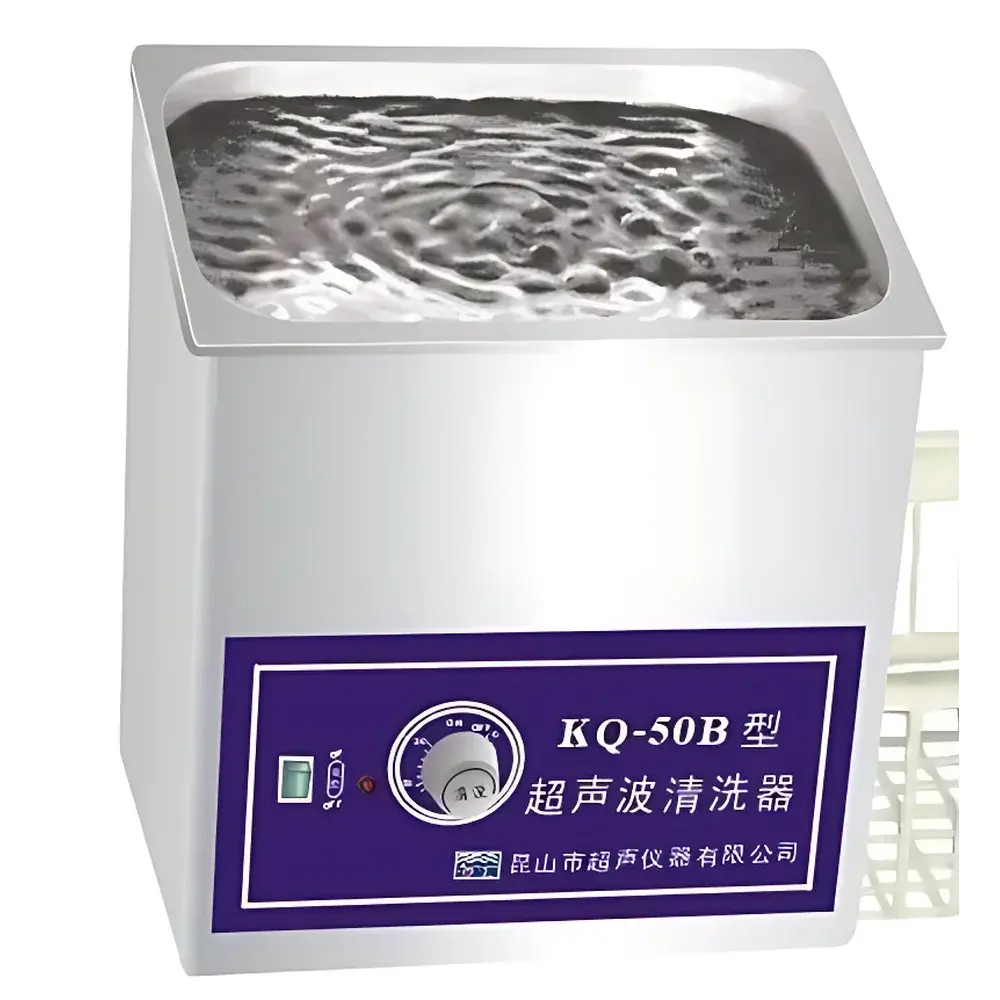
Shumei KQ-50DE Benchtop Ultrasonic Cleaner
| Brand | Shumei |
|---|---|
| Origin | Jiangsu, China |
| Model | KQ-50DE |
| Type | General-purpose ultrasonic cleaner |
| Tank capacity | 2 L |
| Ultrasonic frequency | 40 kHz |
| Ultrasonic power output | 50 W |
| Power adjustment range | 40–99% |
| Heating temperature range | 20–80 °C |
| Timer range | 1–99 min |
| Sound-dampening lid | Yes |
| Drain port | No |
| Heating power | 200 W |
| Tank material | Stainless steel (304) |
| External housing | Engineering-grade plastic |
| Safety features | Low-water level protection, over-temperature, over-voltage and over-current protection |
| Control system | Microprocessor-based digital control with real-time display of set/actual temperature, elapsed time, cumulative operating hours (up to 999,999 h), and ultrasonic power level |
Overview
The Shumei KQ-50DE Benchtop Ultrasonic Cleaner is an entry-level, microprocessor-controlled cleaning instrument engineered for precision laboratory applications requiring reliable cavitation-based cleaning, degassing, and sample preparation. It operates on the principle of high-frequency (40 kHz) ultrasonic energy transmission through liquid media, generating controlled acoustic cavitation—microscopic bubble formation and implosion—that delivers mechanical shear forces to dislodge particulate contaminants, biofilms, and residues from surfaces of immersed components. Designed for consistent performance in academic labs, QC environments, and R&D settings, the KQ-50DE integrates a sealed stainless steel tank (150 × 140 × 100 mm internal dimensions), digitally regulated heating, adjustable power output, and programmable timing—all within a compact footprint (208 × 192 × 210 mm). Its integrated transducer design ensures uniform energy distribution across the cleaning volume, minimizing dead zones and supporting reproducible cleaning efficacy per ASTM D2603 and ISO 13847 guidelines for ultrasonic cleaning validation.
Key Features
- Digital microprocessor control with simultaneous real-time display of set/actual temperature, ultrasonic power level (%), elapsed time, and cumulative operational hours (up to 999,999 h)
- Adjustable ultrasonic power output (40–99% of nominal 50 W) to match sample sensitivity and soil load
- Precise thermostatic heating (20–80 °C, ±2 °C accuracy) via 200 W embedded heater with over-temperature cutoff
- Programmable timer (1–99 minutes) with automatic shutdown and audible end-of-cycle alert
- Integrated sound-dampening lid to reduce ambient noise and prevent solvent evaporation during operation
- Comprehensive safety architecture: low-fluid-level detection, over-temperature, over-voltage, and over-current protection circuits
- Stainless steel (AISI 304) tank interior and welded stainless steel mesh basket for corrosion resistance and mechanical durability
- Robust engineering-grade plastic housing resistant to common lab solvents and routine disinfectants
Sample Compatibility & Compliance
The KQ-50DE accommodates a wide range of sample types—including glassware (vials, cuvettes, pipette tips), metal parts (surgical instruments, watch components), ceramic substrates, and polymer-based devices—provided they are compatible with aqueous or mild solvent-based cleaning solutions. It supports standard cleaning protocols aligned with ISO 15883-5 (cleaning of medical devices), USP (ultrasonic cleaning validation), and GLP-compliant documentation requirements when paired with external data logging. While not certified to IEC 61000-6-3 (EMC) or UL 61010-1 out-of-the-box, its electrical design adheres to general safety principles for Class I laboratory equipment. Note: The unit lacks a drain port and is intended for manual fill/empty procedures; users must verify chemical compatibility of cleaning solutions with 304 stainless steel and engineering plastics prior to use.
Software & Data Management
The KQ-50DE employs embedded firmware—not external PC software—for all operational logic. All parameters (temperature setpoint, power level, timer duration) are stored in non-volatile memory and retained after power cycling. Cumulative operating hours are logged automatically and serve as an objective metric for preventive maintenance scheduling and equipment lifecycle tracking—supporting internal QA audits and ISO/IEC 17025 clause 6.4.3 (equipment management). Though it does not feature USB/Ethernet connectivity or FDA 21 CFR Part 11-compliant electronic signatures, its deterministic digital interface enables traceable parameter recording via manual logbooks or external environmental monitoring systems. For regulated environments, integration with LIMS or ELN platforms is achievable using external relay-triggered event logging.
Applications
- Routine cleaning of analytical glassware and chromatography components prior to HPLC or GC analysis
- Removal of polishing compounds and organic residues from optical lenses and semiconductor wafers
- Cell lysis and tissue homogenization support in molecular biology workflows (e.g., RNA extraction prep)
- Degassing of solvents and resin mixtures prior to casting or coating processes
- Disassembly aid for micro-mechanical assemblies contaminated with lubricants or particulates
- Preparation of calibration standards by homogenizing suspended reference materials in liquid media
FAQ
Is the KQ-50DE suitable for cleaning delicate optics or MEMS devices?
Yes—when operated at reduced power (40–60%) and with low-surface-tension, non-corrosive solvents (e.g., IPA/water blends), it provides gentle yet effective contaminant removal without mechanical abrasion.
Does the unit meet regulatory requirements for pharmaceutical QC labs?
It satisfies foundational functionality and safety expectations for non-GMP ancillary equipment. Full compliance with GMP Annex 15 or EU GMP Chapter 3 requires supplementary IQ/OQ documentation, temperature mapping, and cavitation uniformity verification—performed independently by the end user.
Can the stainless steel tank withstand aggressive solvents like chlorinated hydrocarbons?
No. AISI 304 stainless steel is incompatible with halogenated solvents (e.g., chloroform, carbon tetrachloride) and strong acids/bases. Use only water-based detergents, ethanol, isopropanol, or manufacturer-approved formulations.
What maintenance is required to ensure long-term reliability?
Regular descaling (every 2–4 weeks, depending on water hardness) using 5–10% citric acid solution; visual inspection of transducer adhesion and lid seal integrity; periodic verification of temperature sensor drift using a calibrated NIST-traceable thermometer.
Is the unit compatible with continuous operation modes?
No. The maximum single-cycle duration is 99 minutes. For extended cleaning, users must manually reinitiate cycles. Continuous operation is not supported due to thermal management constraints and safety interlock design.



