
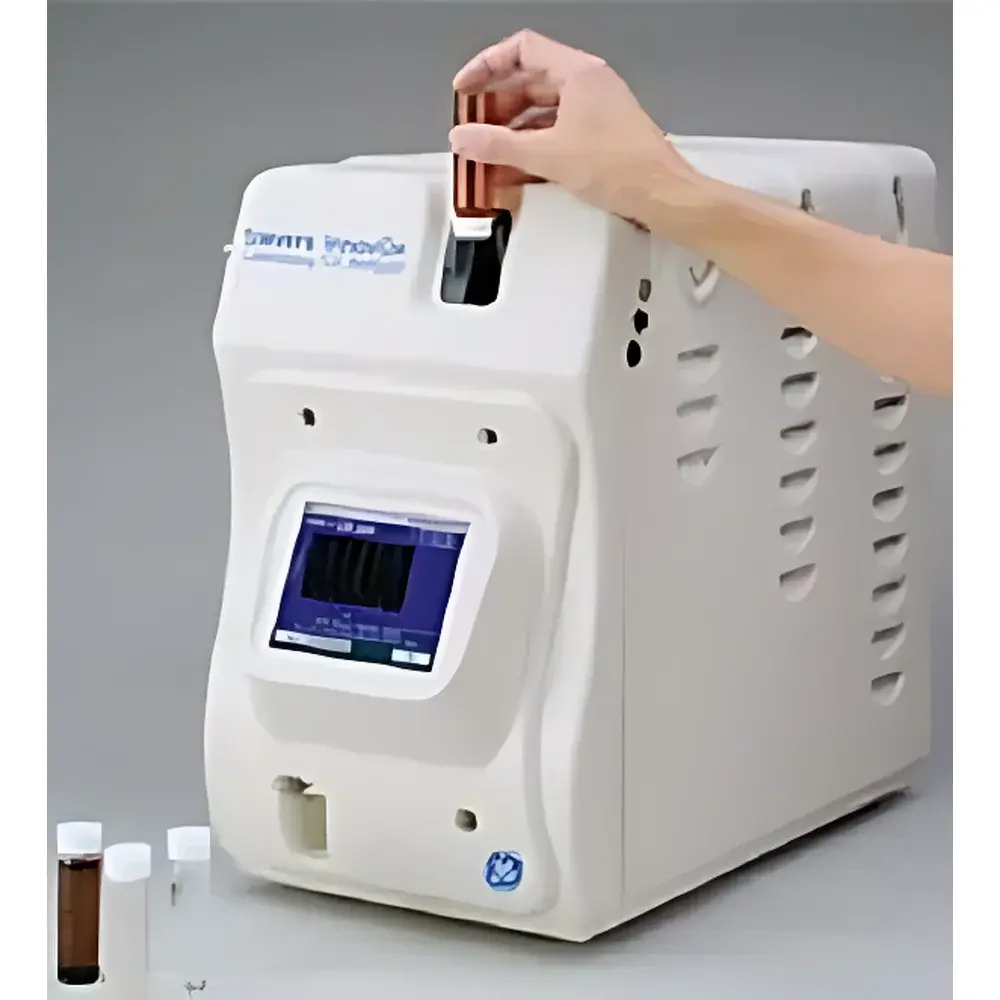
Sievers InnovOx Laboratory Total Organic Carbon (TOC) Analyzer
| Brand | Sievers (Veolia) |
|---|---|
| Origin | USA |
| Model | InnovOx Laboratory |
| Instrument Type | Laboratory TOC Analyzer |
| Detection Principle | Non-Dispersive Infrared (NDIR) Absorption |
| Oxidation Method | Supercritical Water Oxidation (SCWO) |
| Measurement Range | 0.05–50,000 ppm TOC |
| Accuracy | ±3% |
| Resolution | 0.01 ppm |
| Detection Limit | 0.05 ppm |
| Repeatability | ±3% |
| Regulatory Compliance | US EPA Methods 415.1, 415.3, 9060A |
Overview
The Sievers InnovOx Laboratory Total Organic Carbon (TOC) Analyzer is a high-performance benchtop instrument engineered for precise, reliable quantification of total organic carbon in aqueous matrices using supercritical water oxidation (SCWO) coupled with non-dispersive infrared (NDIR) detection. Unlike conventional catalytic combustion or UV/persulfate oxidation systems, SCWO achieves near-complete oxidation (>99% recovery) of recalcitrant and heterogeneous organic compounds—including humic substances, polymers, halogenated organics, and particulate-bound carbon—under extreme thermodynamic conditions (≥374 °C, ≥22.1 MPa). This enables robust, matrix-tolerant analysis across complex industrial effluents, high-salinity brines, seawater, wastewater, steam condensate, and process cooling water without pre-dilution or filtration. The system operates on the principle of differential NDIR measurement: after acidification and sparging to remove inorganic carbon (IC), the sample undergoes SCWO, converting all organic carbon to CO₂, which is then quantified via dual-beam NDIR optics—ensuring long-term stability and zero moving parts in the detection path.
Key Features
- Supercritical water oxidation (SCWO) module delivering >99% TOC recovery across diverse molecular weight ranges and challenging matrices (e.g., cellulose, iodinated contrast media, crude oil emulsions)
- Non-dispersive infrared (NDIR) detector with dual-beam architecture and temperature-stabilized optical cell—no consumables, no lamps, no alignment drift
- Dynamic linear range spanning 0.05 ppm to 50,000 ppm TOC (equivalent to 50 ppb–50 g/L), supporting both ultra-trace environmental monitoring and concentrated industrial waste characterization
- Integrated autosampler with programmable stirring, multi-point rinsing, and high-viscosity sample handling—designed for unattended batch analysis of up to 120 vials
- Optional high-temperature inlet module enabling direct analysis of samples up to 85 °C, eliminating cold-condensation artifacts in steam cycle monitoring
- Configurable measurement modes: TOC (TC – IC), NPOC (non-purgeable organic carbon), and TC (total carbon), compliant with method-defined workflows
Sample Compatibility & Compliance
The InnovOx Laboratory demonstrates exceptional tolerance for high ionic strength (up to saturation NaCl), suspended solids (≤1000 mg/L TSS), and oxidant-resistant organics—making it suitable for seawater desalination plant intake monitoring, offshore oilfield produced water, pharmaceutical clean-in-place (CIP) validation rinse waters, and biopharmaceutical buffer solutions. It meets or exceeds performance criteria specified in key regulatory frameworks: US EPA Methods 415.1 (drinking water, surface water, seawater, wastewater), 415.3 (surface water and drinking water), and 9060A (groundwater, surface water, saline water, wastewater); as well as European standard CEN EN 1484 (water quality—determination of total organic carbon). All calibration, blank, and system suitability checks are traceable to NIST-certified potassium hydrogen phthalate (KHP) standards. Data integrity complies with ALCOA+ principles and supports audit-ready 21 CFR Part 11 compliance when deployed with validated LIMS integration.
Software & Data Management
Instrument control, method development, and data review are managed through Sievers’ proprietary INNOVATE software—a Windows-based application featuring role-based user access, electronic signatures, and full audit trail logging (including parameter changes, calibration events, and result overrides). Raw chromatograms, CO₂ peak integrations, and oxidation efficiency reports are stored in secure, encrypted SQLite databases. Export options include CSV, PDF analytical reports, and ASTM E1382-compliant structured data files. The software supports IQ/OQ/PQ documentation templates aligned with ISO/IEC 17025 and GMP/GLP laboratory requirements. Remote diagnostics and firmware updates are enabled via secure HTTPS channel with TLS 1.2 encryption.
Applications
- Optimization of biological nutrient removal (BNR) and activated sludge processes through real-time TOC loading assessment
- Regulatory compliance monitoring of wastewater discharge permits (NPDES, EU Urban Wastewater Treatment Directive)
- Steam and condensate purity verification in power generation and pharmaceutical manufacturing (USP , EP 2.2.44)
- High-salinity process water analysis in desalination, mining leachates, and oil & gas produced water management
- Validation of cleaning efficacy in biotech manufacturing (FDA Guidance for Industry: Process Validation)
- Correlation studies between TOC, COD, and BOD₅ to refine predictive modeling in municipal wastewater treatment
FAQ
What oxidation method does the InnovOx Laboratory use, and why is it superior for complex samples?
It employs supercritical water oxidation (SCWO), which achieves complete mineralization of refractory organics under thermodynamically defined critical point conditions—eliminating catalyst poisoning and oxidation bias seen in UV/persulfate or thermal catalytic methods.
Can the system analyze samples with high chloride content, such as seawater or brine?
Yes. SCWO inherently suppresses chloride interference, and the system has been validated per EPA 9060A for salinities up to 35 g/L NaCl without signal suppression or carryover.
Is the NDIR detector calibrated automatically, and how often is recalibration required?
The NDIR cell is factory-calibrated with NIST-traceable CO₂ standards; field verification uses daily system suitability tests (SST) with KHP and inorganic carbon standards—full recalibration is recommended annually or after major maintenance.
Does the InnovOx Laboratory support 21 CFR Part 11 compliance?
When configured with INNOVATE software version 4.2 or later and deployed on a validated Windows domain environment with time-synced servers, it supports electronic signatures, audit trails, and role-based permissions required for regulated laboratories.
What is the typical analysis time per sample, and how is throughput optimized?
Standard cycle time is 6–8 minutes per sample (including rinse, acidify, purge, oxidize, detect); throughput reaches 120 samples/24 hours using the optional 120-position autosampler with parallel rinse/stir protocols.
Related Products







