
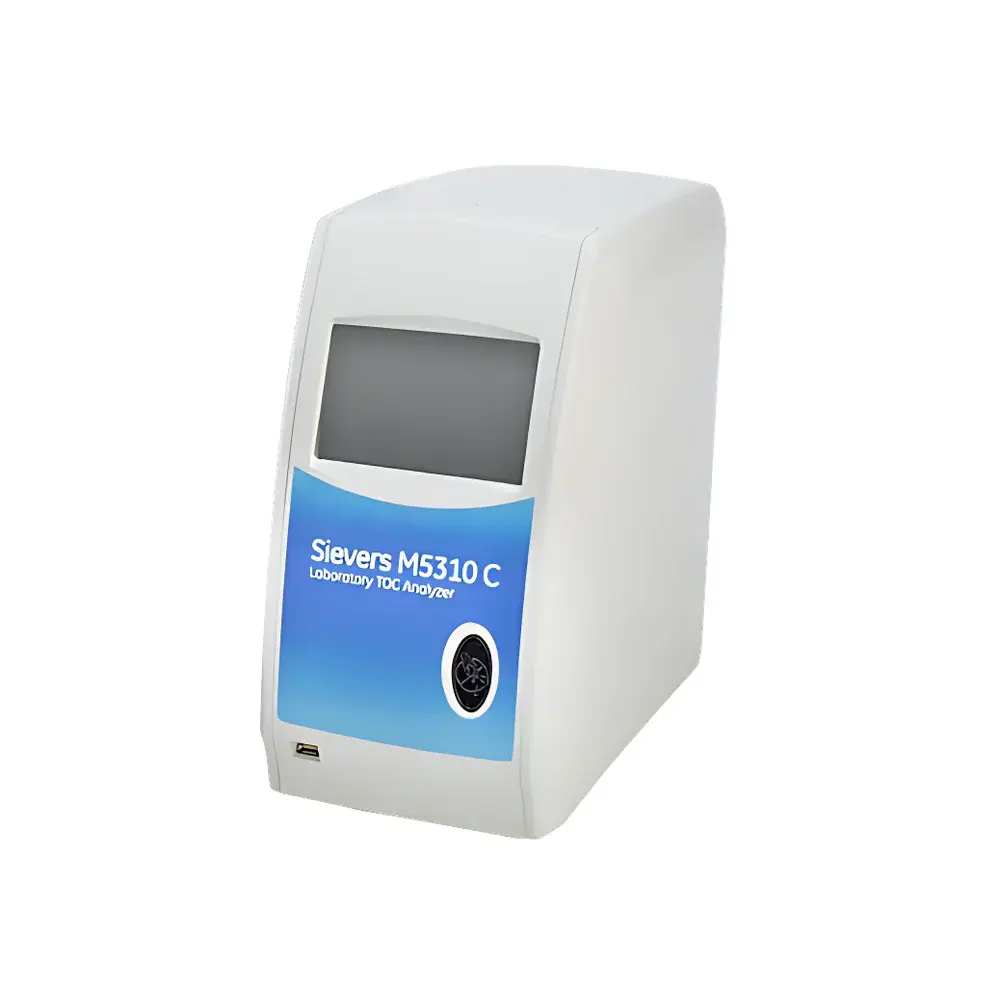
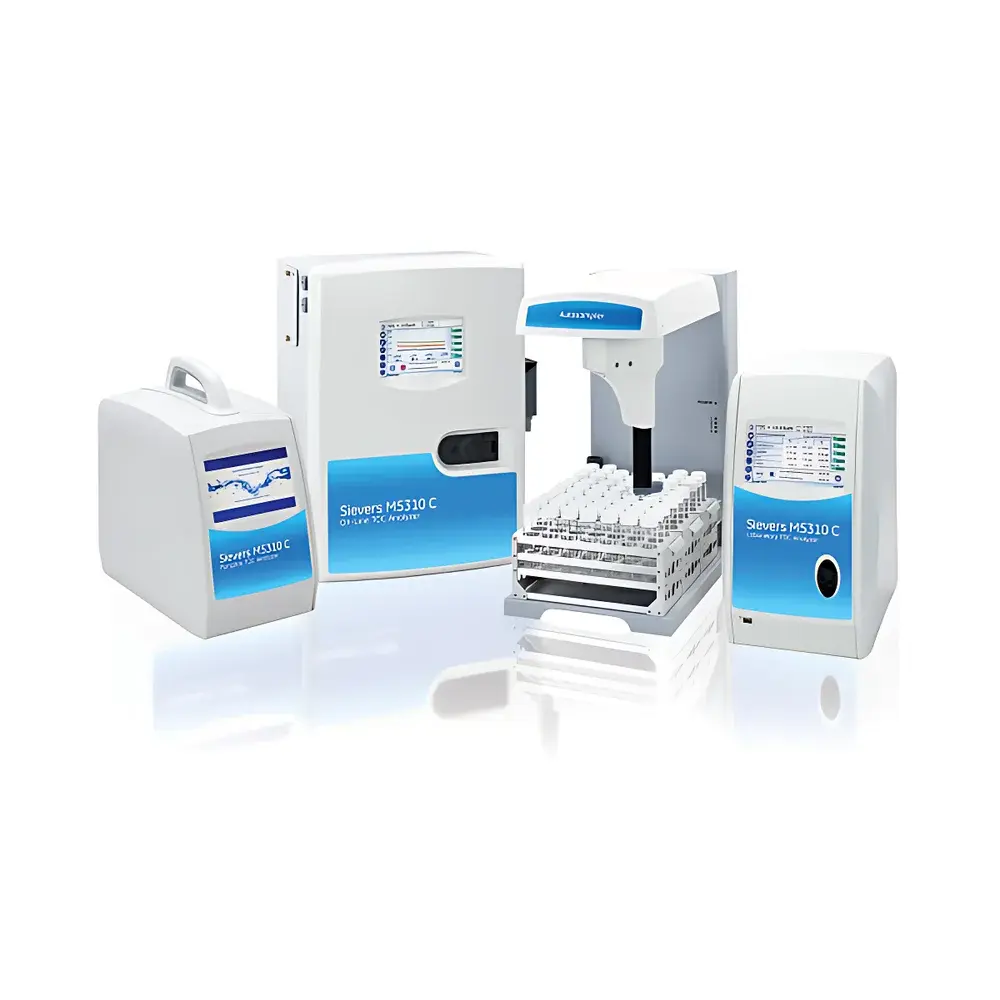
Sievers M5310 C Laboratory Total Organic Carbon (TOC) Analyzer
| Brand | Sievers (Veolia) |
|---|---|
| Origin | USA |
| Manufacturer Type | Original Equipment Manufacturer (OEM) |
| Product Category | Imported Instrument |
| Model | M5310 C Laboratory |
| Instrument Type | Laboratory TOC Analyzer |
| Detection Principle | Membrane Conductivity Detection |
| Oxidation Method | UV/Persulfate Oxidation |
| Measurement Range | 4 ppb – 50 ppm |
| Accuracy | ±2% or ±0.5 ppb (whichever is greater) |
| Resolution | 0.1 ppb |
| Detection Limit | 4 ppb |
| Repeatability | <1% RSD |
Overview
The Sievers M5310 C Laboratory Total Organic Carbon (TOC) Analyzer is a high-performance, regulatory-compliant analytical instrument engineered for precise quantification of organic carbon in water matrices across pharmaceutical, biotechnology, power generation, and municipal drinking water applications. It employs a dual-stage oxidation process—combining 185 nm ultraviolet (UV) irradiation with sodium persulfate—to fully mineralize non-purgeable organic carbon (NPOC) into carbon dioxide. The resulting CO2 is selectively stripped from the aqueous stream using a gas-permeable membrane and measured via highly stable, low-drift membrane conductivity detection. This principle ensures minimal interferences from inorganic ions, chloride, or carbonate alkalinity—critical for accurate TOC measurement in complex matrices such as purified water (PW), water for injection (WFI), and treated distribution system water. Designed to meet stringent requirements of USP , EP 2.2.44, JP 2.59, and ASTM D5907, the M5310 C delivers trace-level sensitivity down to 4 ppb with metrological traceability validated against NIST-traceable potassium hydrogen phthalate (KHP) standards.
Key Features
- Two-minute analysis cycle: Achieves full NPOC quantification—including oxidation, CO2 stripping, conductivity measurement, and data reporting—in ≤120 seconds, doubling throughput versus prior-generation 5310 C systems.
- Auto-calibration & auto-verification: Integrated sequence control enables unattended calibration verification (CV) and system suitability testing (SST) per FDA 21 CFR Part 11 and EU Annex 11 guidelines; supports bracketing calibration and multi-point linearity verification.
- TOC removal efficiency calculation: Automatically computes differential TOC between paired inlet/outlet samples—essential for evaluating filtration, UV, or advanced oxidation process (AOP) performance in pilot or full-scale treatment studies.
- Intelligent reagent management: Dynamically adjusts persulfate dosing and carrier gas flow rate per sample, optimizing oxidant utilization and minimizing carryover risk across wide concentration ranges (4 ppb–50 ppm).
- 7-inch WVGA color touchscreen interface: Intuitive graphical navigation with contextual error diagnostics, real-time method status indicators, and on-screen SOP guidance—reducing operator training time and procedural deviation.
- Compact footprint (24.6 cm W): Engineered for space-constrained QC labs; meets IEC 61000-6-3 EMC and IEC 61010-1 safety standards (ETL & CE certified); rated for operation up to 3,000 m altitude and 95% RH (non-condensing).
Sample Compatibility & Compliance
The M5310 C accepts discrete manual injections or automated sampling via the optional Sievers 120-position autosampler with random-access capability. It accommodates liquid samples within 5–95 °C, including ultrapure water, wastewater effluents, groundwater, and steam condensate. All wetted components are constructed from PFA, PEEK, and quartz to prevent adsorption or leaching. The system supports GLP/GMP workflows through secure user authentication, electronic audit trails, and configurable data retention policies. Calibration stability is verified over 12 months under routine use, with preventive maintenance limited to annual UV lamp replacement and quarterly membrane inspection—both documented in the built-in service log.
Software & Data Management
Data acquisition and reporting are managed via Sievers Insight™ Software (v3.0+), compliant with 21 CFR Part 11 requirements for electronic records and signatures. The software architecture features a relational SQLite database optimized for rapid querying across thousands of analyses, supporting customizable report templates (PDF/CSV/XLSX), trend charts with statistical process control (SPC) limits, and automated alarm thresholds. Raw conductivity waveforms, calibration curves, and system logs are stored with immutable timestamps and user attribution. USB host ports enable direct export to external drives; Ethernet connectivity supports integration into LIMS and centralized data lakes via standard TCP/IP protocols.
Applications
- Pharmaceutical water system validation (PW, WFI, pure steam condensate) per USP and EU GMP Annex 1
- Disinfection byproduct precursor monitoring in drinking water treatment per EPA Method 415.3 and DBPR compliance
- Membrane fouling assessment in desalination and reuse facilities
- TOC mass balance studies in activated carbon or ozone-biological filtration processes
- Raw water quality trending and source protection program support
- Regulatory submission-ready data packages for FDA, EMA, or PMDA inspections
FAQ
What oxidation method does the M5310 C use, and why is it suitable for regulated water testing?
It combines 185 nm UV photolysis with acidified sodium persulfate—proven to achieve >95% oxidation efficiency for refractory compounds (e.g., humic acids, pyrogens) without requiring high-temperature combustion, thus preserving instrument longevity and meeting USP validation criteria.
How is data integrity ensured during long-term deployment?
Through hardware-enforced audit trails, role-based access control, digital signature capture for critical actions (e.g., calibration), and encrypted local storage—all independently verifiable during regulatory audits.
Can the M5310 C be integrated into an existing laboratory network?
Yes: native Ethernet support enables seamless connection to corporate intranets, LIMS, and cloud-based analytics platforms using standard HTTP/HTTPS and FTP protocols.
What maintenance is required to sustain 12-month calibration stability?
Annual replacement of the low-pressure mercury UV lamp (containing Hg—dispose per local hazardous waste regulations), quarterly inspection of the hydrophobic gas-diffusion membrane, and biannual verification of pump tubing integrity.
Does the instrument support method transfer from legacy Sievers models?
Yes: Insight™ Software includes backward-compatible method import tools and automated parameter mapping for seamless migration from M9, M500, or earlier 5310 platforms.
Related Products







